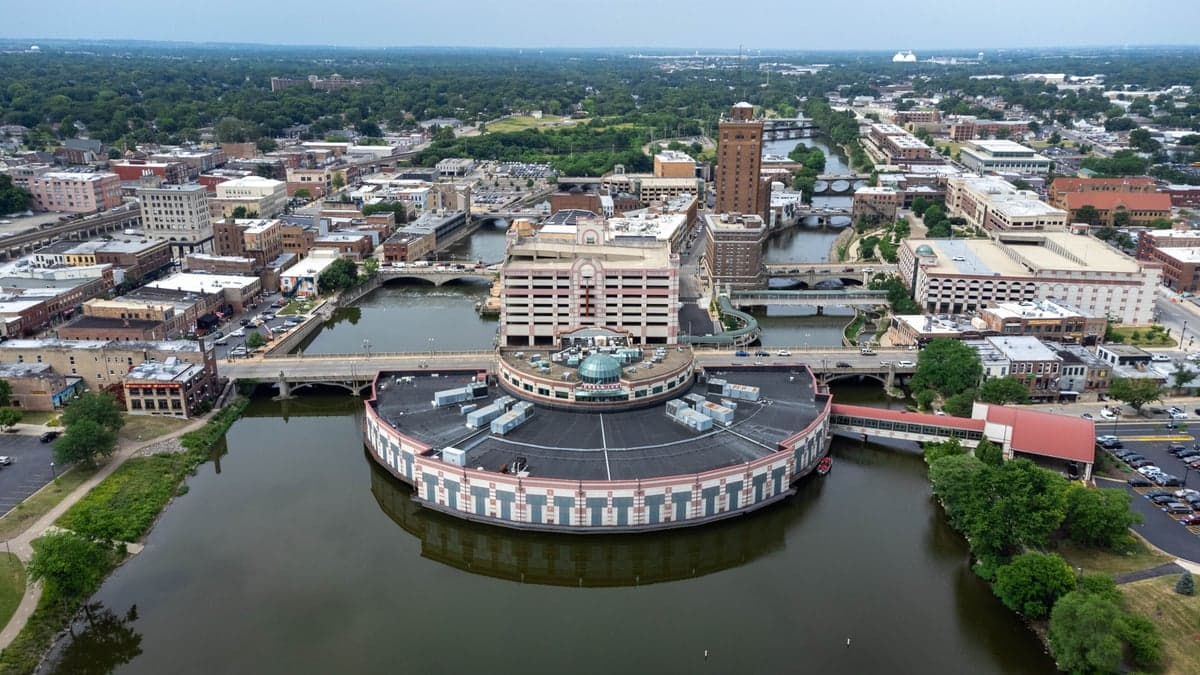
Photo: Wikipedia
Personal Sovereignty in Aurora, IL
Viable for self-reliance. Generally workable, though some barriers may limit total independence.
What does Personal Sovereignty tell us?
Personal Sovereignty measures your capacity for self-reliance and independence with minimal government friction. Higher scores mean fewer barriers between you and the way you want to live... but it assumes you have the space you need and good neighbors.
What does this tell us?
Personal Sovereignty measures your capacity for self-reliance and independence with minimal government friction. Higher scores mean fewer barriers between you and the way you want to live... but it assumes you have the space you need and good neighbors.
State Policy
Energy independence: Importer (45% of energy produced in-state)
Personal Liberty
Homesteading

Personal Liberty Analysis
Aurora, Illinois, presents a complex sovereignty picture for the conservative-leaning individualist or prepper. While the city itself operates under a progressive municipal framework, the surrounding Kane and DuPage County environments offer a mixed bag of regulatory burdens and practical freedoms. The core tension here is between the state-level erosion of personal autonomy—driven by Springfield’s one-party rule—and the day-to-day realities of a large, diverse suburb that still retains pockets of self-reliant living. For the strategic relocator, Aurora is not a libertarian haven, but it is a place where a savvy, low-profile operator can carve out meaningful personal space if they understand the legal and cultural landscape.
Tax burden and regulatory posture in Aurora and Illinois
Illinois is a high-tax state, and Aurora sits squarely within that reality. The combined state and local sales tax rate in Aurora is 8.75%, one of the highest in the nation, and property taxes in Kane County average around 2.1% of assessed value—a significant annual drain on any homesteader’s budget. The state income tax is a flat 4.95%, which, while not progressive, still cuts into earnings that could otherwise fund self-reliance projects. Regulatory posture is similarly burdensome: Illinois has a statewide building code that Aurora enforces strictly, meaning any off-grid modifications—like solar panel installations or rainwater collection systems—require permits and inspections that can be costly and time-consuming. The state’s Private Sewage Disposal Licensing Act also complicates any attempt to install a composting toilet or septic system outside municipal sewer lines. For the prepper, this means that while you can own property, the government maintains a heavy hand in how you use it, with annual tax bills that can easily exceed $5,000 on a modest single-family home.
Self-defense and gun law specifics in Aurora and Illinois
Illinois is not a gun-friendly state, and Aurora’s local ordinances add another layer of restriction. The state requires a Firearm Owners Identification (FOID) card to even possess a firearm—a process that involves a background check and a wait that can stretch months due to backlog. Concealed carry is legal only with a Concealed Carry License (CCL), which requires 16 hours of training and a $150 fee. However, Aurora has its own municipal code that bans the possession of assault weapons and large-capacity magazines (defined as over 10 rounds for long guns and 15 for handguns), which was upheld by the Illinois Supreme Court in 2023. This means that standard prepper gear like an AR-15 or a Glock with a 17-round magazine is illegal within city limits. The state’s Firearm Restraining Order Act also allows family members or law enforcement to petition a court to temporarily seize firearms without a criminal conviction—a red-flag law that many conservatives view as a due-process violation. For self-defense, the best bet is to live in the unincorporated areas of Kane County just outside Aurora, where county-level ordinances are less restrictivehare, but even then, the state’s FOID and CCL requirements remain in full force.
Self-reliance and homesteading viability in Aurora
Homesteading in Aurora is possible but requires navigating zoning and lot-size restrictions. Most residential lots in the city are 0.15 to 0.25 acres, which limits gardening to raised beds and small chicken coops—though Aurora’s municipal code allows up to six hens (no roosters) on lots under 10,000 square feet. Larger livestock like goats or pigs are prohibited within city limits. For off-grid feasibility, the picture is grim: Illinois law requires grid-tied solar systems to have net metering agreements with the utility (ComEd), and standalone battery-only systems are technically allowed but must meet strict electrical codes. Rainwater collection is legal but limited to 55-gallon barrels per downspout, and any system for potable use requires a permit from the Illinois Environmental Protection Agency. The state’s Homeowners’ Energy Policy Statement also allows HOAs to restrict solar panel placement, so if you buy in a subdivision, you may face additional hurdles. For the serious prepper, the best strategy is to purchase a property in the unincorporated areas of Kane County, where lot sizes of 1 to 5 acres are common, and zoning is more permissive for small-scale agriculture and alternative energy. Even then, the property tax burden remains a constant drag on self-reliance capital.
Personal liberties in Aurora: parental rights, medical autonomy, speech, and property
Parental rights in Illinois are under increasing pressure. The state’s Keeping Youth Safe and Healthy Act (2022) mandates that public schools provide comprehensive sex education, including LGBTQ+ content, without a parental opt-out for the entire curriculum—only for specific lessons. Aurora School District 131 has fully implemented this, meaning parents who want to shield their children from certain topics must homeschool or enroll in private religious schools. Medical autonomy is similarly constrained: Illinois has a mandatory vaccination law for school attendance, with only medical exemptions allowed (no religious or philosophical exemptions), and the state’s Reproductive Health Act (2019) codified abortion as a fundamental right, including for minors without parental notification in some cases. Free speech is protected under the First Amendment, but Aurora has a disorderly conduct ordinance that has been used to ticket individuals for loud political protests near schools and churches, though such cases are rare. Property rights are the strongest liberty here: Illinois is a “property rights” state under the Private Property Rights Protection Act, meaning that if a regulation reduces property value by more than 20%, the owner can seek compensation. However, eminent domain is still a threat, as seen in the 2023 expansion of the Aurora Transportation Center, which displaced several small businesses. Overall, personal liberties in Aurora are a patchwork—strong on paper for property, weak on paper for parental and medical autonomy, and subject to local enforcement whims.
In the broader context of the Midwest, Aurora offers a moderate level of personal sovereignty—better than Chicago or Cook County, but far worse than rural Indiana or Wisconsin. The high tax burden and restrictive gun laws are the primary drags on autonomy, while the ability to own property and the relative safety of the suburbs (violent crime rate of 3.2 per 1,000 residents in 2024, below the national average) provide a baseline of security. For the conservative prepper, Aurora is a place to build a low-profile life if you are willing to pay the state’s price for the privilege. The strategic move is to live just outside city limits, in unincorporated Kane County, where you can own a few acres, keep chickens, and store supplies without the city’s assault weapon ban. But if you are looking for a true sovereignty sanctuary—where you can homeschool without state interference, carry a standard-capacity magazine, and keep your tax dollars—you will need to look farther west, to states like Missouri or Tennessee. Aurora is a compromise, not a citadel.

* Values derived from national, state, county, city and local statistics and may differ in a specific area. Last updated: 2026-04-30T00:20:53.000Z
Narrative content on this page is AI-generated and may contain mistakes. Verify any details that matter before acting on them.
ReloMaps may earn a commission from affiliate links at no extra cost to you.

