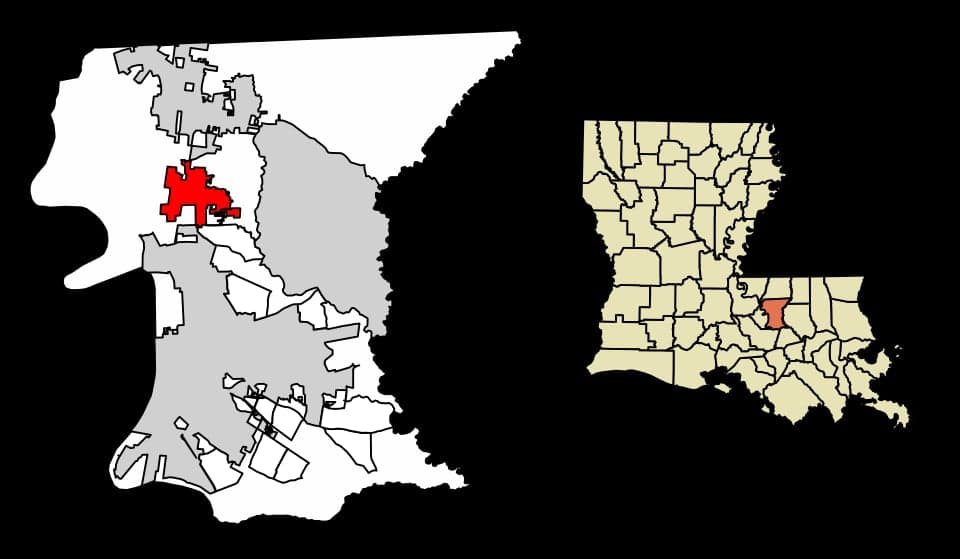
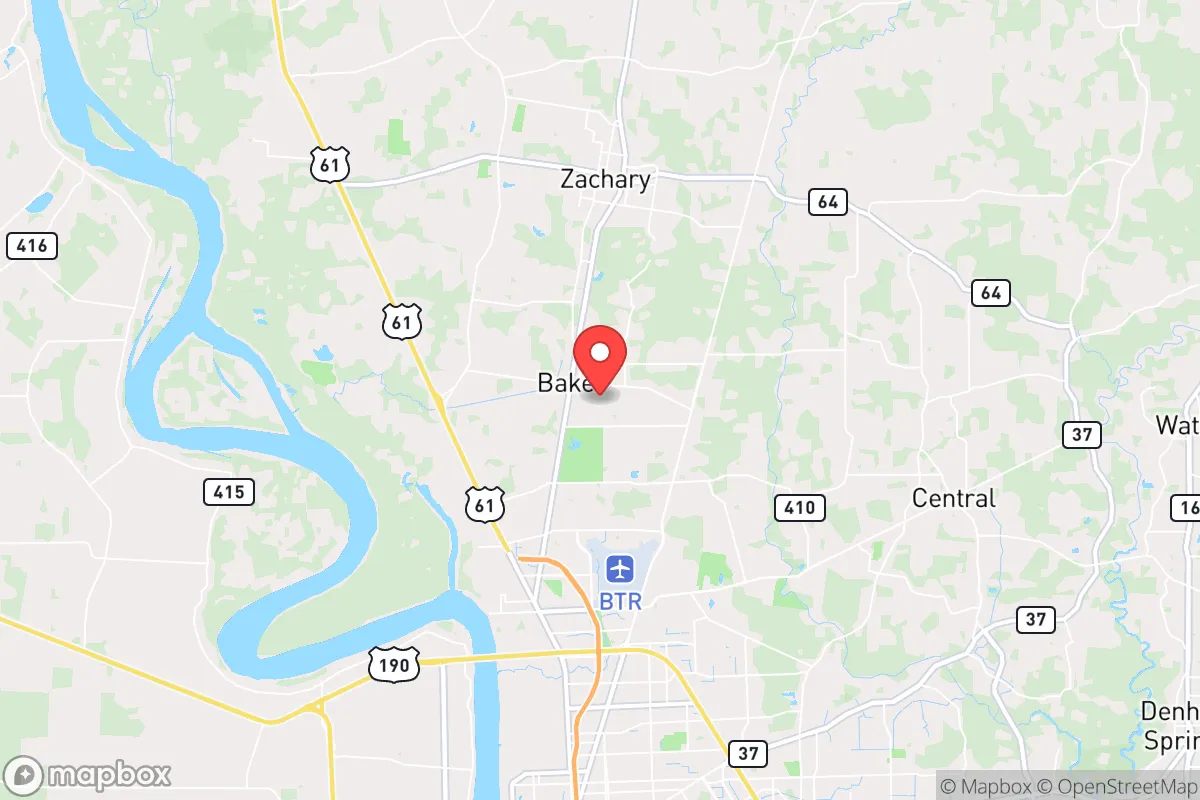
Photo: Wikipedia
Strategic Assessment of Baker, LA
Workable tactical position. Some exposure to population density or targets, but generally defensible in a crisis.
What does the Strategic Assessment tell us?
Our Strategic Assessment grades tactical survivability of an area. Major population centers, military targets, fallout zones, natural disasters, and border exposure all drive risk — lower exposure means a more defensible position in a crisis.
This is heavily inspired by Joel Skousen's Strategic Relocation book. Highly recommended you checkout the book ($)What does this tell us?
Our Strategic Assessment grades tactical survivability of an area. Major population centers, military targets, fallout zones, natural disasters, and border exposure all drive risk — lower exposure means a more defensible position in a crisis.
This is heavily inspired by Joel Skousen's Strategic Relocation book. Highly recommended you checkout the book ($)Strategic Pillars

Key Distances
Regional Safe Places
Below is our recommended "safe zones" in Louisiana and the surrounding area based on our strategic heuristics. For most people, it's unrealistic to live in a “safe zone” full-time due to work, family or other personal reasons. They tend to be more rural. However, many of these areas are perfect for second homes and retreat properties that double as a vacation home or even a short-term rental.

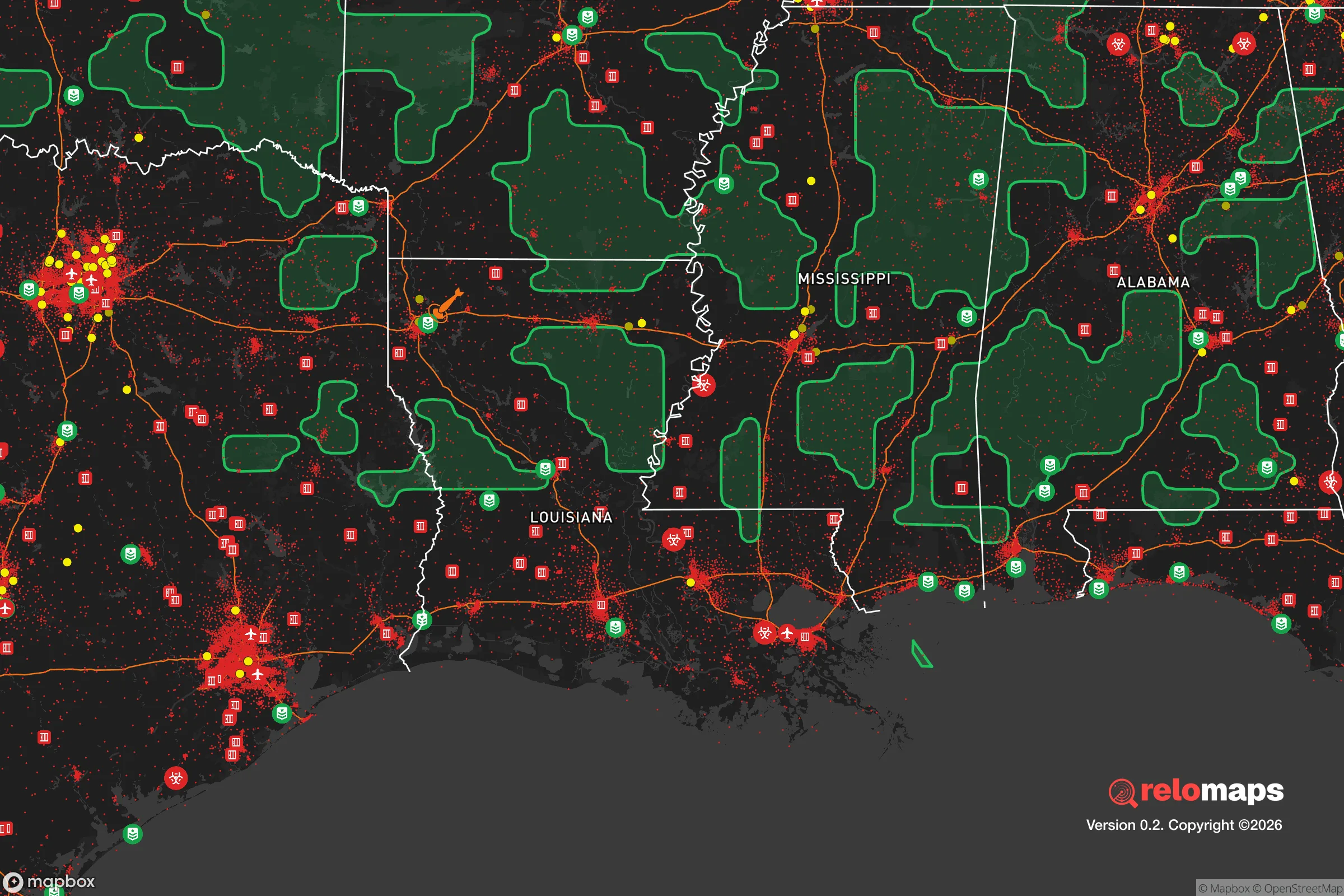


Important Note: For informational purposes only. This does not mean nothing bad ever happens in the green zones. Please use common sense. This is based on public data and modeled with AI. We tried to take a conservative approach but mistakes happen. We update this regularly as new information becomes available.
Solar Generator Recommendations
Backup power matters more here than in safer locations. We've picked three solar generators across budgets and capacity tiers — start with the budget unit if you only need a few essentials, or step up if you want to run a fridge and HVAC for days at a time.

Jackery Portable Power Station Explorer 300
Budget OptionPower on the Go: Weighing only 11 lbs, it's convenient to set up and store with book-sized foldable solar panels

BLUETTI Portable Power Station AC180
Designed for both indoor and outdoor scenarios, AC180 is highly capable as it has a robost capacity and continuous output power.

EF ECOFLOW DELTA Pro Ultra Power Station
Upgraded PickEcoFlow DELTA Pro Ultra is a whole-home energy system designed to grow with your family. Integrated with the Smart Home Panel 2, it scales to meet your evolving energy needs — keeping your home powered, intelligent, and secure through every stage of life.
We earn a commission, at no additional cost to you.
Strategic Assessment Analysis
Baker, Louisiana, offers a mixed strategic picture for the conservative prepper or survivalist. Its primary advantage is its position along the I-12 corridor, roughly 15 miles north of Baton Rouge and 70 miles northwest of New Orleans, placing it within a day’s drive of major Gulf Coast infrastructure but far enough to avoid the immediate blast radius of a major urban or industrial target. The city’s population hovers around 13,000, with a low population density that reduces competition for resources during a crisis, but its proximity to the Mississippi River and major petrochemical corridors introduces distinct vulnerabilities that must be weighed carefully.
Geographic position and natural advantages for long-term survival
Baker sits on the eastern edge of the Florida Parishes, a region defined by piney woods, bayous, and relatively low elevation. The area’s natural advantages include abundant surface water—the Comite River and several smaller creeks run nearby—and a climate that supports year-round gardening and foraging. The soil is sandy loam in many spots, suitable for root vegetables and legumes, and the long growing season (typically March through November) allows for multiple harvest cycles. The surrounding forests of the Kisatchie National Forest, about 40 miles north, provide a potential retreat zone with dense cover and limited road access. Baker itself is not a major transportation hub, which is a double-edged sword: it avoids the traffic choke points of I-10 or I-12 during an evacuation, but its own road network (primarily LA-19 and LA-3034) can become clogged quickly if Baton Rouge residents flee north. The city’s elevation averages about 50 feet above sea level, meaning it is not prone to the catastrophic flooding seen in coastal Louisiana, though heavy rain events can cause localized flash flooding in low-lying neighborhoods near the Comite River.
Risks, exposures, and proximity to fallout-relevant landmarks
The most significant strategic liability is Baker’s location within the “Chemical Corridor” of the Mississippi River. The river’s industrial spine, stretching from Baton Rouge to New Orleans, contains dozens of refineries, chemical plants, and LNG terminals. A major industrial accident—or a deliberate attack on these facilities—could release toxic clouds or trigger cascading fires that would affect Baker depending on wind direction. The ExxonMobil Baton Rouge Refinery, one of the largest in the country, is only 20 miles south. A worst-case scenario involving a catastrophic release of hydrogen fluoride or chlorine could force a rapid evacuation or shelter-in-place order. Additionally, the Louisiana State Penitentiary at Angola, about 30 miles northwest, is a high-security prison that could become a focal point for unrest during a societal collapse. Baker is also within 100 miles of the Strategic Petroleum Reserve at Bayou Choctaw, a potential target for sabotage. On the positive side, the city is far enough from New Orleans to avoid the direct effects of a hurricane’s storm surge, but it is still vulnerable to hurricane-force winds and prolonged power outages. The 2021 Hurricane Ida knocked out power to much of the region for weeks, a pattern that repeats with any major Gulf storm.
Practical resilience for a relocator: food, water, energy, and defensibility
For a relocator with a prepper mindset, Baker’s practical resilience depends heavily on property selection and preparation. The city’s water supply comes from the Baton Rouge Water Company, which draws from the Southern Hills Aquifer—a deep, relatively protected source. However, a prolonged grid failure would render municipal water pumps inoperable, so a private well is a non-negotiable asset for any serious survival property. Homes with existing wells are common in the rural outskirts of Baker, particularly along LA-19 north toward Zachary. The electrical grid is vulnerable to both hurricanes and industrial accidents; solar panels with battery storage are advisable, as the region gets ample sunlight (about 210 sunny days per year). Natural gas is available in parts of the city, but a propane tank setup for cooking and heating is more reliable off-grid. Food production is feasible: the local soil supports tomatoes, peppers, okra, and sweet potatoes, and the nearby Atchafalaya Basin offers wild game (deer, hog, turkey) and fish. However, defensibility is a concern. Baker is a bedroom community with a typical suburban layout—cul-de-sacs, strip malls, and a single main drag. A determined group could easily block the two primary access roads (LA-19 and LA-3034), but the same roads would be escape routes. The city’s police force is small (roughly 30 officers), and during a major event, state police and National Guard resources would prioritize Baton Rouge. A better strategic choice for a relocator might be a property on the northern edge of Baker, near the Zachary line, where lots are larger (1–5 acres) and the terrain offers more natural cover. The local gun culture is strong—Louisiana has permissive concealed carry laws and a “stand your ground” statute—which aligns with a self-reliant mindset. The nearest major medical facility is Our Lady of the Lake Regional Medical Center in Baton Rouge, about 20 minutes south, but in a grid-down scenario, a well-stocked trauma kit and basic medical training become essential.
Overall, Baker presents a moderate-risk, moderate-reward strategic option for the conservative relocator. Its proximity to Baton Rouge and the Chemical Corridor introduces clear vulnerabilities that cannot be ignored, but its low population density, access to water and arable land, and distance from the most likely urban targets make it a viable base for those who are willing to invest in off-grid infrastructure and maintain a low profile. The key is to avoid the suburban core and instead secure a property with a well, solar capability, and defensible perimeter on the northern or eastern fringe. For a single individual or family willing to accept the trade-offs of living near a major industrial zone, Baker offers a realistic starting point for long-term preparedness—provided you have a bug-out plan for the worst-case chemical release scenario. The area’s conservative political leanings (East Baton Rouge Parish voted 58% Republican in 2024) and strong community ties to hunting and outdoor skills further support a survivalist lifestyle. In short, Baker is not a fortress, but it is a defensible outpost for those who understand the risks and prepare accordingly.

* Values derived from national, state, county, city and local statistics and may differ in a specific area. Last updated: 2026-05-01T03:40:57.000Z
Narrative content on this page is AI-generated and may contain mistakes. Verify any details that matter before acting on them.
ReloMaps may earn a commission from affiliate links at no extra cost to you.

