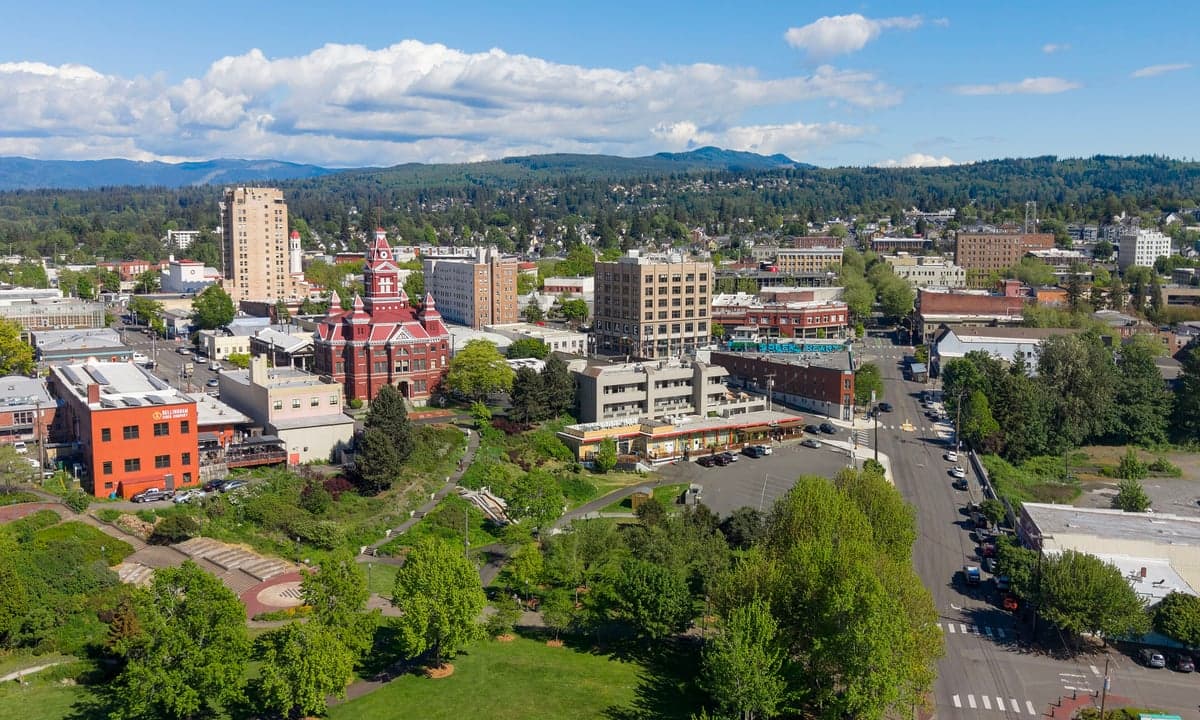
Photo: Wikipedia
Personal Sovereignty in Bellingham, WA
Viable for self-reliance. Generally workable, though some barriers may limit total independence.
What does Personal Sovereignty tell us?
Personal Sovereignty measures your capacity for self-reliance and independence with minimal government friction. Higher scores mean fewer barriers between you and the way you want to live... but it assumes you have the space you need and good neighbors.
What does this tell us?
Personal Sovereignty measures your capacity for self-reliance and independence with minimal government friction. Higher scores mean fewer barriers between you and the way you want to live... but it assumes you have the space you need and good neighbors.
State Policy
Energy independence: Importer (55% of energy produced in-state)
Personal Liberty
Homesteading

Personal Liberty Analysis
Bellingham, Washington, presents a deeply conflicted environment for personal sovereignty, one where stunning natural resources and a strong do-it-yourself culture clash with some of the most aggressive state-level governance in the Pacific Northwest. For the strategic relocator with a survivalist or prepper mindset, this city offers a mixed bag: a robust foundation for self-reliance in terms of land and community, but a legal and regulatory climate that actively erodes individual autonomy. The bottom line is that while you can carve out a life of relative independence here, you will be doing so under the constant shadow of Olympia’s expanding reach into your personal freedoms, finances, and defensive capabilities.
Tax burden and regulatory posture for the self-reliant individual
Washington State’s tax structure is a double-edged sword for those seeking financial sovereignty. The absence of a state income tax is a major draw—your labor and investments are not directly taxed by the state, which preserves capital for self-directed projects and prepping. However, this is offset by the state’s second-highest-in-the-nation gas tax and a sales tax in Whatcom County that hovers around 8.7%, hitting every purchase of gear, supplies, and building materials. For the prepper, this means every generator, case of MREs, or lumber order carries a significant premium. More concerning is the regulatory posture. Washington’s Growth Management Act (GMA) imposes strict land-use controls that limit what you can do on your own property. In Bellingham city limits, you face a labyrinth of permits for anything beyond basic maintenance—building a detached shop, installing a rainwater catchment system, or keeping backyard chickens requires navigating city bureaucracy. This is government overreach into your property rights, plain and simple. Outside city limits, in unincorporated Whatcom County, the GMA still applies, but enforcement is looser, making the rural fringe a better bet for those who want to minimize regulatory friction. The state’s long-term care payroll tax (WA Cares Fund), which took effect in 2023, is a direct infringement on personal financial planning, forcing workers to pay into a government program they may not want or need. For the sovereignty-minded, this is a clear signal that Olympia views your paycheck as its own.
Self-defense and gun law specifics in a restrictive state
For the individual who believes the right to keep and bear arms is the bedrock of personal sovereignty, Bellingham is a challenging location. Washington has become one of the most restrictive states for gun owners in the nation. The state’s 2023 ban on "assault weapons" (including many common semi-automatic rifles like the AR-15) and high-capacity magazines (over 10 rounds) directly impacts a prepper’s ability to maintain a versatile defensive arsenal. Furthermore, the state requires a 10-day waiting period on all firearm purchases, a universal background check for private sales, and a permit to purchase a semi-automatic rifle (which requires a firearms safety course and fingerprinting). Open carry is legal but practically discouraged, and concealed carry requires a permit (which is shall-issue, but the process adds another layer of government scrutiny). In Bellingham itself, the local police department has a mixed record on enforcing these laws, but the political climate is overwhelmingly anti-gun. For the strategic relocator, this means you must either comply with a regime that treats law-abiding citizens as potential threats or consider a different state entirely. The practical reality is that building a self-defense stockpile here is expensive, legally fraught, and requires meticulous record-keeping to avoid running afoul of state agents. This is not a place for those who view the Second Amendment as a non-negotiable right.
Self-reliance and homesteading viability: lot sizes, zoning, and off-grid feasibility
The potential for self-reliance in the Bellingham area is high, but it requires careful property selection. Within the city, standard lot sizes are small (5,000-7,000 square feet), and zoning is restrictive. Urban homesteading is possible—many residents keep chickens, bees, and extensive gardens—but you will be doing so under city codes that limit the number of animals and require setbacks. True off-grid living is nearly impossible inside city limits due to building codes that mandate grid-tied electrical and sewer connections. The real opportunity lies in the rural areas of Whatcom County, particularly east of I-5 toward the foothills of Mount Baker. Here, you can find 5- to 20-acre parcels zoned for rural use, where the county is more permissive. Off-grid solar is feasible, though the region’s heavy cloud cover from October to March means you will need a substantial battery bank and possibly a backup generator. Rainwater catchment is legal for outdoor use but requires a permit for potable indoor use—a bureaucratic hurdle that many simply ignore. Wells are common, but drilling costs can exceed $15,000. The county allows for composting toilets and septic systems, which is a plus for those seeking to disconnect from municipal infrastructure. However, the state’s ban on new natural gas hookups in many areas (effective 2024) pushes you toward electric heat pumps, which are less resilient in a grid-down scenario. For the serious prepper, the land is here, but the regulatory framework is designed to keep you tethered to the system. The best strategy is to buy rural acreage, build with a "permit-avoiding" mindset (e.g., using a shipping container or a yurt as a temporary structure), and slowly develop your property under the radar.
Personal liberties: parental rights, medical autonomy, speech, and property
On the spectrum of personal liberties, Bellingham and Washington State lean heavily toward collective authority over individual rights. Parental rights are under direct assault. The state’s 2023 "shield law" for gender-affirming care allows minors to receive treatments without parental consent if they are deemed "mature enough," and schools are not required to inform parents of a child’s gender identity changes. This is a clear violation of the family as the fundamental unit of society. For parents, this means constant vigilance and the likelihood of needing to homeschool or enroll in a private religious school to maintain control over your children’s upbringing. Medical autonomy is similarly constrained. Washington has some of the most aggressive vaccine mandates in the country, extending to healthcare workers, school staff, and even some private employers. The state’s public health apparatus has shown a willingness to use emergency powers to enforce compliance, as seen during the COVID-19 pandemic. For the sovereignty-minded, this means your medical decisions are not fully your own. Free speech is legally protected, but the cultural climate in Bellingham is hostile to conservative viewpoints. Openly expressing skepticism of government narratives or advocating for individual rights can lead to social ostracism or professional consequences. Property rights, as noted, are heavily regulated, with the state’s ability to restrict land use through the GMA and environmental regulations (like the Shoreline Management Act) being a constant threat. Eminent domain is a concern, particularly for infrastructure projects like the proposed I-5 bridge replacement. In short, Bellingham offers a high degree of personal freedom in lifestyle choices (e.g., alternative medicine, organic farming) but a low degree of freedom from government interference in core areas of family, health, and property.
Overall, Bellingham’s personal sovereignty profile is one of stark trade-offs. It is a place where you can achieve a high degree of physical self-reliance—growing food, harvesting timber, living on solar power—but only if you are willing to fight a constant rear-guard action against a state government that views your independence as a problem to be managed. Compared to areas like rural Idaho or Montana, Bellingham is a poor choice for those seeking maximum sovereignty. Compared to urban centers like Seattle or Portland, it is a relative haven. For the strategic relocator, the calculus is clear: if you are willing to accept a high regulatory burden and a hostile political climate in exchange for access to world-class natural resources and a like-minded community of fellow travelers, Bellingham can work. But if you want to live truly free, with minimal government intrusion into your guns, your land, your family, and your health, you should look elsewhere. This is a place for the prepared, not the naive.

* Values derived from national, state, county, city and local statistics and may differ in a specific area. Last updated: 2026-04-21T11:02:35.000Z
Narrative content on this page is AI-generated and may contain mistakes. Verify any details that matter before acting on them.
ReloMaps may earn a commission from affiliate links at no extra cost to you.

