Photo: Wikipedia
Demographics of Beloit, WI
Affluence Level in Beloit, WI
A below-average socioeconomic profile. Incomes, home values, and educational attainment trail the U.S., with higher poverty and unemployment.
People of Beloit, WI
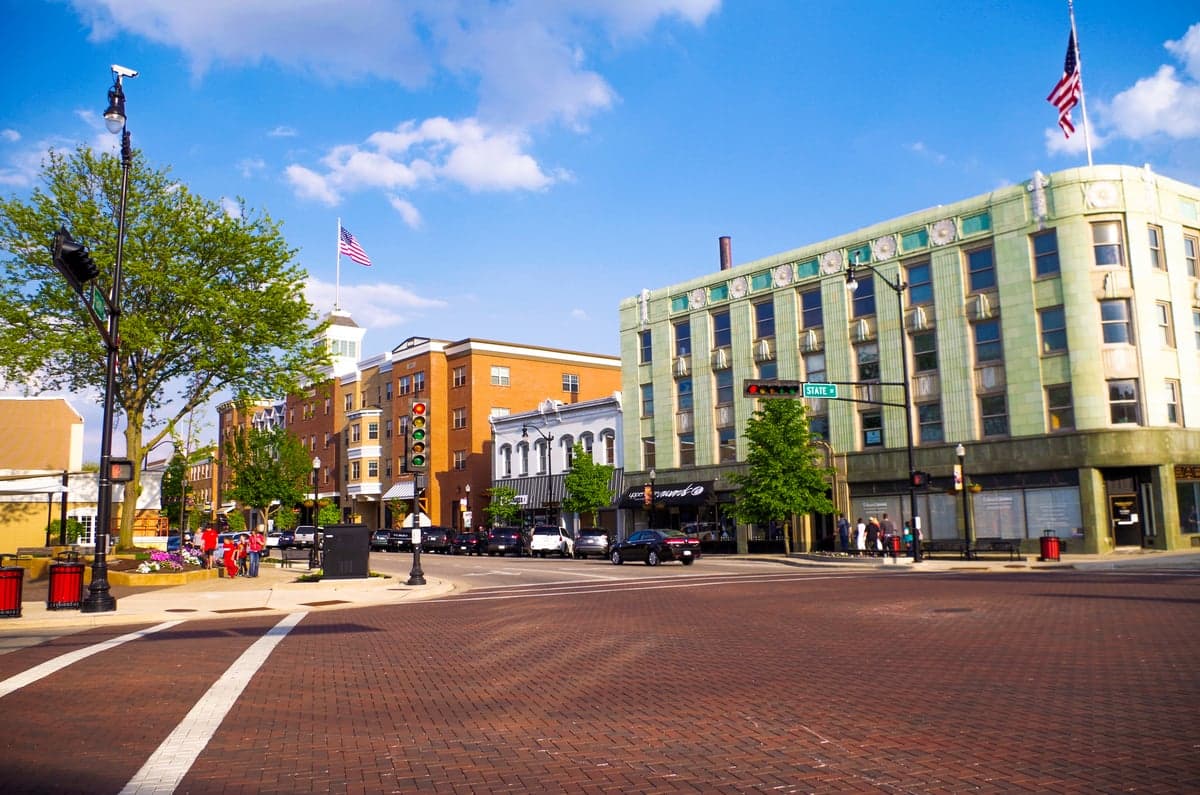
Beloit, Wisconsin, is a small industrial city of 36,554 residents with a working-class, multiethnic character shaped by successive waves of migration. Its population is notably diverse for southern Wisconsin, with a white population of 57.8%, a Hispanic community of 21.9%, a Black population of 13.4%, and a small East/Southeast Asian community of 1.2%. The city’s identity is rooted in its manufacturing past, its position on the Illinois border, and a demographic trajectory that is becoming more Hispanic and less white with each passing decade.
How the city was settled and grew
Beloit’s original settlers were Yankee migrants from New England and New York who arrived in the 1830s and 1840s, drawn by water power from the Rock River and cheap land from the federal land office. These early families, many of Congregationalist and Presbyterian stock, built the city’s first mills, churches, and schools in what is now the Olde Towne East neighborhood, the historic core along the river. By the 1850s, Irish immigrants digging the railroad and German farmers seeking cheap land formed the next wave, settling in the West Side neighborhoods near the rail yards and the emerging industrial corridor. The city’s industrial boom came after the Civil War, when the Beloit Iron Works (later Fairbanks Morse) and other heavy manufacturers drew skilled Scandinavian immigrants—Swedes and Norwegians—who clustered in the East Side around the factories. A smaller wave of Italian and Polish immigrants arrived around 1900, settling in the South Beloit area and the near-downtown blocks. By 1920, Beloit was a solidly white, heavily Protestant city of about 21,000, with distinct ethnic neighborhoods that persisted for decades.
Modern era (post-1965)
The post-1965 era brought the most significant demographic shift. The Hart-Cellar Act opened immigration from Latin America and Asia, while the collapse of heavy manufacturing in the 1970s and 1980s triggered white flight to suburbs like Janesville and rural Rock County. The first major Hispanic wave came in the 1970s, when Mexican and Puerto Rican workers were recruited for the remaining factory jobs and agricultural work in the surrounding dairy and corn fields. They settled primarily in the Riverside neighborhood along the Rock River and in the Colley Road corridor, where older housing stock was affordable. By 2000, the Hispanic share had reached 12%, and it has since nearly doubled to 21.9%. The Black population grew more slowly, rising from about 4% in 1980 to 13.4% today, driven by domestic migration from Chicago and Milwaukee. Black families concentrated in the East Side and Downtown neighborhoods, where public housing and rental units were available. The East/Southeast Asian community, at 1.2%, is small but stable, composed largely of Hmong and Vietnamese families who arrived as refugees in the 1980s and 1990s, settling near the Beloit College area and the Shopiere Road corridor. The Indian-subcontinent population is effectively zero, reflecting the city’s lack of tech or professional-service employers that typically attract that group.
The future
Beloit’s population is trending younger and more Hispanic, with the white share declining from about 72% in 2000 to 57.8% today. The Hispanic community is growing through both immigration and natural increase, and it is becoming less concentrated as second-generation families move into previously white neighborhoods like West Side and Olde Towne East. The Black population appears stable, with little new in-migration from Chicago. The East/Southeast Asian community is aging and not being replenished by new arrivals. The city is not tribalizing into rigid enclaves—neighborhoods are becoming more mixed—but economic segregation is increasing, with the Riverside and East Side areas seeing higher poverty rates while the West Side and northern outskirts remain more middle-class and white. The next 10-20 years will likely see Beloit become a majority-minority city, with Hispanics approaching 30-35% of the population, while the white share drops below 50%. The city’s industrial base is not coming back, but its low housing costs and proximity to the Madison and Chicago job markets may attract new domestic migrants, potentially diversifying the population further.
For someone moving in now, Beloit is a city in demographic transition: increasingly Hispanic and multiethnic, with a shrinking white working class and a stable Black community. It is not a homogenizing suburb but a small industrial city where distinct waves of migration have layered on top of each other, creating a place that is more diverse than most of southern Wisconsin but also poorer and less educated. The city’s future depends on whether it can retain its younger, more diverse population and attract new investment to replace the manufacturing jobs that once defined it.

* Values derived from national, state, county, city and local statistics and may differ in a specific area. Last updated: 2026-05-03T20:39:25.000Z
Narrative content on this page is AI-generated and may contain mistakes. Verify any details that matter before acting on them.
ReloMaps may earn a commission from affiliate links at no extra cost to you.

