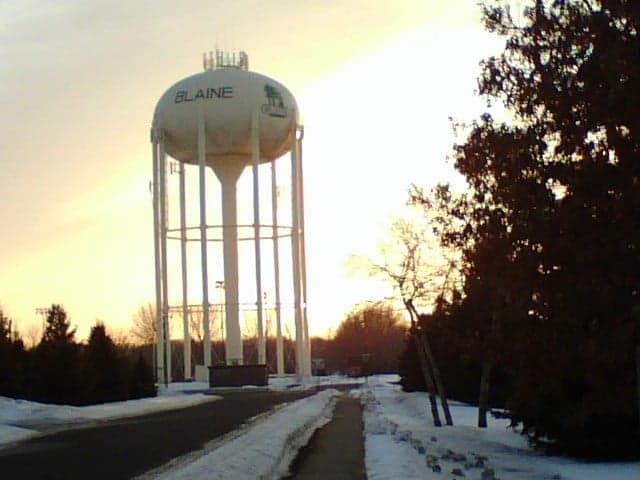
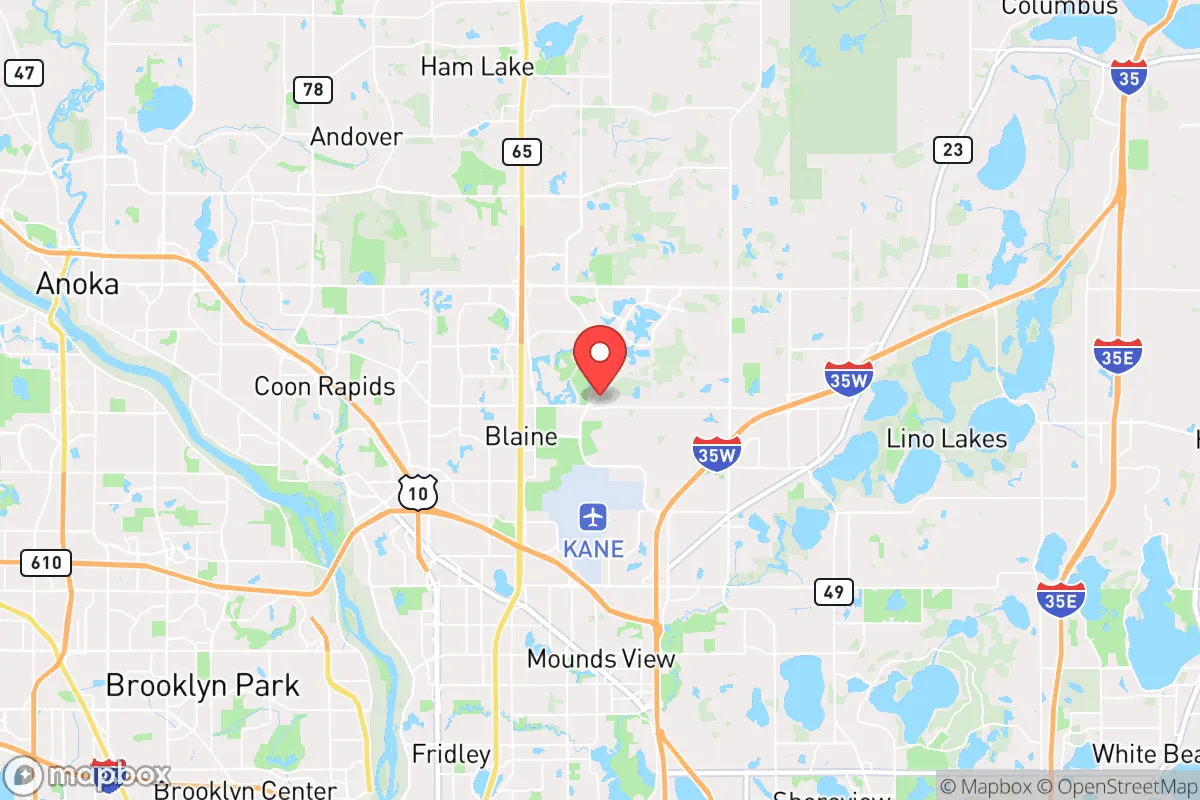
Photo: Wikipedia
Demographics of Blaine, MN
Affluence Level in Blaine, MN
A middle-class area roughly in line with national averages across income, home values, education, and employment.
People of Blaine, MN
The people of Blaine, Minnesota, today number 71,261, forming a predominantly white (71.4%) and increasingly diverse suburban community with a distinctively family-oriented, middle-class character. The city’s identity is rooted in its rapid post-war growth as a bedroom community for the Twin Cities, yet it retains a strong sense of local pride and a relatively low foreign-born population of just 3.5%. Blaine is a place where long-established Scandinavian and German families live alongside newer waves of East/Southeast Asian, Black, and Hispanic residents, creating a demographic landscape that is slowly diversifying but remains anchored by its European-American heritage.
How the city was settled and grew
Blaine’s human history begins not with a grand founding, but with the slow agricultural settlement of Anoka County in the 1850s and 1860s. The area was originally part of the larger town of Anoka, and the first permanent settlers were primarily Yankee farmers from New England and New York, drawn by the fertile soil and the promise of land under the Homestead Act of 1862. These early families—names like Fridley, Rice, and Moore—established scattered farmsteads along the Rum River and the railroad lines that would later define the community. The village of Blaine was not formally organized until 1877, named after the politician James G. Blaine. The original population cluster was around the Old Central Park neighborhood, near the intersection of what is now Highway 65 and 125th Avenue, where the first general store, church, and school served a sparse farming population. Through the early 20th century, Blaine remained a quiet, rural township of a few hundred people, with no significant immigrant enclaves beyond the original Yankee and later German and Swedish farm families who trickled in during the 1880s and 1890s.
Modern era (post-1965)
The modern transformation of Blaine began in earnest after 1965, driven by the construction of Interstate 35W and the expansion of the Twin Cities suburbs. The city’s population exploded from just over 5,000 in 1960 to over 40,000 by 1990, fueled by white, middle-class families fleeing Minneapolis and St. Paul for affordable new housing and good schools. The Northtown area, centered around the Northtown Mall (opened 1972), became the commercial and residential hub for this wave, with sprawling subdivisions like Lakes of Blaine and Sunfish Lake filling with young families, many of German and Scandinavian descent. This era cemented Blaine’s reputation as a safe, family-oriented suburb with a strong sense of community. The post-1965 immigration reforms had a modest impact on Blaine compared to the core cities. The city’s foreign-born population remains low at 3.5%, but the composition has shifted. The largest non-white group today is East/Southeast Asian (7.6%), concentrated in the Woodland Creek and Bunker Lake neighborhoods, where many Hmong and Vietnamese families moved during the 1990s and 2000s, drawn by affordable housing and proximity to jobs in the northern suburbs. The Black population (8.6%) is more dispersed but has a visible presence in the Northtown area, while the Hispanic community (5.1%) is growing steadily, particularly in the Lexington Avenue corridor. The Indian subcontinent population (1.9%) is a smaller but notable group, largely professionals in tech and healthcare, living in newer developments near the National Sports Center.
The future
Blaine’s demographic future points toward slow but steady diversification, though it is unlikely to become a majority-minority city in the next 20 years. The white population, while still dominant, is gradually declining as older residents age in place and younger families move to more affordable exurbs. The East/Southeast Asian and Black communities are growing at a moderate pace, driven by chain migration and the city’s reputation for good schools and safe neighborhoods. The Hispanic population is the fastest-growing segment, but from a small base. The city is not tribalizing into distinct enclaves; rather, the newer groups are dispersing across the city, with the Lakes of Blaine and Woodland Creek areas showing the most integration. The foreign-born share is expected to rise slowly, possibly reaching 5-6% by 2040, as Blaine attracts more skilled immigrants working in the Twin Cities’ medical and tech sectors. The biggest challenge will be maintaining the affordable housing stock that drew earlier waves, as rising home prices could push out younger families and accelerate the trend toward an older, whiter population in the core neighborhoods.
For someone moving to Blaine today, the city offers a stable, family-oriented environment with a slowly diversifying population and a strong sense of local identity. It is becoming a more inclusive suburb, but one where the dominant culture remains rooted in its Scandinavian and German heritage. The key takeaway is that Blaine is a place of gradual change, not rapid transformation—a safe bet for those seeking a traditional suburban lifestyle with growing diversity, but not a hub of intense multiculturalism. The neighborhoods to watch are Northtown for its commercial vitality and diversity, Lakes of Blaine for its family-friendly stability, and Woodland Creek for its emerging Asian and Black communities.

* Values derived from national, state, county, city and local statistics and may differ in a specific area. Last updated: 2026-04-30T00:19:51.000Z
Narrative content on this page is AI-generated and may contain mistakes. Verify any details that matter before acting on them.
ReloMaps may earn a commission from affiliate links at no extra cost to you.

