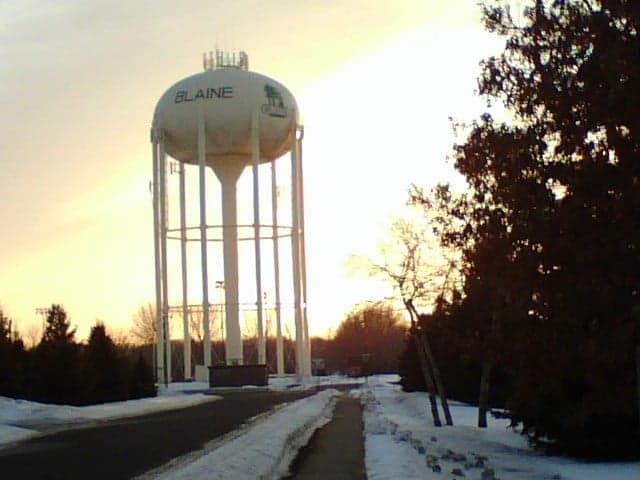
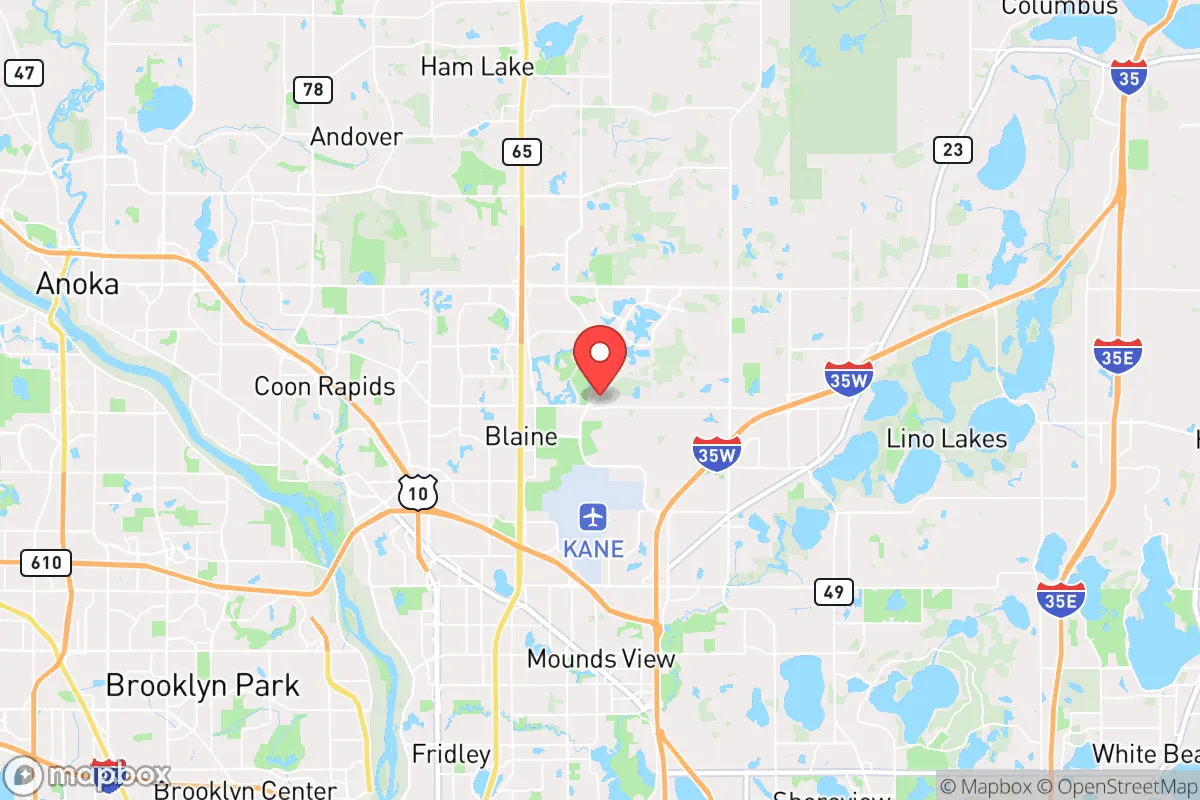
Photo: Wikipedia
Political ClimatePolitical Climate in Blaine, MN
District shown is the primary district for this city’s centroid. Cities may span multiple districts.
Local Political AnalysisPolitical Analysis of Blaine, MN
Blaine, Minnesota, has long been a solidly conservative stronghold in the northern suburbs of the Twin Cities, and despite some demographic shifts, it still leans reliably red. The Cook Partisan Voting Index (PVI) of R+10 tells you the baseline: this is a place where Republican candidates can expect to win by double digits in most elections, though the margin has tightened a bit over the last decade. If you’ve lived here as long as I have, you remember when it was a near lock for the GOP in every race—now, you see a slow creep of progressive influence from Minneapolis and the inner-ring suburbs, but Blaine’s core values of fiscal responsibility, limited government, and personal freedom still hold strong.
How it compares
Drive ten miles south into the city of Minneapolis, and you’re in a completely different political universe—a deep-blue urban center where progressive policies on taxes, policing, and zoning are the norm. Head west to Anoka or Coon Rapids, and you’ll find a similar conservative tilt, though Anoka County as a whole has been trending purple in recent years. The real contrast is with neighboring communities like Fridley or Columbia Heights, which have shifted left faster due to younger, more transient populations. Blaine, by contrast, has a higher proportion of long-term homeowners, families, and small-business owners who value stability and local control. The R+10 PVI reflects that Blaine is still a reliable Republican vote in a state that’s become increasingly competitive, but it’s not as deep red as rural areas like Wright County (R+18) or Sherburne County (R+16).
What this means for residents
For folks who live here, the political climate means a few practical things. First, local government tends to be more hands-off—zoning is less restrictive, property taxes are lower than in Minneapolis or St. Paul, and there’s less appetite for new regulations on businesses or homeowners. Second, school board and city council races matter a lot; these are the bodies that decide on things like mask mandates, library policies, and development approvals. In recent years, we’ve seen some progressive candidates make inroads in school board elections, which is a real concern for parents who want curriculum focused on fundamentals, not ideology. Third, the shift toward progressive ideology is real but slow—if you’re worried about government overreach into your personal freedoms, like how you raise your kids or run your small business, Blaine is still a safe bet compared to the inner suburbs. But you have to stay engaged; the long-term trend is concerning, especially as more young families move in from the city looking for cheaper housing but bringing their voting habits with them.
One cultural distinction worth noting: Blaine has a strong tradition of local control and skepticism of state-level mandates. During the pandemic, the city pushed back against some of Governor Walz’s executive orders, and there’s a general distrust of one-size-fits-all policies coming from St. Paul. You’ll also see a lot of Second Amendment support here—gun rights are taken seriously, and any talk of new restrictions is met with organized opposition. The city’s rapid growth (it’s one of the fastest-growing suburbs in the metro) has brought some tension between long-time residents and newcomers, but the political culture remains rooted in a belief that government should stay out of your life unless absolutely necessary. If that’s your view, Blaine is still a good place to call home—just keep an eye on those school board meetings and city council votes, because that’s where the real battles are fought.

State Political ClimatePolitical Climate in Minnesota
State Political AnalysisPolitical Environment in the State
Minnesota has shifted from a classic purple battleground to a solidly blue state over the past two decades, with Democrats now controlling all three levers of state government for the first time since 2014. The state voted for Hillary Clinton by 1.5 points in 2016, Joe Biden by 7 points in 2020, and Kamala Harris by 4 points in 2024, but the real story is the collapse of GOP support in the Twin Cities suburbs that once made the state competitive. For a conservative considering relocation, the political climate is increasingly hostile to traditional values, with a progressive trifecta that has passed sweeping legislation on taxes, education, and social policy since 2023.
Urban vs. rural divide
The political map of Minnesota is a tale of two worlds. The Twin Cities metro—Minneapolis, St. Paul, and their inner-ring suburbs like Edina, Bloomington, and St. Louis Park—drives the state’s blue lean, delivering massive margins for Democrats. Hennepin County alone gave Biden 71% of the vote in 2020, while Ramsey County hit 68%. Meanwhile, greater Minnesota is deeply red: counties like Stearns (St. Cloud), Olmsted (Rochester), and Wright (Buffalo) vote Republican by double digits. But the GOP’s problem is that the metro area now contains over 55% of the state’s population, and that share is growing. The suburbs that once swung elections—like Anoka County, which voted for Trump in 2016 but flipped to Biden in 2020—are trending left as educated professionals move in. Outside the metro, rural counties like Murray and Pipestone are bleeding population, further concentrating Democratic power in the urban core.
Policy environment
Since the DFL (Democratic-Farmer-Labor Party) took full control in 2023, Minnesota has enacted a policy agenda that alarms many conservatives. The state now has a progressive income tax with a top rate of 9.85% on income over $190,000, one of the highest in the nation. Property taxes are locally set but average about 1.05% of home value, with metro areas seeing steeper rates. The 2023 session also passed a paid family and medical leave program funded by a new payroll tax, a carbon-free electricity mandate by 2040, and a law requiring all new residential construction to be electric-ready by 2027. On education, the state eliminated high school graduation test requirements and expanded funding for ethnic studies. Election laws now include automatic voter registration, same-day registration, and no-excuse absentee voting—policies that conservatives argue erode ballot integrity. The state also legalized recreational marijuana in 2023, which some see as a freedom win but others view as a cultural shift that attracts a more progressive population.
Trajectory & freedom
Minnesota is becoming less free by any conservative measure. The 2023 legislative session was a firehose of government expansion: the state banned non-compete agreements for most workers, mandated that employers provide earned sick and safe time, and created a new state-run retirement savings program for workers without 401(k)s. On gun rights, Minnesota passed a red flag law in 2023 and expanded background checks to private sales—a direct infringement on Second Amendment freedoms. Parental rights took a hit with the passage of a law requiring schools to adopt policies on transgender student accommodations, effectively sidelining parents from decisions about their children’s gender identity. Medical autonomy is also under pressure: the state codified abortion rights into law in 2023, removing any parental notification requirements for minors. On the plus side, property taxes remain relatively low compared to neighboring Wisconsin, and there is no state sales tax on clothing or groceries. But the overall trajectory is clear: more mandates, more taxes, and less individual liberty.
Civil unrest & political movements
The George Floyd protests in 2020 left deep scars, with Minneapolis seeing over $500 million in property damage and a lasting breakdown in trust between residents and city leadership. The "defund the police" movement had real teeth here: the Minneapolis City Council attempted to disband the police department, though a 2021 ballot measure to replace it with a public safety department failed. Since then, crime rates have stabilized but remain elevated, with carjackings and retail theft still common in the metro. On the right, the "Take Back Minnesota" movement has organized around school board races and county commissioner seats, with some success in exurban areas like Wright County. Immigration politics are a flashpoint: Minnesota is a sanctuary state, with a 2023 law prohibiting state and local law enforcement from cooperating with federal immigration authorities. This has led to tensions in communities like Worthington and Willmar, where meatpacking plants have drawn large immigrant populations. Election integrity remains a concern for conservatives, especially after the 2020 election saw a record number of absentee ballots and a 2023 law that further expanded mail-in voting.
Projection
Over the next 5-10 years, Minnesota will likely become more progressive. The Twin Cities metro is growing while rural counties shrink, and the state’s in-migration is dominated by younger, college-educated professionals from blue states like California and Illinois. The 2024 election results showed Democrats gaining ground in previously competitive suburbs like Lakeville and Woodbury, while Republicans held steady in rural areas but failed to expand their coalition. The state’s budget surplus—projected at $2.4 billion for 2025—gives the DFL room to continue expanding government programs, including a proposed state-run health insurance option and a public bank. The biggest wildcard is the 2026 gubernatorial election: if Republicans can’t win back the governor’s mansion, expect more of the same. For a conservative moving in now, the political environment will feel increasingly like a blue state in the Northeast, with high taxes, heavy regulation, and a cultural tilt that prizes government solutions over individual freedom.
For a new resident, the bottom line is this: Minnesota offers a high quality of life in many respects—good schools, strong job market, beautiful outdoors—but the political climate is actively hostile to conservative values. If you value low taxes, parental rights, gun freedoms, and limited government, you will find yourself fighting an uphill battle against a well-funded progressive machine. The state is not a lost cause—rural communities and exurban counties still offer refuge—but the trend lines are clear. Come for the lakes and the economy, but be prepared to engage politically or watch your freedoms erode further.
* Values derived from national, state, county, city and local statistics and may differ in a specific area. Last updated: 2026-04-30T00:19:51.000Z
Narrative content on this page is AI-generated and may contain mistakes. Verify any details that matter before acting on them.
ReloMaps may earn a commission from affiliate links at no extra cost to you.

