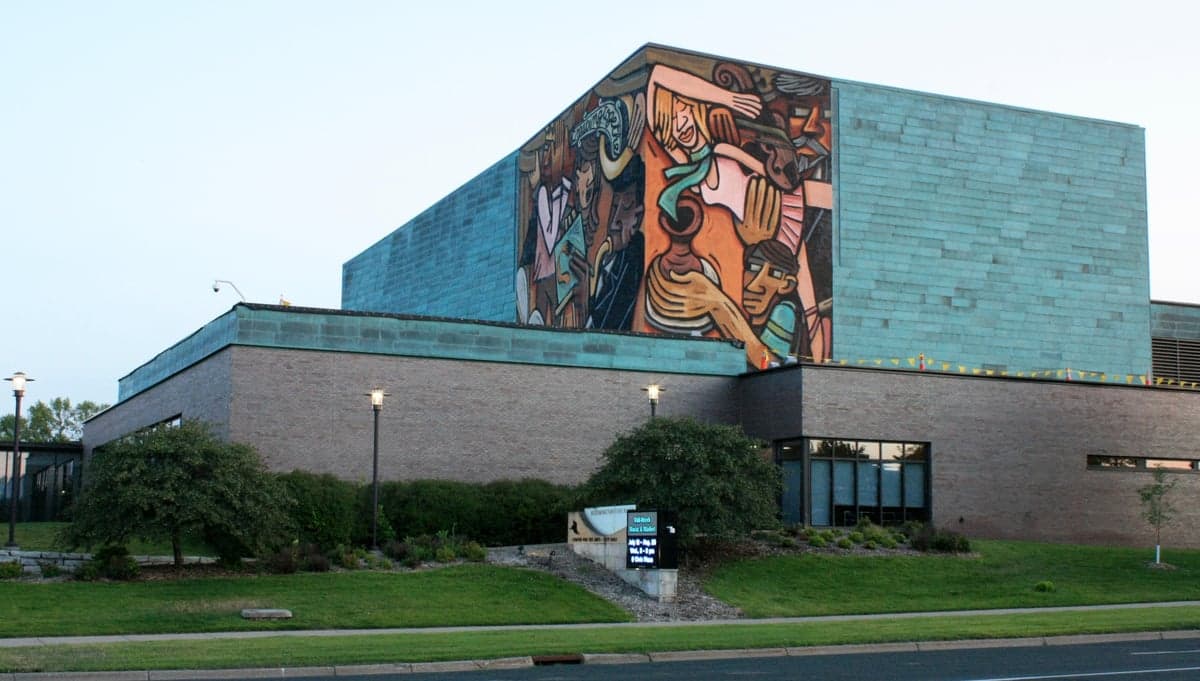
Photo: Wikipedia
Political ClimatePolitical Climate in Bloomington, MN
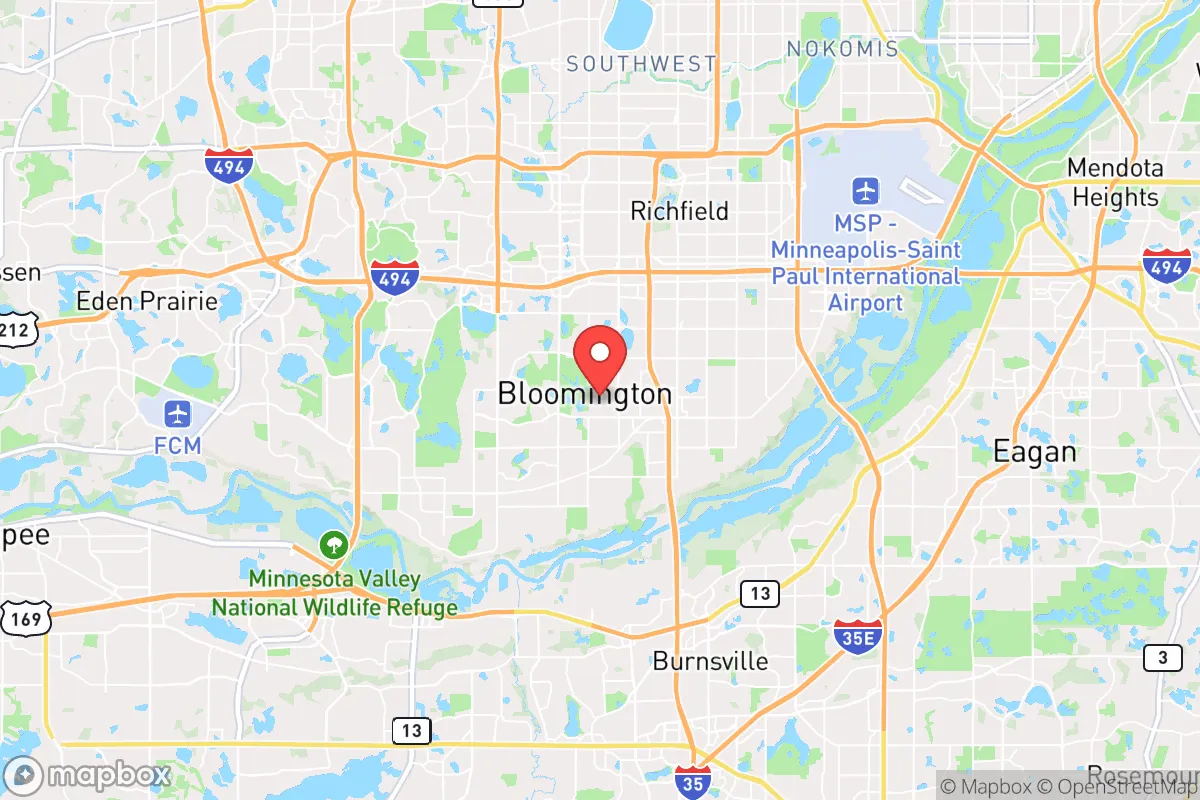
District shown is the primary district for this city’s centroid. Cities may span multiple districts.
Local Political AnalysisPolitical Analysis of Bloomington, MN
Bloomington, Minnesota, has a political climate that leans heavily to the left, and it’s been drifting that way for a while now. The Cook Partisan Voting Index (PVI) of D+11 tells you the story right off the bat—this isn’t a purple town; it’s a solidly blue one in a reliably blue state. If you’ve lived here as long as I have, you’ve watched the shift from a more moderate, middle-ground community to one where progressive policies are the norm, and frankly, that’s a concern for anyone who values personal freedoms and limited government overreach.
How it compares
To understand Bloomington’s politics, you have to look at the neighbors. Head south to Eden Prairie or Edina, and you’ll find similar D+10 to D+12 territory—affluent suburbs that vote reliably Democratic. But drive just 20 minutes west to Chanhassen or Chaska, and the landscape changes: those areas lean more Republican, with PVIs around R+4 to R+6. Even closer, Richfield to the north is even more liberal than Bloomington, while Burnsville to the south is a bit more mixed but still left-leaning. The contrast is stark: Bloomington is part of the inner-ring metro that’s become a stronghold for progressive politics, surrounded by a few pockets of sanity. It wasn’t always this way—back in the ‘90s, you could have a reasonable conversation with a neighbor about taxes or school policy without being labeled a reactionary. Now, the local council and school board are dominated by folks who seem more interested in social engineering than practical governance.
What this means for residents
For a resident who values personal liberty, living in Bloomington means navigating a system that increasingly prioritizes collective goals over individual rights. Property taxes are high—among the highest in the metro—and they fund a growing bureaucracy that doesn’t always respect your wallet or your choices. The city council has pushed for density-focused zoning and environmental mandates that can feel like a thumb on the scale for developers and activists, not homeowners. If you’re a small business owner or a parent who wants school choice, you’ll find the local government more interested in expanding its reach than in getting out of your way. The long-term trajectory is concerning: as the state legislature in St. Paul continues to pass laws that erode local control—like rent control and energy regulations—Bloomington’s leaders are often eager to implement them, not push back. I’ve seen friends move to Prior Lake or Lakeville just to get a little breathing room from the constant policy churn.
What daily life is like for families
On the ground, the political tilt shows up in everyday ways. School board meetings have become battlegrounds over curriculum and parental rights, with a vocal progressive majority often sidelining conservative voices. The Mall of America area is a hub for tourism and commerce, but the city’s tax policies and regulations make it harder for independent shops to thrive compared to neighboring cities with lighter touch. If you’re a gun owner, you’ll find Bloomington’s local ordinances more restrictive than in surrounding towns, and the police department—while professional—is often caught between enforcing state mandates and respecting local sentiment. Culturally, the city prides itself on being “inclusive,” but that can feel like a code word for conformity to progressive norms. I’ve seen longtime residents sell and move to Shakopee or Farmington just to escape the feeling that their values are out of step with the local government. Bloomington is a nice place to live if you keep your head down, but if you’re looking for a community that respects your right to live as you see fit, you might want to look a little further out.

State Political ClimatePolitical Climate in Minnesota
State Political AnalysisPolitical Environment in the State
Minnesota has undergone a dramatic political transformation over the past decade, shifting from a classic purple battleground to a reliably blue state at the statewide level, though with deep internal divisions. The Democratic-Farmer-Labor Party (DFL) now holds a trifecta in state government, and the state voted for Joe Biden by over 7 points in 2020, a stark contrast to the 2000s when it was decided by razor-thin margins. For a conservative considering relocation, the key takeaway is that while the Twin Cities metro area drives the state's leftward tilt, vast stretches of Greater Minnesota remain deeply red, creating a political landscape that feels like two different states under one capitol dome.
Urban vs. rural divide
The political map of Minnesota is a textbook case of the urban-rural chasm. The seven-county Twin Cities metro area (Hennepin, Ramsey, Dakota, Washington, Anoka, Carver, Scott) generates roughly 55% of the state's vote and is overwhelmingly Democratic. Minneapolis and St. Paul are among the most progressive cities in the Midwest, with suburban counties like Hennepin (home to Minneapolis) and Ramsey (St. Paul) routinely delivering 65-70% of their votes to Democrats. In contrast, Greater Minnesota—everything north and west of the metro—is a sea of red. Counties like Stearns (St. Cloud), Olmsted (Rochester), and St. Louis (Duluth) are competitive or lean blue, but the vast rural expanses of Kandiyohi, Becker, and Marshall counties vote Republican by 30-40 point margins. The Iron Range (St. Louis, Itasca, Lake counties) was historically a DFL stronghold due to union mining, but has been trending right as cultural issues and gun rights overtake economic loyalty. A notable flip: Carlton County, just south of Duluth, went from +12 D in 2016 to +4 R in 2020, a 16-point swing that signals the rural exodus from the Democratic coalition.
Policy environment
The DFL trifecta (2023-present) has enacted a sweeping progressive agenda that conservatives will find deeply concerning. Taxes are among the highest in the Midwest: the state income tax tops out at 9.85% on income over $190,000 (indexed), and the state sales tax is 6.875% with local add-ons pushing it to 8-9% in many cities. In 2023, the legislature passed a new paid family and medical leave program funded by a 0.7% payroll tax split between employers and employees, and a new 0.7% payroll tax for a state-run paid sick leave program. Education policy is a flashpoint: Minnesota has some of the nation's strongest teacher unions, and the 2023 session passed a universal free school meals program and expanded funding for "culturally responsive" curricula. Parental rights took a hit with the passage of a law banning "conversion therapy" for minors (broadly defined) and a law requiring schools to adopt policies that affirm a student's gender identity without parental notification in some cases. Election laws were loosened: automatic voter registration, pre-registration for 16- and 17-year-olds, and no-excuse absentee voting are now law. Gun rights saw major restrictions: a "red flag" law (extreme risk protection order) and universal background checks for private sales were passed in 2023. Healthcare is heavily regulated, with a state-run insurance exchange (MNsure) and a 2023 law requiring insurers to cover abortion and gender transition procedures without cost-sharing. The regulatory posture is business-friendly in some sectors (agriculture, mining) but hostile in others (energy, environmental permitting).
Trajectory & freedom
Minnesota is unequivocally becoming less free from a conservative perspective, especially since the 2022 election. The 2023 legislative session was one of the most aggressive in state history. Gun rights were curtailed by the red flag law and universal background checks, which passed without a single Republican vote. Parental rights were eroded by the "trans refuge" law (HF 1465), which protects out-of-state minors seeking gender transition care from parental notification or legal action by their home states. Medical autonomy was expanded for some (abortion and gender care are codified as "fundamental rights") but restricted for others (vaccine mandates for healthcare workers were not repealed, and a 2023 law requires all private insurers to cover abortion and gender transition). Property rights are under pressure: the 2023 legislature passed a law allowing local governments to impose rent control, and a "just cause" eviction law that makes it harder to remove problem tenants. Taxation is a clear freedom loss: the new payroll taxes for paid leave and the new 1% surcharge on income over $1 million (passed in 2023) make Minnesota one of the highest-tax states in the nation. On the positive side for conservatives, school choice remains limited but not dead: the state has a modest tax credit for private school expenses, and charter schools are relatively robust. However, the trajectory is clear: the DFL is using its trifecta to lock in a high-tax, high-regulation, culturally progressive state.
Civil unrest & political movements
Minnesota has been a national epicenter of political unrest since the 2020 George Floyd protests, which caused an estimated $500 million in property damage in Minneapolis and St. Paul. The Third Precinct police station was burned to the ground, and the city saw months of nightly protests and riots. The aftermath included a failed ballot measure to replace the Minneapolis Police Department with a new public safety agency (2021), and a successful 2022 measure that restructured the police department but kept it intact. Immigration politics are a flashpoint: Minnesota is a "sanctuary state" by practice if not by law—the 2023 legislature passed a law prohibiting state and local law enforcement from cooperating with federal immigration enforcement in most circumstances. The Minneapolis-St. Paul area has seen a surge in Somali, Hmong, and Latino populations, and the state's refugee resettlement program is one of the largest per capita in the nation. Election integrity is a live issue: the 2020 election saw no evidence of widespread fraud, but the 2023 law allowing automatic voter registration and pre-registration for 16-year-olds has raised concerns among conservatives about voter roll accuracy. Political movements on the right are active but fragmented: the Minnesota Gun Owners Caucus is a powerful lobbying force, and the Minnesota Family Council fights parental rights battles. The Walmart in St. Louis Park was a site of a 2023 protest over a Pride display, reflecting the cultural war intensity. Secession rhetoric is mostly confined to fringe groups, but the "Greater Minnesota" vs. "Metro" divide is real and growing, with some rural counties exploring "county secession" proposals to form a new state (though none have advanced).
Projection
Over the next 5-10 years, Minnesota is likely to become more blue and more progressive, driven by three factors. First, demographics: the Twin Cities metro is growing while rural counties shrink, and the metro's population is younger, more diverse, and more liberal. Second, in-migration: the state is attracting educated professionals from other blue states (Illinois, California) who reinforce the progressive tilt, while conservative-leaning families are moving to South Dakota, Iowa, or Wisconsin for lower taxes and fewer regulations. Third, policy lock-in: the DFL's 2023 laws on paid leave, gun control, and abortion are now entrenched, and the state's high tax burden will make it harder to attract conservative-leaning businesses and families. However, there are countercurrents: the 2026 gubernatorial election could flip the governor's office if the DFL overreaches (the 2022 race was only 7 points), and the state's constitutional amendment process (requiring a simple majority of voters) could be used to block future progressive initiatives. For a conservative moving in now, expect to live in a state where your vote in state elections is increasingly marginalized, but where local control in red counties (like Wright, Sherburne, or Steele) can still provide a buffer. The Iron Range may continue its rightward drift, potentially flipping a few more legislative seats, but the overall trajectory is toward a California-style one-party state at the top.
For a conservative considering Minnesota, the bottom line is this: you can find a welcoming community in the red counties of Greater Minnesota, but you will be living under a state government that is actively hostile to your values on taxes, guns, education, and parental rights. The state's natural beauty, strong economy, and high quality of life are real, but they come with a political price tag that is only going up. If you value low taxes, gun rights, and local control, you may be better served by neighboring states like South Dakota or Iowa. If you are determined to move here, target counties like Wright (west of the metro), Sherburne (northwest), or Steele (south), where the local culture and school boards still reflect conservative values, and be prepared to fight for those values at the ballot box every two years.
* Values derived from national, state, county, city and local statistics and may differ in a specific area. Last updated: 2026-04-30T01:10:24.000Z
Narrative content on this page is AI-generated and may contain mistakes. Verify any details that matter before acting on them.
ReloMaps may earn a commission from affiliate links at no extra cost to you.

