Photo: Wikipedia
Political ClimatePolitical Climate in Boone, IA
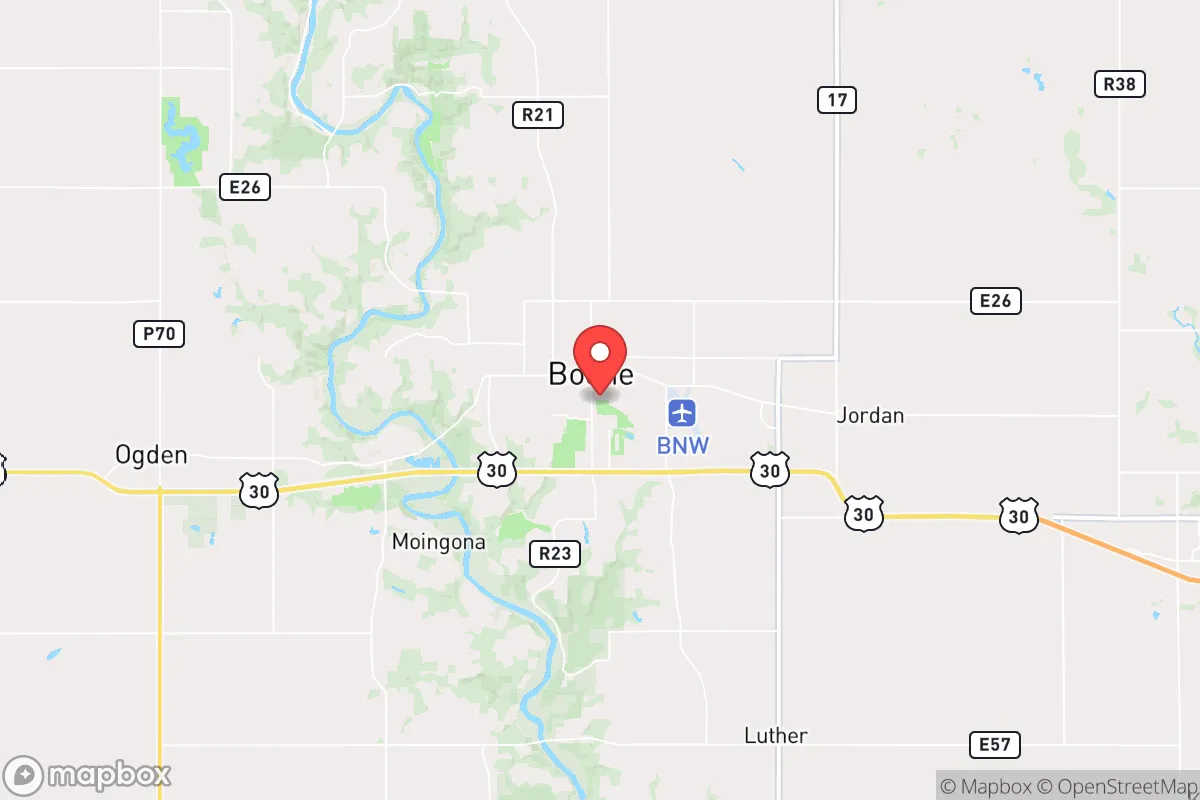
District shown is the primary district for this city’s centroid. Cities may span multiple districts.
Local Political AnalysisPolitical Analysis of Boone, IA
Boone, Iowa, sits solidly in the red, with a Cook PVI of R+15 that reflects a deep-rooted conservative tradition. For as long as anyone around here can remember, this town has leaned Republican, and the numbers back it up—Boone County hasn't voted for a Democratic presidential candidate since 1964, and in 2024, the county went +24 points for the GOP. That's not just a trend; it's a way of life. But like a lot of small-town Iowa, you can feel the winds shifting, and not always in a good way. The older generation—the farmers, the small business owners, the folks who remember when Main Street was bustling—they still hold the line on personal freedoms and limited government. But there's a creeping unease that progressive ideas, especially from Ames and Des Moines, are starting to seep in, and it's got people watching the school board meetings a little closer.
How it compares
Drive 20 minutes east to Ames, and you're in a different world. That's Iowa State University territory, and the politics there are as blue as the Cyclones' uniforms—think a Cook PVI of D+5 or so. Boone, by contrast, is the quiet, steady counterweight. We don't have the protests or the campus activism; we have church suppers and county fairs. Head south to Des Moines, and you'll find a similar split—the city core is reliably Democratic, but the suburbs and rural edges lean hard right. Boone sits in that sweet spot where the values are still traditional: low taxes, Second Amendment rights, and a general distrust of government telling you how to live your life. The contrast is stark, and it's why a lot of folks here feel like they're holding the line against a tide of overreach coming from the bigger cities.
What this means for residents
For the people who call Boone home, the political climate means a lot of things are still done the old-fashioned way. You don't see mask mandates or vaccine passports here—that kind of government overreach would get laughed out of a city council meeting. The local schools still teach civics without the woke baggage, and the county sheriff is more likely to be a friend than a bureaucrat. Property taxes are reasonable, and there's a general sense that your personal freedoms—whether it's how you raise your kids, what you do on your land, or which church you attend—are respected. But there's a growing concern that the progressive push from the state level, especially on things like land use regulations and education standards, could start chipping away at that. The long-time residents I talk to are worried that if we don't stay vigilant, we'll end up like Ames—a place where the government thinks it knows better than the people.
Culturally, Boone is still a place where the Fourth of July parade is a bigger deal than any election, and the local diner is where you hash out politics over coffee. There's a strong sense of community self-reliance—people don't look to the government to solve their problems. That said, the recent push for a county-wide zoning ordinance raised eyebrows; it felt like a foot in the door for more control over private property. For now, the conservative majority on the board of supervisors keeps things in check, but the next few years will tell the tale. If you're looking for a place where your rights come first and the government stays out of your business, Boone is still that place—but you've got to keep an eye on the horizon.

State Political ClimatePolitical Climate in Iowa
State Political AnalysisPolitical Environment in the State
Iowa has been a reliably Republican state in presidential elections since 2016, but its political identity is more nuanced than a simple red-state label suggests. The state’s overall lean is roughly R+6 to R+8 at the presidential level, driven by a coalition of rural conservatives, evangelical voters, and a growing number of exurban families fleeing left-leaning metros in neighboring states. However, the state’s two largest population centers—Des Moines and Iowa City—have shifted sharply left over the past decade, creating a widening urban-rural chasm that defines Iowa’s modern political landscape.
Urban vs. rural divide
The political map of Iowa is a study in contrasts. Polk County (Des Moines) and Johnson County (Iowa City) are the Democratic strongholds, with Johnson County voting +30 points for Biden in 2020 and Polk County trending blue as the state capital’s suburbs fill with white-collar professionals and government workers. Meanwhile, the rural counties that make up the rest of the state—places like Sioux County in the northwest (home to conservative Dordt University) and Plymouth County along the Missouri River—routinely vote 70-80% Republican. The real battlegrounds are the suburban donut counties around Des Moines: Dallas County (Waukee, Adel) and Warren County (Indianola) have flipped from purple to reliably red over the past two cycles, driven by families moving from more expensive, left-leaning states like Illinois and California. Linn County (Cedar Rapids) remains a swing area, but its rural townships are increasingly voting Republican while the city core stays Democratic.
Policy environment
Iowa’s policy environment is broadly conservative, with a few notable exceptions. The state has a flat income tax rate of 3.9% (down from 8.5% in 2018), and property taxes are among the lowest in the Midwest—a deliberate strategy to attract retirees and remote workers. The 2023 Education Savings Account (ESA) law allows any family to use state funds for private or homeschool expenses, making Iowa a national leader in school choice. Gun laws are permissive: permitless carry was signed into law in 2021, and there are no magazine capacity limits or red-flag laws. On the flip side, the state’s medical cannabis program remains highly restrictive (no smokable flower, low THC caps), and the 2024 “bathroom bill” (SF 482) requires schools to designate single-sex facilities based on biological sex—a move popular with conservatives but criticized by progressives. Election integrity is strong: Iowa requires voter ID, has purged inactive voter rolls, and banned private funding of elections (like Zuckerbucks) in 2021.
Trajectory & freedom
Over the past five years, Iowa has moved decisively toward greater personal freedom in most areas. The 2021 permitless carry law eliminated the need for a state-issued license to carry a concealed firearm. The 2023 ESA expansion gave parents near-total control over their children’s education, including the ability to use funds for homeschooling curricula. The 2024 “Parental Bill of Rights” (HF 595) requires schools to notify parents of any curriculum involving sexuality or gender identity and to obtain parental consent before a child can change their name or pronouns at school. However, the state has also expanded government power in ways that concern liberty-minded residents: the 2022 ban on mask mandates in schools was a win for freedom, but the 2023 law restricting local zoning authority over wind and solar projects was seen by some as a corporate giveaway that tramples property rights. The 2024 law banning TikTok on state devices is popular but raises free-speech questions. Overall, Iowa is trending more free on education, guns, and taxes, but less free on medical freedom and local control.
Civil unrest & political movements
Iowa has seen relatively little civil unrest compared to coastal states, but there have been flashpoints. The 2020 Black Lives Matter protests in Des Moines turned violent on one occasion (a police car was burned), but the state’s Republican legislature responded by passing a 2021 law increasing penalties for rioting and blocking highways. The 2023 “Drag Queen Story Hour” protests at public libraries in Cedar Rapids and Davenport drew large counter-protests from both sides, but the legislature has not passed any anti-drag laws. Immigration politics are relatively quiet—Iowa has no sanctuary cities, and the 2024 law requiring local law enforcement to cooperate with ICE passed easily. The most visible political movement is the “Parents’ Rights” movement, which has been highly effective at school board elections in suburbs like Waukee and Ankeny, where conservative slates have won majorities and removed controversial library books. Election integrity concerns have been minimal; the state’s voter ID law and post-election audits have kept fraud allegations rare.
Projection
Over the next 5-10 years, Iowa is likely to become more Republican and more culturally conservative, driven by two demographic trends. First, the state is attracting a steady stream of migrants from Illinois, California, and Minnesota—many of them conservative-leaning families who cite taxes, school choice, and gun rights as their reasons for moving. Second, the state’s rural counties are aging but not depopulating as fast as other Midwestern states, thanks to a strong agricultural economy and the growth of meatpacking plants in towns like Storm Lake and Postville. The urban centers (Des Moines, Iowa City) will continue to vote Democratic, but their influence will be diluted by the growth of red suburbs like Waukee and Norwalk. The biggest wildcard is the state’s aging population—Iowa has the fifth-oldest median age in the country, and if younger families don’t continue to move in, the state could see a gradual shift toward more moderate politics as older conservatives are replaced by younger, more libertarian-leaning voters. However, for the foreseeable future, Iowa will remain a reliably red state with a strong conservative policy environment.
For a new resident, the bottom line is this: Iowa offers a high degree of personal freedom in education, gun rights, and taxation, with a government that is generally responsive to conservative priorities. The trade-off is a relatively low level of urban amenities and a climate that can be harsh. If you value school choice, low taxes, and a culture that respects parental authority, Iowa is one of the best bets in the Midwest. Just be prepared for the cold—and for the fact that your vote will matter more in a primary than a general election.
* Values derived from national, state, county, city and local statistics and may differ in a specific area. Last updated: 2026-04-30T00:23:41.000Z
Narrative content on this page is AI-generated and may contain mistakes. Verify any details that matter before acting on them.
ReloMaps may earn a commission from affiliate links at no extra cost to you.

