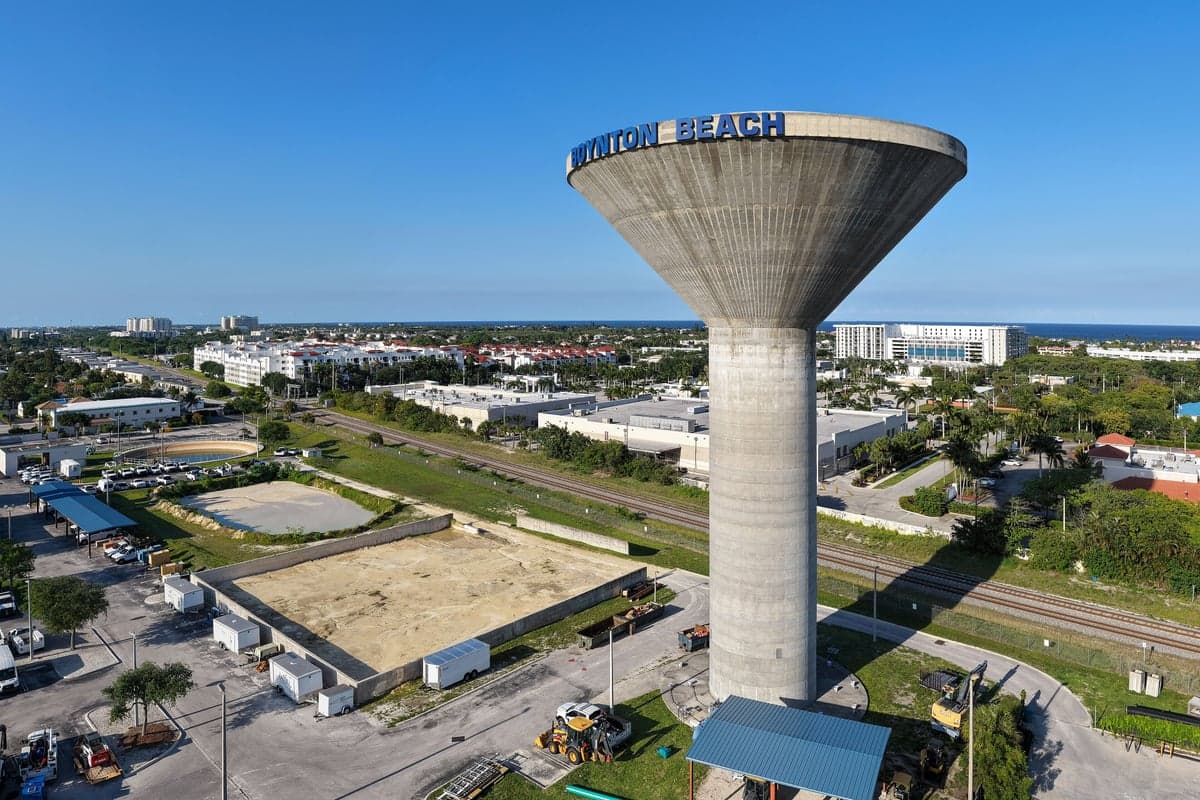
Photo: Wikipedia
Demographics of Boynton Beach, FL
Affluence Level in Boynton Beach, FL
A middle-class area roughly in line with national averages across income, home values, education, and employment.
People of Boynton Beach, FL
The people of Boynton Beach, Florida today form a diverse, majority-minority city of 80,601 residents, characterized by a nearly even split between White (44.2%) and Black (33.4%) populations, with a significant Hispanic community (16.5%) and smaller East/Southeast Asian (1.6%) and Indian subcontinent (0.8%) groups. The city’s identity is shaped by its role as a mid-century retirement and vacation destination that has since evolved into a more economically and racially mixed suburban hub, with a foreign-born population of 11.8% and a college-educated rate of 31.9%. Distinct neighborhoods reflect distinct settlement waves, from the historic Heart of Boynton district to the newer Canyon Lakes and Golfview Harbour communities.
How the city was settled and grew
Boynton Beach was founded in the late 19th century, a product of the Florida East Coast Railway’s expansion southward. The city is named after Major Nathan S. Boynton, a Michigan Civil War veteran who wintered in the area and promoted it as a resort. The original settlers were primarily White farmers and fishermen from the northern United States, drawn by the promise of subtropical agriculture—pineapples, tomatoes, and beans—and the newly accessible coastline. The Historic Boynton Beach neighborhood, centered around Ocean Avenue and the old downtown, was the original hub, with modest wood-frame homes built by these early families. By the 1920s, the land boom brought a second wave of White middle-class retirees and speculators, who built bungalows and small hotels along the Intracoastal Waterway in areas like Golfview Harbour. The city remained overwhelmingly White and small—fewer than 2,000 residents—through the 1940s, with a tiny Black population of domestic workers and farm laborers living in segregated enclaves near the railroad tracks.
Modern era (post-1965)
The 1965 Hart-Cellar Act and the broader civil rights movement reshaped Boynton Beach’s population. The city’s Black population grew significantly as families moved from the rural South for jobs in Palm Beach County’s expanding service and construction sectors. They settled primarily in the Heart of Boynton district, a historically Black neighborhood east of I-95 that became the cultural and commercial core for the African American community. By the 1980s, suburbanization accelerated: White middle-class families moved into newer developments like Canyon Lakes (a gated golf-course community) and Hunters Run, while Hispanic immigrants—largely from Puerto Rico, Cuba, and Central America—began arriving for work in landscaping, hospitality, and construction, clustering in the Le Lac area and along the Federal Highway corridor. The 1990s and 2000s saw an influx of East/Southeast Asian families (Vietnamese, Filipino, Chinese) into the Boynton Lakes and Lakes of Sherbrooke neighborhoods, drawn by affordable housing and proximity to Palm Beach County’s growing healthcare and tech sectors. The Indian subcontinent community, though small, established a presence near the Quantum Corporate Park area, linked to engineering and IT jobs. Today, the city’s racial geography is distinct: Heart of Boynton remains predominantly Black, Canyon Lakes and Golfview Harbour are majority White, and Le Lac is heavily Hispanic, while newer subdivisions are more mixed.
The future
Boynton Beach’s population is trending toward greater diversity and modest growth. The White share has declined from over 60% in 2000 to 44.2% today, while the Hispanic and Black shares have risen steadily. The East/Southeast Asian and Indian populations are small but growing, driven by professionals in healthcare and tech. The city is not homogenizing; instead, it is tribalizing into distinct enclaves, with each group maintaining strong neighborhood identities. The Heart of Boynton area is seeing some gentrification pressure from new townhomes and retail, but it remains a Black-majority district. The Hispanic community in Le Lac is expanding, with new immigrant arrivals from Central America. The foreign-born share (11.8%) is below the national average (13.7%), suggesting that future growth will come more from domestic migration than international immigration. Over the next 10–20 years, Boynton Beach is likely to become a more evenly tri-ethnic city (White, Black, Hispanic), with small but stable Asian and Indian communities. The college-educated rate (31.9%) is below the national average (33.7%), but new mixed-use developments near the Tri-Rail station may attract younger, more educated residents.
For someone moving in now, Boynton Beach is a city in transition—still affordable compared to coastal Palm Beach County, but with clear neighborhood boundaries that reflect its layered settlement history. It offers a genuinely diverse environment, though one where community identity is often tied to specific districts rather than a unified citywide culture. The city is becoming more suburban and family-oriented, with improving schools and infrastructure, but it remains a place where the past waves of settlement—from farmers to retirees to immigrants—are still visible in the neighborhoods they built.

* Values derived from national, state, county, city and local statistics and may differ in a specific area. Last updated: 2026-04-24T15:11:04.000Z
Narrative content on this page is AI-generated and may contain mistakes. Verify any details that matter before acting on them.
ReloMaps may earn a commission from affiliate links at no extra cost to you.

