Photo: Wikipedia
Demographics of Breckenridge, CO
Affluence Level in Breckenridge, CO
An upper-middle-class area. Household wealth, education levels, and homeownership run ahead of national benchmarks.
People of Breckenridge, CO
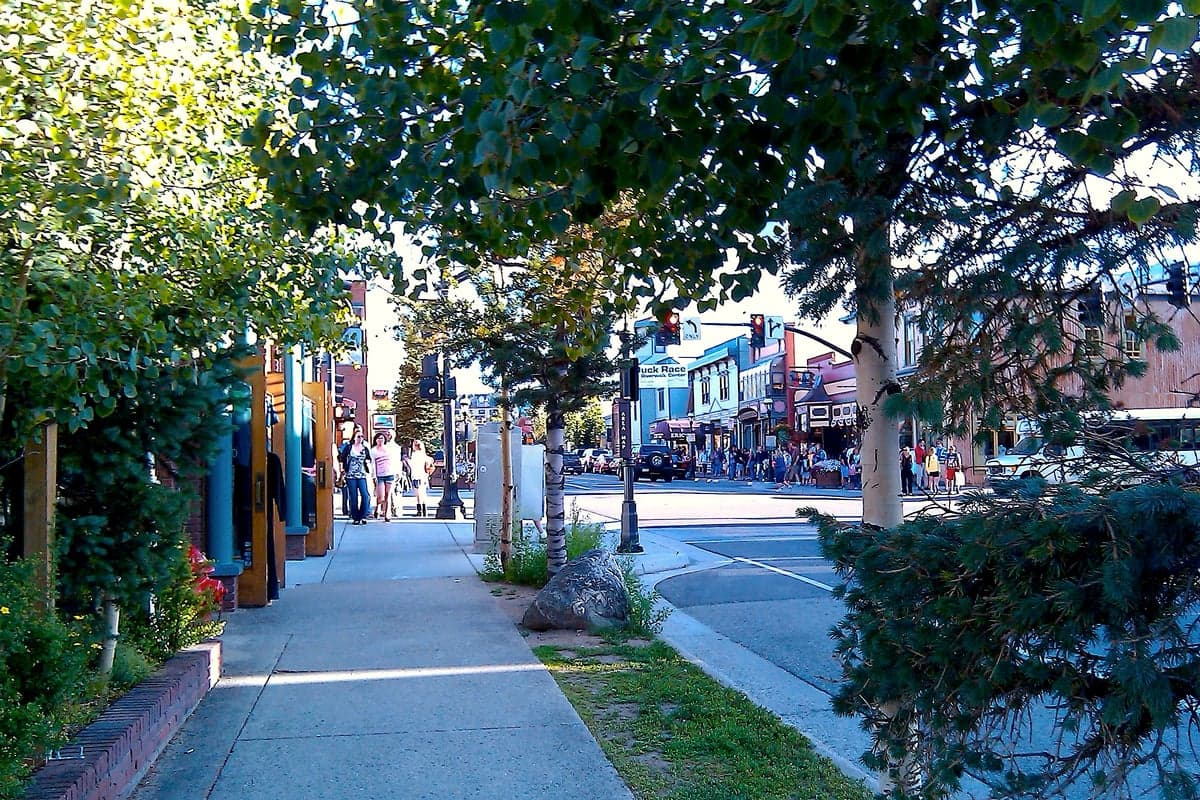
The people of Breckenridge, Colorado today number just over 5,000 year-round residents, a population that is overwhelmingly white (81.0%) and highly educated (59.9% hold a college degree). The town’s identity is shaped by a sharp contrast: a historic mining-rooted core and a modern, affluent resort economy that draws seasonal workers and second-home owners. With only 2.0% foreign-born and a modest 4.9% Hispanic population, Breckenridge remains less ethnically diverse than Summit County as a whole, but its character is increasingly defined by the tension between long-time locals and a transient, wealth-driven influx.
How the city was settled and grew
Breckenridge was founded in 1859 during the Pike’s Peak Gold Rush, when prospectors discovered gold in the Blue River Valley. The original population was almost entirely white, Anglo-American men from the eastern United States, with a small number of Chinese laborers who worked mining claims after the 1860s. The town’s early neighborhoods grew organically around the mining district: French Gulch became home to many of the early placer miners, while Lincoln Park (the area around modern Lincoln Avenue) housed the commercial and residential core. By the 1880s, the railroad arrived, bringing more permanent settlers and a small wave of European immigrants—mostly Irish, German, and Scandinavian—who worked the hard-rock mines. The town’s population peaked around 2,500 in the 1890s, then declined sharply as mining faded after World War I. By 1950, Breckenridge had fewer than 400 residents, a near-ghost town preserved largely by its isolation.
Modern era (post-1965)
The modern transformation began in the 1960s with the development of the Breckenridge Ski Resort, which opened in 1961. This triggered a dramatic demographic shift: the town was reborn as a destination for ski tourism and second-home ownership. The post-1965 wave was overwhelmingly domestic, drawing white, college-educated professionals from Denver, Texas, and the Midwest. The Warren Station area (near the base of Peak 9) became the epicenter of resort-oriented development, while Wellington Park and Blue River Estates attracted families and long-term residents seeking more space. The Hispanic population grew modestly during the 1990s and 2000s, driven by workers in hospitality and construction, but remains small (4.9%). East/Southeast Asian residents (0.9%) and Black residents (0.3%) are present in very low numbers, largely concentrated in seasonal service roles. The Indian-subcontinent population is effectively zero. The town’s racial composition has remained remarkably stable since 2000, with white share declining only slightly from 85% to 81% as the total population grew from 2,400 to 5,001.
The future
Breckenridge’s population is heading toward further homogenization by income and lifestyle, rather than by race or ethnicity. The town’s extreme housing costs—median home prices above $1 million—are filtering out all but the wealthiest newcomers, while long-time locals are increasingly pushed to neighboring towns like Frisco or Silverthorne. The Hispanic and Asian populations are likely to plateau or grow slowly, as service-sector jobs are filled by commuters from lower-cost areas rather than new immigrants. The next decade will likely see Breckenridge become more of a seasonal, part-time community: the year-round population may stagnate or even decline, while the number of second homes and short-term rentals continues to rise. The Historic District (the original mining grid) is becoming a boutique retail and dining zone, while Shock Hill and Four O’Clock areas are dominated by luxury vacation rentals. There is no sign of tribalization into ethnic enclaves; instead, the divide is economic—between the resort-wealthy and the service-worker commuter.
For a conservative-leaning individual or family considering a move, Breckenridge offers a safe, highly educated, and politically moderate-to-liberal community (Summit County voted +38 Democratic in 2024) with a strong outdoor lifestyle. The population is stable in size but increasingly transient and wealthy, meaning newcomers should expect a town that feels more like a resort than a traditional mountain community. The lack of ethnic diversity and the high cost of entry make it a niche choice—ideal for those who prioritize recreation and scenery over a broad social fabric or affordable housing.

* Values derived from national, state, county, city and local statistics and may differ in a specific area. Last updated: 2026-04-29T00:29:45.000Z
Narrative content on this page is AI-generated and may contain mistakes. Verify any details that matter before acting on them.
ReloMaps may earn a commission from affiliate links at no extra cost to you.

