 Popular
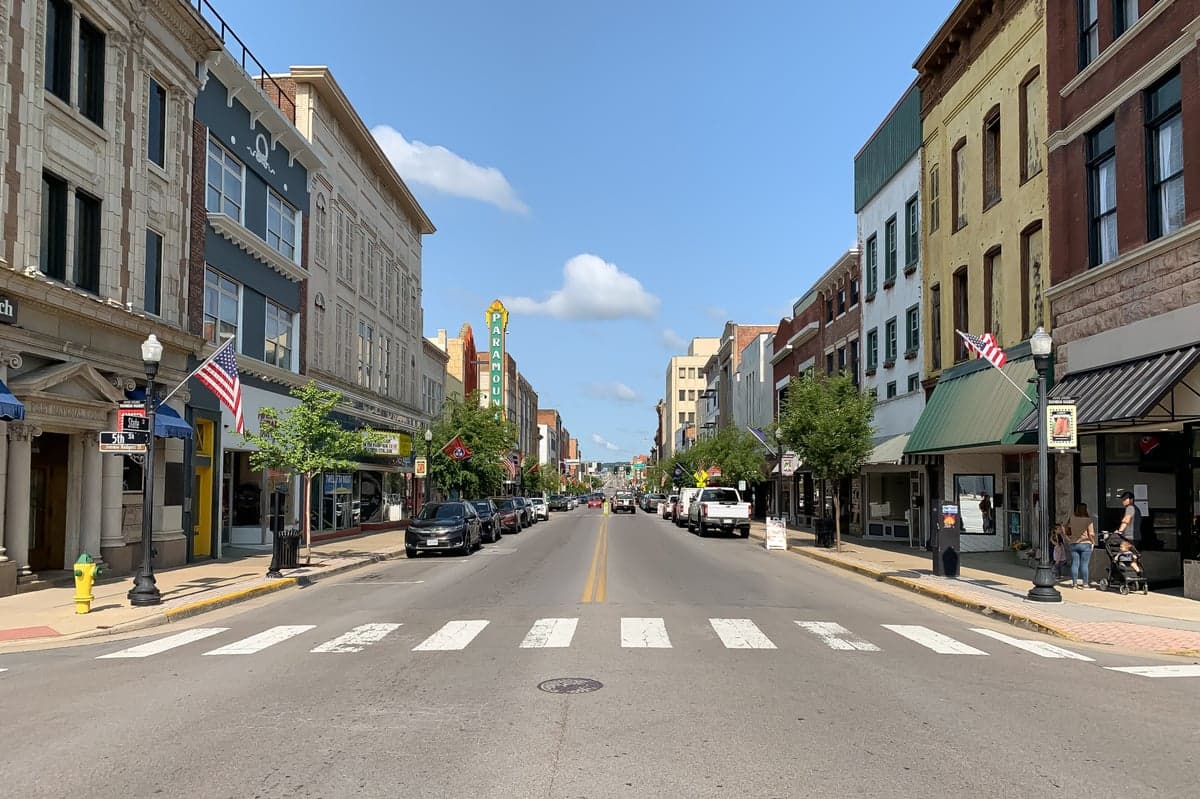
Photo: Wikipedia
Demographics of Bristol, TN
Affluence Level in Bristol, TN
A middle-class area roughly in line with national averages across income, home values, education, and employment.
People of Bristol, TN
The people of Bristol, Tennessee today number 27,490, forming a predominantly white (89.3%) and native-born community where only 0.8% of residents are foreign-born. The city’s character is rooted in its Appalachian border location and a manufacturing-and-healthcare economy that has historically attracted domestic migrants rather than international ones. With a college-educated rate of 29.8% and a small but growing Hispanic population (4.1%), Bristol retains a distinctly Southern, working-to-middle-class identity that sets it apart from larger Tennessee cities like Nashville or Knoxville.
How the city was settled and grew
Bristol was founded in 1856 as a planned railroad town at the Virginia-Tennessee state line, deliberately sited along the newly completed Virginia & Tennessee Railroad. The original population was overwhelmingly of English, Scots-Irish, and German stock, drawn from the surrounding Appalachian valleys and the Upper South. These early settlers built the city’s first residential core in what is now Historic Downtown Bristol, where the state line runs down the middle of State Street. The railroad made Bristol a regional hub for tobacco, livestock, and timber, and by the 1880s the city had attracted a small number of German and Irish immigrants who worked in the rail yards and foundries. These groups settled in the Fairmount and Pleasant Valley neighborhoods, which remain predominantly white and working-class today. The early 20th century brought a second wave of domestic migrants—rural Appalachians displaced by the decline of subsistence farming—who filled jobs in the city’s expanding textile mills and furniture factories. They concentrated in East Bristol and the King College Hill area, building modest frame houses that still characterize those districts. By 1950, Bristol’s population was nearly 100% white and native-born, with only a handful of Black families living in the Pleasant Valley area, a pattern that persisted through the Jim Crow era.
Modern era (post-1965)
The post-1965 period brought little change to Bristol’s racial composition, in sharp contrast to national trends. The 1965 Hart-Cellar Act, which opened immigration from Asia and Latin America, had almost no effect here: the foreign-born share remains below 1%. Instead, the city’s modern demographic story is one of domestic in-migration from other parts of Appalachia and the rural South, driven by the expansion of the healthcare sector (Bristol Regional Medical Center) and the arrival of light manufacturing plants such as Electrolux and Strongwell. The West End neighborhood, developed in the 1970s and 1980s, absorbed many of these new arrivals—mostly white families from surrounding counties seeking newer housing and better schools. The Hispanic population, now 4.1%, began growing in the 1990s as a small number of Mexican and Central American workers took jobs in construction and poultry processing. They have concentrated in the Pleasant Valley and Fairmount areas, where older, lower-cost housing is available. The Black population (2.6%) has remained stable and small, with most Black residents living in the Pleasant Valley corridor. East/Southeast Asian residents (0.2%) and Indian-subcontinent residents (0.2%) are present in negligible numbers, typically professionals employed at the medical center or at King University. The city has not experienced the large-scale suburbanization seen in metro areas like Knoxville; instead, growth has been infill and small-lot development within the existing city limits.
The future
Bristol’s population is likely to remain overwhelmingly white and native-born for the foreseeable future. The Hispanic share may grow slowly, reaching perhaps 6-8% by 2040, as existing families have children and a trickle of new arrivals come for construction and service jobs. However, the city lacks the large employers, university system, or immigrant networks that drive rapid diversification elsewhere. The white population is aging, and out-migration of young adults to larger cities is a persistent challenge. The West End and newer subdivisions near the Bristol Motor Speedway are attracting some retirees and remote workers from higher-cost areas, but these are overwhelmingly white and domestic. The city is not tribalizing into distinct ethnic enclaves; rather, it is slowly homogenizing as the small Black and Hispanic populations assimilate into predominantly white neighborhoods. The next 10-20 years will likely see a slightly older, slightly more Hispanic Bristol, but one that remains culturally and demographically closer to its 1950s self than to the diverse cities of the New South.
For someone moving to Bristol now, the city offers a stable, low-diversity community with a strong sense of local identity and a cost of living well below the national average. The population is not growing rapidly, but it is not shrinking either—a steady-state demographic environment that appeals to those seeking predictability and traditional community structures. The trade-off is limited exposure to different cultures and a workforce that may not attract the kinds of employers that require a diverse talent pool.

* Values derived from national, state, county, city and local statistics and may differ in a specific area. Last updated: 2026-05-01T18:33:56.000Z
Narrative content on this page is AI-generated and may contain mistakes. Verify any details that matter before acting on them.
ReloMaps may earn a commission from affiliate links at no extra cost to you.

