Photo: Wikipedia
Demographics of Broken Arrow, OK
Affluence Level in Broken Arrow, OK
A middle-class area roughly in line with national averages across income, home values, education, and employment.
People of Broken Arrow, OK
The people of Broken Arrow, Oklahoma, today number 115,919, forming a predominantly white (64.6%) and politically conservative suburb of Tulsa. The city is characterized by a strong family-oriented identity, with 35.0% of adults holding a college degree and a foreign-born population of just 3.7%—well below the national average. Distinctive markers include a deep-rooted sense of community in older neighborhoods and a rapid expansion of master-planned subdivisions that attract domestic migrants from across the region.
How the city was settled and grew
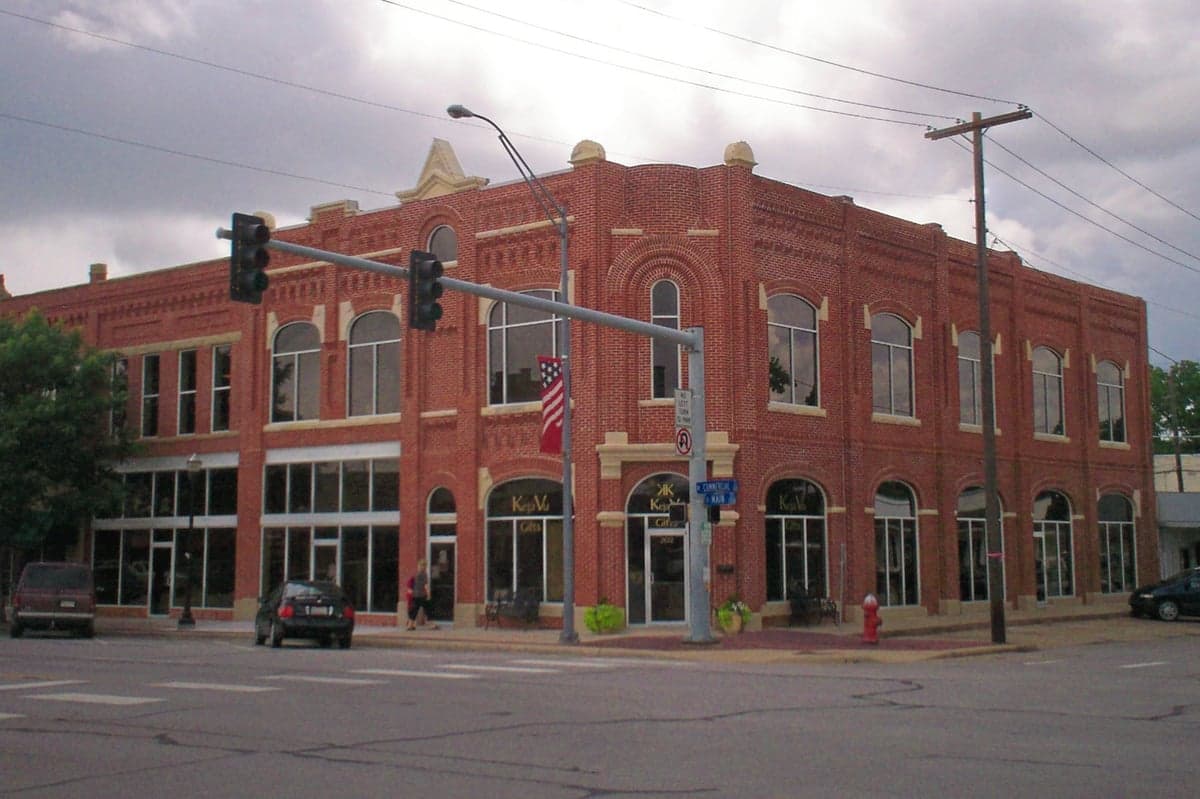
Broken Arrow was founded in 1902 as a railroad town on the Missouri-Kansas-Texas line, drawing its original population from white homesteaders and farmers moving into Indian Territory after the Dawes Act. The city’s name derives from a Creek (Muscogee) settlement, but the early Anglo settlers were primarily of German and Scots-Irish stock. The first wave of growth centered around the historic downtown district, along Main Street and the railroad corridor, where merchants and tradesmen built wood-frame houses and storefronts. By the 1920s, the discovery of oil in nearby fields brought a second wave of workers, many settling in the Flint Creek area and the South Main neighborhood. The population remained small—under 3,000—through the 1950s, as Broken Arrow stayed a quiet agricultural and oil-service town.
Modern era (post-1965)
The post-1965 era transformed Broken Arrow from a sleepy town into a fast-growing Tulsa suburb. The 1965 Immigration and Nationality Act had little direct effect here—the foreign-born share remains low—but domestic in-migration surged as families sought affordable housing and good schools. The city’s population exploded from roughly 11,000 in 1970 to over 100,000 by 2020. The Indian Springs neighborhood, developed in the 1970s and 1980s, absorbed many of these new arrivals: white middle-class families moving from Tulsa and other parts of Oklahoma. The Briarwood and Stone Wood subdivisions, built in the 1990s and 2000s, attracted a similar demographic, with larger lots and newer schools. The Hispanic population, now 11.3%, began growing in the 1990s, concentrated in the East Albany Street corridor and parts of the Lynn Lane area, where lower housing costs and construction jobs drew families from Mexico and Central America. The Black population (5.8%) and East/Southeast Asian population (3.6%) are smaller but visible, with Asian families—many of Vietnamese and Korean heritage—settling in the Hickory Hills and Glenpool border areas. The Indian-subcontinent population (1.0%) is a recent, professional cohort, often working in Tulsa’s energy and healthcare sectors and living in newer subdivisions like Shadow Mountain.
The future
The population of Broken Arrow is heading toward continued growth, but with a notable homogenization of its core demographic. The city is projected to add another 20,000–30,000 residents by 2040, driven by domestic migration from other Oklahoma towns and from Texas and Kansas. The white share (64.6%) is slowly declining as the Hispanic and Asian shares rise, but the city is not tribalizing into distinct ethnic enclaves—rather, newer subdivisions are economically stratified but racially mixed. The Hispanic community is growing steadily, with second-generation families moving into previously white-dominated neighborhoods like Briarwood. The East/Southeast Asian population is plateauing, as the initial wave of Vietnamese and Korean families has largely assimilated. The Indian-subcontinent population, though small, is growing through professional recruitment and is likely to double by 2035. The foreign-born share will remain below 10% for the foreseeable future, as Broken Arrow lacks the industrial or service-sector magnets that draw large immigrant populations.
For someone moving in now, Broken Arrow is becoming a more diverse but still overwhelmingly white and conservative suburb. The city’s identity is rooted in its family-friendly reputation, low crime, and strong schools—not in ethnic enclaves or urban energy. New arrivals will find a place where the population is growing, but the cultural character is stable, with the biggest changes coming from the gradual expansion of the Hispanic community and the professional Indian-subcontinent cohort.

* Values derived from national, state, county, city and local statistics and may differ in a specific area. Last updated: 2026-04-22T08:40:57.000Z
Narrative content on this page is AI-generated and may contain mistakes. Verify any details that matter before acting on them.
ReloMaps may earn a commission from affiliate links at no extra cost to you.

