Photo: Wikipedia
Demographics of Bryan, TX
Affluence Level in Bryan, TX
A below-average socioeconomic profile. Incomes, home values, and educational attainment trail the U.S., with higher poverty and unemployment.
People of Bryan, TX
The people of Bryan, Texas today form a majority-minority population of 86,169 that is 41.3% Hispanic, 38.0% White, 16.0% Black, and 0.8% East/Southeast Asian, with a separate 0.8% Indian-subcontinent community and 10.4% foreign-born. The city is denser and more working-class than its twin city College Station, with a distinctive identity rooted in railroad-era commerce, agricultural labor, and a historically Black east side. Bryan’s character is shaped by a long-standing Hispanic plurality, a stable Black community, and a smaller but growing professional class tied to Texas A&M University across the highway.
How the city was settled and grew
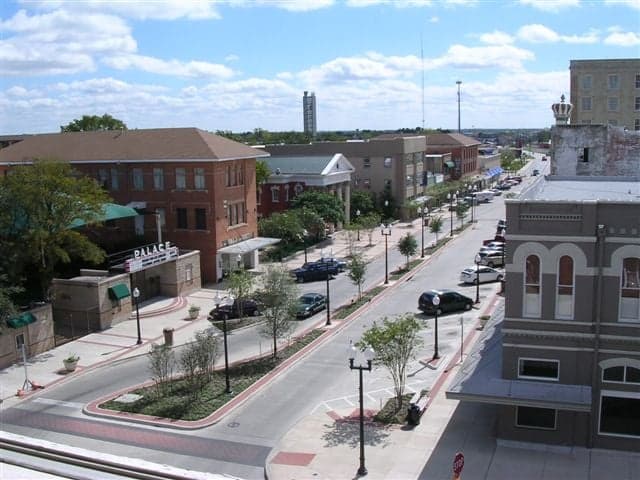
Bryan was founded in 1866 as a railroad town on the Houston and Texas Central Railway, drawing Anglo-American merchants and cotton farmers from the surrounding Brazos Valley. The original population clustered around the downtown depot, now the Bryan Downtown Historic District, where commercial buildings and Victorian homes still stand. By the 1880s, freedmen from nearby plantations established the East Bryan neighborhood, a historically Black district centered on MLK Street that became the heart of the city’s African American community, with its own schools, churches, and businesses. A second wave of Anglo settlers arrived during the early 20th century cotton boom, filling the South Brazos and West Side neighborhoods with bungalows and farmworker housing. Mexican laborers began arriving in significant numbers during the 1910s and 1920s, recruited for cotton picking and railroad maintenance, settling in the La Salle area near the rail yards and along the North Bryan corridor. By 1950, Bryan’s population was roughly 70% White, 25% Black, and 5% Hispanic, with rigid residential segregation enforced by deed restrictions and custom.
Modern era (post-1965)
The 1965 Hart-Cellar Act and the broader Civil Rights movement reshaped Bryan’s demographics. Hispanic immigration accelerated through the 1970s and 1980s, driven by agricultural labor demand and later by construction and service jobs tied to Texas A&M’s expansion. The North Bryan corridor and La Salle neighborhood became predominantly Hispanic, with new arrivals from Mexico and Central America filling rental housing and mobile home parks. Meanwhile, the Black population in East Bryan stabilized but did not grow proportionally, as younger generations moved to Houston or Dallas for professional opportunities. White flight to College Station and suburban subdivisions like Briarcrest and Castlegate accelerated after school desegregation in the 1970s, leaving Bryan’s core neighborhoods more diverse. By 2000, the city had become Hispanic-plurality for the first time. The East/Southeast Asian community (0.8%) and Indian-subcontinent community (0.8%) are small but visible, concentrated near the Texas A&M campus fringe and in newer apartment complexes along Texas Avenue, drawn by university employment and graduate programs. The foreign-born share of 10.4% is lower than the national average but higher than most Texas interior cities, reflecting ongoing immigration from Mexico and Central America.
The future
Bryan’s population is trending toward greater Hispanic majority, with the White share declining from 38% and likely to fall below 35% within a decade. The Black share of 16% is stable, sustained by natural increase and some return migration from Houston. The East/Southeast Asian and Indian communities are growing slowly from a small base, driven by Texas A&M’s international recruitment, but remain far below College Station’s shares. The city is not homogenizing; instead, it is tribalizing into distinct enclaves: East Bryan remains the Black cultural center, North Bryan and La Salle are heavily Hispanic, and the Briarcrest and Castlegate subdivisions are predominantly White and middle-class. The foreign-born population is plateauing as immigration enforcement tightens and local agricultural jobs mechanize, but second-generation Hispanic families are assimilating into the broader working and middle class. The next 10-20 years will likely see Bryan become a solidly Hispanic-majority city with a persistent Black minority and a small but stable White professional class, mirroring trends in similar Texas railroad towns like Temple and Waco.
For someone moving in now, Bryan offers a genuinely diverse, working-class community with a strong sense of place in its historic neighborhoods, but with limited upward mobility for those without college degrees. The city is becoming more Hispanic, more family-oriented, and more politically moderate, while retaining its distinct identity separate from College Station’s student-driven economy. New residents should expect a slower pace, lower housing costs, and a population that values local schools, church life, and community ties over rapid growth or cosmopolitan amenities.

* Values derived from national, state, county, city and local statistics and may differ in a specific area. Last updated: 2026-05-12T15:26:32.000Z
Narrative content on this page is AI-generated and may contain mistakes. Verify any details that matter before acting on them.
ReloMaps may earn a commission from affiliate links at no extra cost to you.

