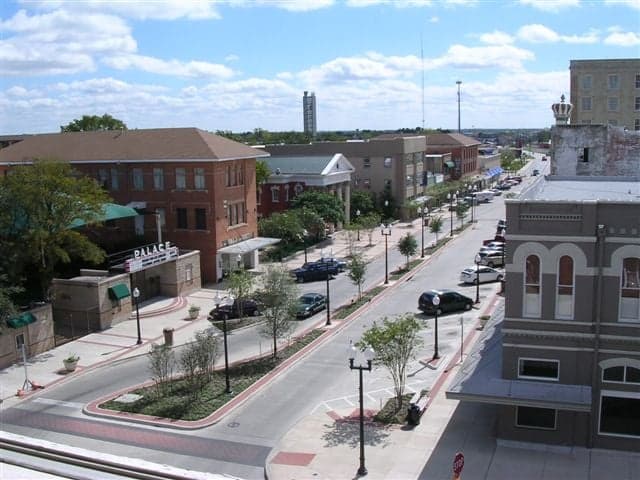
Photo: Wikipedia
Personal Sovereignty in Bryan, TX
Strong independent fundamentals that actively favor personal liberty and low regulation.
What does Personal Sovereignty tell us?
Personal Sovereignty measures your capacity for self-reliance and independence with minimal government friction. Higher scores mean fewer barriers between you and the way you want to live... but it assumes you have the space you need and good neighbors.
What does this tell us?
Personal Sovereignty measures your capacity for self-reliance and independence with minimal government friction. Higher scores mean fewer barriers between you and the way you want to live... but it assumes you have the space you need and good neighbors.
State Policy
Energy independence: Net exporter (220% of energy produced in-state)
Personal Liberty
Homesteading

Personal Liberty Analysis
Bryan, Texas offers a notably high degree of personal sovereignty compared to many urban and coastal jurisdictions, particularly for those who prioritize minimal government interference in daily life. The city’s governance, rooted in a conservative Texas tradition, generally respects individual autonomy in areas like property use, self-defense, and family decisions, though it is not a libertarian free-for-all. For the survivalist or prepper mindset, Bryan represents a solid middle ground—far enough from the regulatory overreach of cities like Austin or Houston, yet close enough to access their resources when needed. The key is understanding where local ordinances and state law align to protect your freedoms, and where they still impose constraints you’ll need to navigate.
Tax burden and regulatory posture: How Bryan compares to Texas norms
Texas has no state income tax, which is a foundational advantage for anyone seeking to keep more of their earnings for self-reliance projects, land purchases, or emergency reserves. Bryan’s total tax burden is moderate by Texas standards. The combined state and local sales tax rate is 8.25%, which is the state maximum, but property taxes are the real story. The effective property tax rate in Brazos County hovers around 2.1% of assessed value, slightly above the Texas average of roughly 1.8%. This is driven by the local school district and city services, but there is no county-level income tax or additional municipal levies. For a prepper, this means your primary ongoing cost of sovereignty is property tax—so buying land with a lower assessed value or within the county’s agricultural exemption (if you can qualify) is a smart move. Regulatory posture is generally light-touch: no citywide rent control, no burdensome business licensing for home-based enterprises, and zoning that allows for some flexibility in outbuildings and workshops. However, Bryan does enforce standard building codes and permits for new construction, so going fully off-grid with unpermitted structures will draw attention. The city’s approach is “don’t cause problems, and we won’t bother you,” which is a far cry from the invasive inspections seen in more progressive municipalities.
Self-defense and gun law specifics: What the Second Sanctuary means for residents
Texas is a constitutional carry state, meaning no permit is required to carry a handgun openly or concealed for anyone 21 or older who can legally possess a firearm. Bryan is located in Brazos County, which has been designated a Second Amendment Sanctuary by local resolution—a symbolic but meaningful stance that signals local law enforcement’s reluctance to enforce any future federal overreach on firearms. For the survivalist, this is critical: you can keep a rifle in your truck, carry a sidearm while hiking the nearby Lake Bryan trails, and maintain a home arsenal without fear of magazine capacity bans or “safe storage” mandates that would compromise rapid access. The city does have a few restrictions: discharging a firearm within city limits is generally prohibited except on designated shooting ranges or in self-defense, so zeroing your rifle at home is out. But the county has multiple outdoor ranges within 20 minutes, and private land outside city limits is unrestricted. There are no red flag laws in Texas, and no waiting periods for firearm purchases. For parents, this means you can teach your children firearm safety and marksmanship without state interference—a stark contrast to states like California or New York where such activities are heavily regulated. The legal framework here is designed to maximize individual responsibility and minimize government gatekeeping.
Self-reliance and homesteading viability: Lot sizes, zoning, and off-grid feasibility
Bryan’s zoning code allows for a surprising degree of self-sufficiency, especially in the unincorporated areas of Brazos County. Inside city limits, standard residential lots are typically 6,000 to 10,000 square feet, which is enough for a substantial garden, a chicken coop, and a small workshop. The city permits backyard chickens (hens only, no roosters) and beekeeping with minimal registration. However, if you want to go full homestead—raising goats, pigs, or larger livestock—you need to be outside city limits, where zoning is minimal. In the county, minimum lot sizes for agricultural use can be as small as one acre, and many properties in the 2-5 acre range are available within 15 minutes of downtown Bryan. Off-grid feasibility is real but requires planning. Texas has no state-level ban on rainwater collection; in fact, it incentivizes it. Solar panels are legal and common, though you’ll need to work with the local utility (Bryan Texas Utilities) if you want to stay grid-tied for net metering. Going fully off-grid with batteries and a backup generator is entirely legal, but you must still comply with septic system regulations (required for any dwelling) and well-drilling permits. The county health department is reasonable but not absent. For the prepper, the sweet spot is buying 5-10 acres in the county, drilling a well, installing solar, and building a metal shop with living quarters—this is a common pattern here, and local contractors are familiar with the work. The biggest hurdle is financing: banks are wary of off-grid properties, so cash or owner financing is often the path.
Personal liberties: Parental rights, medical autonomy, speech, and property
Texas law strongly protects parental rights, and Bryan reflects that culture. Parents have the legal authority to direct their children’s education, including homeschooling without onerous state oversight—no curriculum approval, no standardized testing requirements, and no home visits. Medical autonomy is similarly robust: there are no state mandates for COVID-19 vaccines for children or adults, and no mask mandates in schools or businesses. The Texas Medical Board has limited power to compel treatment, and the state has passed laws protecting doctors who refuse to perform procedures they find objectionable. For the survivalist, this means you can stockpile antibiotics (with a prescription from a telemedicine doc), maintain a comprehensive first-aid kit, and even pursue alternative treatments without fear of state prosecution—so long as you don’t practice medicine without a license. Free speech is protected under both the U.S. and Texas constitutions, and Bryan has no local ordinances restricting political signage, public assembly, or religious expression. Property rights are strong: Texas has no statewide zoning, and while Bryan has a city code, it is enforced with discretion. You can build fences, install security cameras, and post “no trespassing” signs without permits. The castle doctrine is in full effect, meaning you have no duty to retreat in your home or vehicle before using deadly force. For parents, this legal environment means you can raise your children with traditional values, teach them practical skills, and limit their exposure to government-run programs without penalty. The only notable constraint is that Bryan is a college town (Texas A&M), so there is a transient population that sometimes brings more progressive attitudes, but the permanent residents and local government remain firmly conservative.
Overall, Bryan’s personal sovereignty profile is strong but not extreme. It offers a better balance of freedom and practicality than most of the country, especially for those who want to live a self-reliant life without constant government interference. Compared to rural areas in the Pacific Northwest or Northeast, Bryan has lower taxes, fewer regulations, and a culture that respects individual choice. Compared to deep rural Texas counties like Llano or Mason, Bryan has more amenities and job opportunities but slightly more oversight. For the strategic relocator with a prepper mindset, Bryan is a solid base of operations—a place where you can build your homestead, keep your guns, raise your kids your way, and still drive to a Home Depot or a hospital in 15 minutes. The sovereignty here is earned through property ownership and local engagement, not granted by a distant government. If you’re looking for a place where the state is a partner, not a master, Bryan deserves a serious look.

* Values derived from national, state, county, city and local statistics and may differ in a specific area. Last updated: 2026-05-12T15:26:32.000Z
Narrative content on this page is AI-generated and may contain mistakes. Verify any details that matter before acting on them.
ReloMaps may earn a commission from affiliate links at no extra cost to you.

