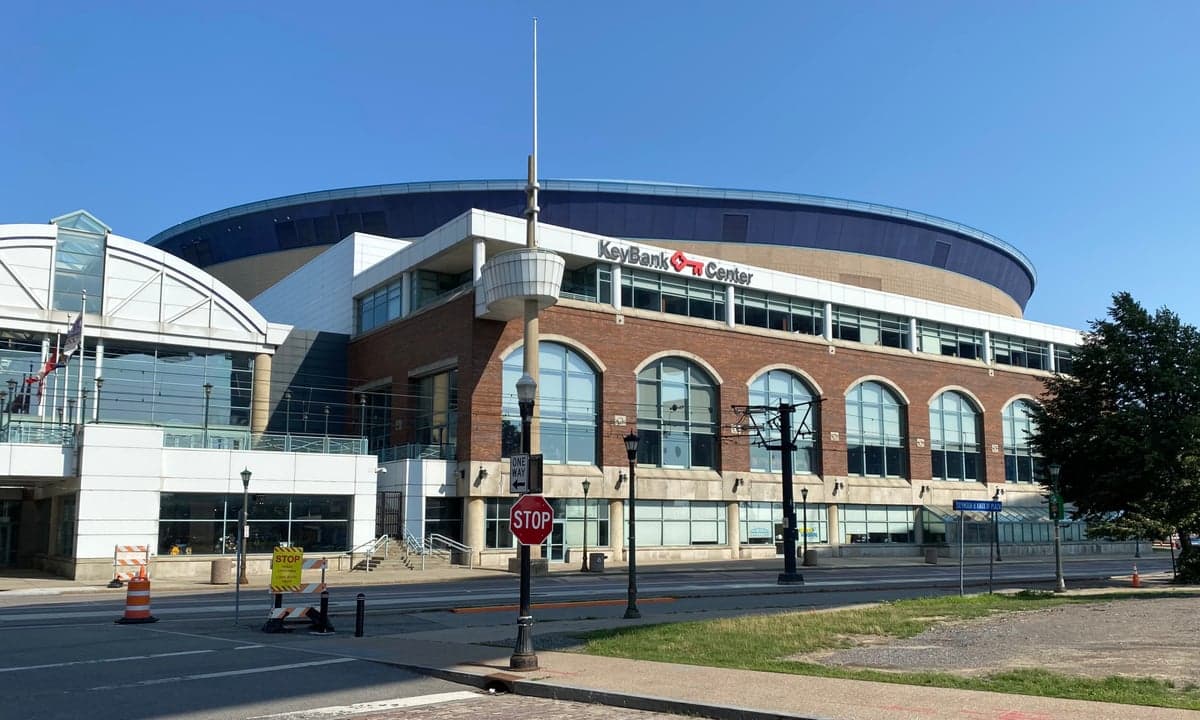
Photo: Wikipedia
Demographics of Buffalo, NY
Affluence Level in Buffalo, NY
A below-average socioeconomic profile. Incomes, home values, and educational attainment trail the U.S., with higher poverty and unemployment.
People of Buffalo, NY
The people of Buffalo, New York today number 276,397, forming a dense, historically rooted Great Lakes city with a distinctive blue-collar character and a population that is 42.7% White, 31.8% Black, 12.7% Hispanic, 4.7% Indian (subcontinent), and 3.4% East/Southeast Asian. The city is notably less foreign-born (4.9%) than the national average, reflecting a population shaped more by domestic migration and generational settlement than by recent international arrivals. With 30.3% of adults holding a college degree, Buffalo remains a predominantly working-class city with a strong sense of neighborhood identity, where ethnic enclaves from the 19th and 20th centuries still echo in the names and character of its districts.
How the city was settled and grew
Buffalo’s population history begins with the Erie Canal, completed in 1825, which transformed a small Lake Erie trading post into a boomtown. The canal made Buffalo the gateway between the Great Lakes and the Atlantic, drawing waves of immigrants who built the city’s industrial base. Germans and Irish arrived first in the 1830s–1850s, settling in the East Side and First Ward near the grain elevators and docks. The Germans established breweries and churches, while the Irish dug the canal and worked the waterfront. By the 1880s, Polish immigrants became the dominant group, creating a dense ethnic enclave in Polonia (Broadway-Fillmore), which remains one of the largest Polish-American neighborhoods in the United States. Italians followed, clustering in the West Side around Connecticut Street, and Jews from Eastern Europe settled on the Lower West Side and along the East Side’s Jefferson Avenue. The city’s population peaked at 580,132 in 1950, powered by steel mills, grain shipping, and auto manufacturing that drew Southern Blacks during the Great Migration, who settled primarily on the East Side and in the Fruit Belt neighborhood near the medical campus.
Modern era (post-1965)
After the 1965 Hart-Cellar Act, Buffalo’s foreign-born population did not surge as in coastal cities; instead, the city experienced dramatic domestic population loss. From 1950 to 2020, Buffalo lost over half its residents as deindustrialization shuttered steel plants and auto factories. The White population declined sharply through suburban flight to the Northtowns (Amherst, Tonawanda) and Southtowns (Hamburg, Orchard Park), while the Black population became the largest single group by the 1990s, concentrated on the East Side and in Masten Park. The Hispanic population, primarily Puerto Rican, grew steadily from the 1970s onward, settling on the Lower West Side and in Niagara Street corridors, where they now form a visible cultural presence. The Indian (subcontinent) population, though small at 4.7%, is a newer growth story, concentrated in the University Heights area near the University at Buffalo’s South Campus and in the North Buffalo neighborhoods. East/Southeast Asian communities (3.4%) are smaller and more dispersed, with Vietnamese and Burmese refugees arriving in the 1980s–2000s and settling in the West Side and Black Rock. The city’s foreign-born share (4.9%) is low, but the Indian and Burmese populations are the fastest-growing immigrant groups, while the White and Black shares have stabilized after decades of decline.
The future
Buffalo’s population is slowly stabilizing after decades of loss, with the 2020 census showing the first increase since 1950, driven by the Indian and Burmese refugee communities and a modest return of younger White professionals to the Elmwood Village and Allentown neighborhoods. The city is not homogenizing; instead, it is tribalizing into distinct enclaves: the East Side remains overwhelmingly Black, the Lower West Side is heavily Hispanic, University Heights is becoming a hub for Indian families, and the North Buffalo and Elmwood Village areas are increasingly White and college-educated. The Hispanic share (12.7%) is growing steadily through natural increase, while the Black share (31.8%) is plateauing. The Indian subcontinent population (4.7%) is likely to continue growing as the University at Buffalo expands its STEM programs and attracts tech workers. The East/Southeast Asian population (3.4%) is stable but not expanding rapidly. Over the next 10–20 years, Buffalo will likely remain a majority-minority city with a strong Black plurality, a growing Hispanic and Indian presence, and a White population that is older and concentrated in the more affluent north-side neighborhoods.
For someone moving in now, Buffalo is a city of distinct, historically rooted neighborhoods where demographic change is slow and incremental rather than rapid. The population is stabilizing after a long decline, and the growth areas are the Indian community in University Heights, the Hispanic community on the West Side, and young professionals in the Elmwood Village. The city remains affordable, working-class, and ethnically defined by its neighborhoods, making it a place where newcomers can find a specific community rather than a melting pot.

* Values derived from national, state, county, city and local statistics and may differ in a specific area. Last updated: 2026-04-23T02:46:01.000Z
Narrative content on this page is AI-generated and may contain mistakes. Verify any details that matter before acting on them.
ReloMaps may earn a commission from affiliate links at no extra cost to you.

