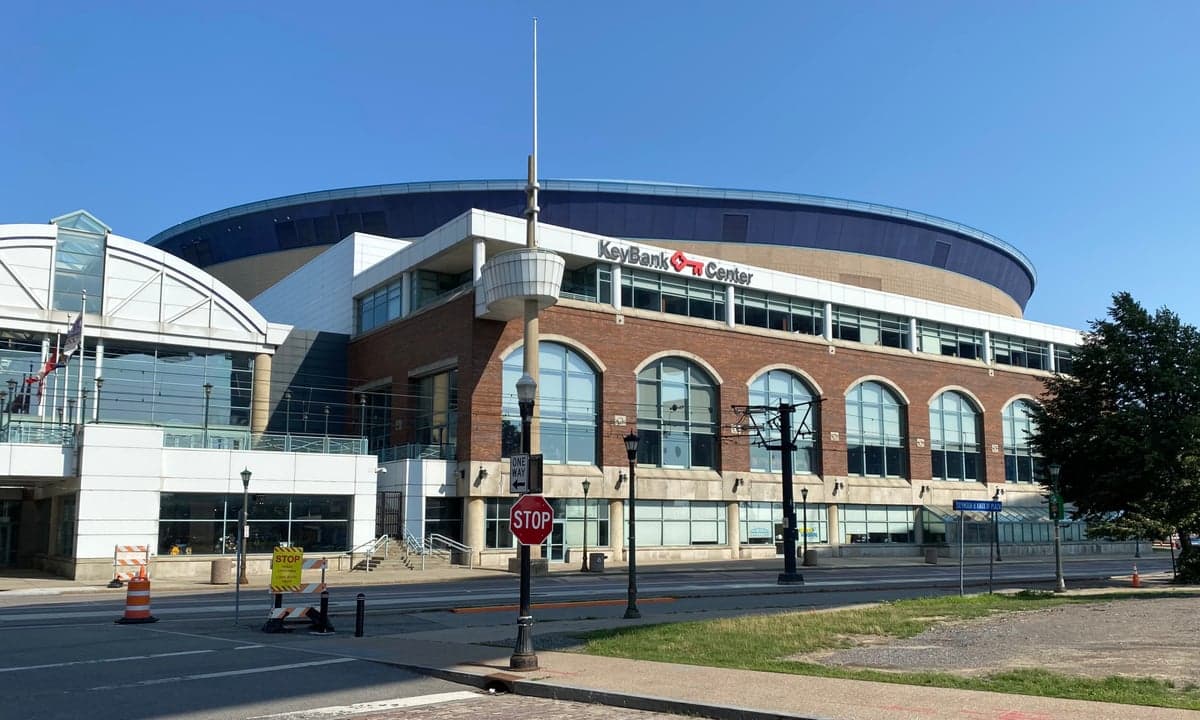
Photo: Wikipedia
Political ClimatePolitical Climate in Buffalo, NY
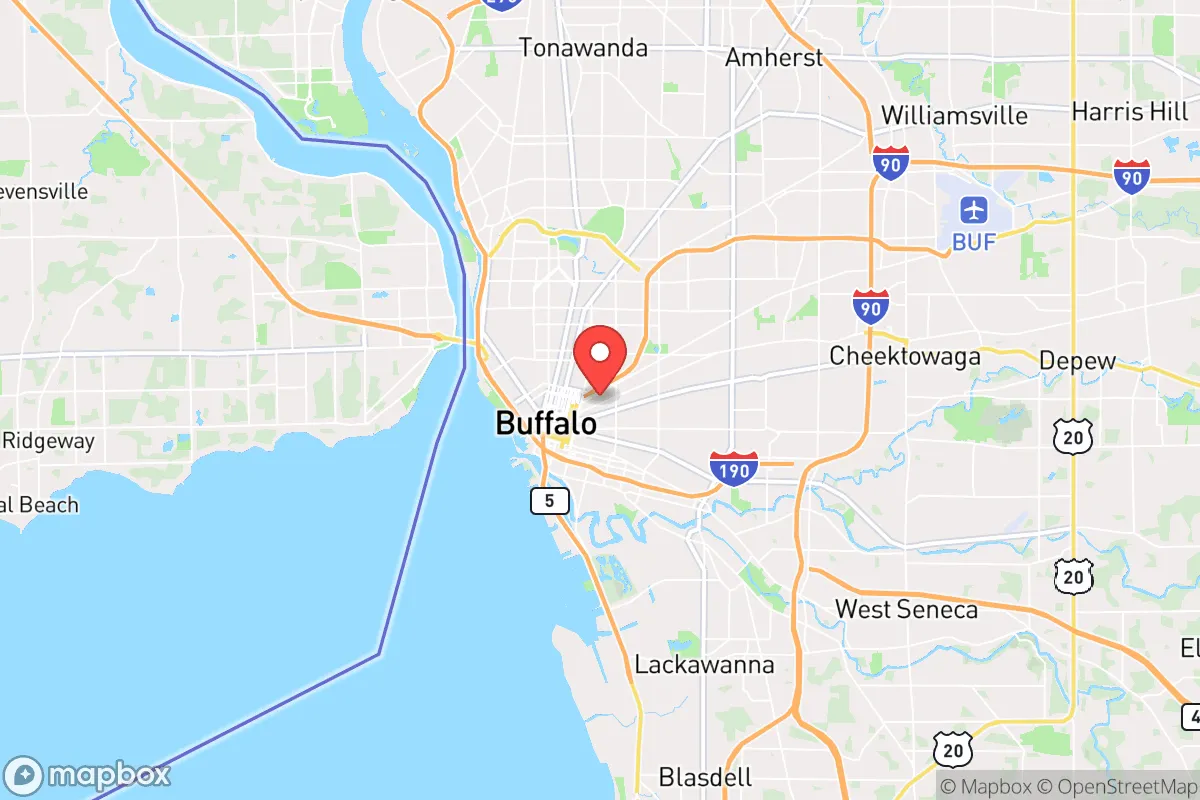
District shown is the primary district for this city’s centroid. Cities may span multiple districts.
Local Political AnalysisPolitical Analysis of Buffalo, NY
Buffalo, New York, has a Cook PVI of D+11, meaning it leans heavily Democratic, and that’s been the reality for decades. But if you’ve lived here as long as I have, you know the political climate isn’t just about party registration—it’s about a slow, steady shift away from the common-sense, blue-collar values that built this city. The old Buffalo was a place where your vote was your business and the government stayed out of your garage, your backyard, and your kids’ school. Now, you’re seeing more and more progressive policies creep in, and it’s starting to feel like the city council and county executives are more interested in social experiments than in keeping the streets safe and the taxes low.
How it compares
Drive 20 minutes east to Amherst or Clarence, and you’ll find a completely different political world. Those suburbs are still reliably red-leaning, with local governments that push back on state mandates and keep property taxes more manageable. Even Cheektowaga, just a few miles away, has a more moderate, working-class vibe where people are skeptical of the progressive agenda coming out of City Hall. The contrast is stark: Buffalo proper is becoming a laboratory for ideas like defunding the police, sanctuary city policies, and zoning changes that prioritize density over single-family homes. Meanwhile, the surrounding towns are holding the line, fighting to keep their neighborhoods quiet and their schools focused on reading, writing, and arithmetic—not social justice workshops.
What this means for residents
If you’re thinking of moving here, you need to understand what this political tilt means for your daily life. First, your property taxes are already among the highest in the nation, and the city’s appetite for new spending—on everything from bike lanes to diversity consultants—shows no sign of slowing. Second, your personal freedoms are increasingly on the line. During the pandemic, Buffalo was one of the most aggressive cities in New York with lockdowns and vaccine mandates, and that overreach hasn’t stopped. There’s a growing push to regulate everything from what you can heat your home with (natural gas bans are being discussed) to what kind of car you can drive. The city government sees itself as a nanny, not a servant. For longtime residents, it’s frustrating to watch a once-proud, self-reliant community get tangled up in red tape and ideological crusades.
On the cultural side, Buffalo still has its charms—the food scene is incredible, the architecture is world-class, and the people are genuinely friendly. But the political direction is unmistakable. The city is doubling down on progressive policies that prioritize government control over individual choice. If you value personal liberty, low taxes, and a government that stays out of your way, you’ll want to look closely at the suburbs or even consider towns like Lancaster or Hamburg, where the local politics are more aligned with traditional American values. Buffalo itself is becoming a place where your rights are secondary to the government’s vision, and that’s a tough pill to swallow for anyone who remembers when this city was about hard work and freedom, not mandates and social engineering.

State Political ClimatePolitical Climate in New York
State Political AnalysisPolitical Environment in the State
New York State has become one of the most reliably Democratic states in the country, with a partisan lean of roughly D+25 in federal elections over the past decade. The dominant coalition is a fusion of New York City’s massive urban population, downstate suburban voters, and upstate college towns, which together have delivered the state’s 28 electoral votes to Democratic presidential candidates since 1988. Over the last 20 years, the state has shifted sharply leftward, driven by the exodus of moderate Republicans from the suburbs and the consolidation of progressive power in Albany. For a conservative-leaning individual or family, the political climate here is increasingly hostile to traditional values, fiscal conservatism, and personal freedoms.
Urban vs. rural divide
The political map of New York is a tale of two states. New York City, with its 8.5 million residents, is the engine of Democratic dominance, delivering roughly 2 million more votes for Democrats than Republicans in statewide races. The five boroughs—Manhattan, Brooklyn, Queens, the Bronx, and Staten Island—are overwhelmingly blue, though Staten Island remains a rare Republican stronghold within the city. The downstate suburbs of Nassau County and Suffolk County on Long Island have been trending blue, with Nassau flipping to Biden in 2020 after supporting Trump in 2016. Upstate, the divide is stark: Buffalo, Rochester, Syracuse, and Albany are Democratic strongholds, while the vast rural stretches of the Southern Tier, North Country, and Finger Lakes are deeply red. Otsego County, for example, voted for Trump by 20 points in 2020, while neighboring Tompkins County (home to Ithaca) went for Biden by 50 points. The rural-urban split is so pronounced that a drive from Plattsburgh to Manhattan feels like crossing into a different country politically.
Policy environment
New York’s policy environment is aggressively progressive, with a tax burden that ranks among the highest in the nation. The state has a progressive income tax with rates up to 10.9% for top earners, plus some of the highest property taxes in the country—averaging over $5,000 annually per household. The regulatory posture is heavy: the state’s rent control laws, strict environmental regulations (including the Climate Leadership and Community Protection Act), and expansive labor laws (like the $15 minimum wage) create a high-cost, low-flexibility business climate. Education policy is dominated by the teachers’ unions, with school choice virtually nonexistent—New York has no voucher program and only a handful of charter schools, mostly in NYC. Healthcare is heavily regulated, with the state expanding Medicaid under the Affordable Care Act and implementing a public option for health insurance. Election laws are among the most liberal in the country: no-excuse absentee voting, early voting, same-day registration, and automatic voter registration are all in place. The state also passed the John R. Lewis Voting Rights Act in 2022, which adds additional protections against voter suppression—but critics argue it centralizes election control in Albany.
Trajectory & freedom
Over the past five years, New York has become less free across multiple dimensions. The 2019 SAFE Act was already one of the nation’s strictest gun control laws, but the 2022 Concealed Carry Improvement Act (CCIA) went further, banning firearms from “sensitive locations” like Times Square and requiring “good moral character” for permits—effectively ending most concealed carry in the state. Parental rights have been eroded: the state’s 2022 law prohibiting schools from notifying parents about a child’s gender identity or sexual orientation without the child’s consent has sparked outrage in conservative upstate communities. Medical autonomy took a hit with the state’s strict COVID-19 mandates, which included a vaccine mandate for healthcare workers that remains in place. Property rights are constrained by the state’s rent stabilization laws, which limit landlords’ ability to raise rents or evict tenants, and by the 2019 Housing Stability and Tenant Protection Act, which banned “no-fault” evictions. On the taxation front, the state’s estate tax exemption is just $6.11 million, far lower than the federal level, and the state has a “millionaire’s tax” that was made permanent in 2021. The only bright spot for freedom advocates was the 2023 repeal of the “bail reform” law that had eliminated cash bail for most non-violent offenses—but even that was a partial rollback, not a full restoration.
Civil unrest & political movements
New York has been a flashpoint for political activism on both sides. The 2020 Black Lives Matter protests in Buffalo and Rochester were particularly intense, with the Buffalo protest resulting in a widely publicized incident where police shoved a 75-year-old man. The state’s sanctuary policies—New York is a “sanctuary state” under the 2017 “Green Light Law,” which allows undocumented immigrants to obtain driver’s licenses and limits cooperation with federal immigration authorities—have made it a target for conservative backlash. In 2023, the influx of over 100,000 asylum seekers to New York City led to a political crisis, with Mayor Eric Adams declaring a state of emergency and the state deploying the National Guard. Election integrity has been a persistent concern: the 2020 election saw widespread use of mail-in ballots, and the state’s lax voter ID laws (no ID required to vote) have fueled distrust among conservatives. Secessionist rhetoric is alive in the “New York State of Mind” movement, which advocates for upstate counties to break away from downstate control—though it remains a fringe idea. Visible flashpoints include the annual “March for Our Lives” gun control rallies in Albany and the “Stand Up for Science” protests in Ithaca.
Projection
Over the next 5-10 years, New York is likely to become even more progressive. Demographic trends are working against conservatives: the state’s population is declining overall, but the losses are concentrated in upstate rural areas, while New York City and its suburbs continue to grow. In-migration from abroad—particularly from Asia and Latin America—is adding to the Democratic base, while domestic out-migration to Florida, Texas, and the Carolinas is draining the state of moderate and conservative voters. The state’s political leadership, from Governor Kathy Hochul to the supermajority Democratic legislature, shows no appetite for moderation. Expect further gun control measures (like a ban on semi-automatic rifles), expansion of rent control, and possibly a state-level single-payer healthcare system. The only wild card is a potential federal shift: if a conservative Supreme Court strikes down some of New York’s gun laws or immigration policies, it could slow the leftward march. But for someone moving in now, the trajectory is clear: expect higher taxes, more regulation, and less personal freedom in the decade ahead.
For a conservative-leaning individual or family, the bottom line is that New York is a state where your political voice will be drowned out by the urban majority, your tax dollars will fund policies you oppose, and your personal freedoms—especially around guns, education, and medical choices—will be increasingly constrained. If you’re considering a move here, be prepared to live in a red pocket like Staten Island, Otsego County, or parts of the Southern Tier, and to fight for every inch of ground in local school board and county elections. Otherwise, the state’s political climate will feel like a constant headwind against your values.
* Values derived from national, state, county, city and local statistics and may differ in a specific area. Last updated: 2026-04-23T02:46:01.000Z
Narrative content on this page is AI-generated and may contain mistakes. Verify any details that matter before acting on them.
ReloMaps may earn a commission from affiliate links at no extra cost to you.

