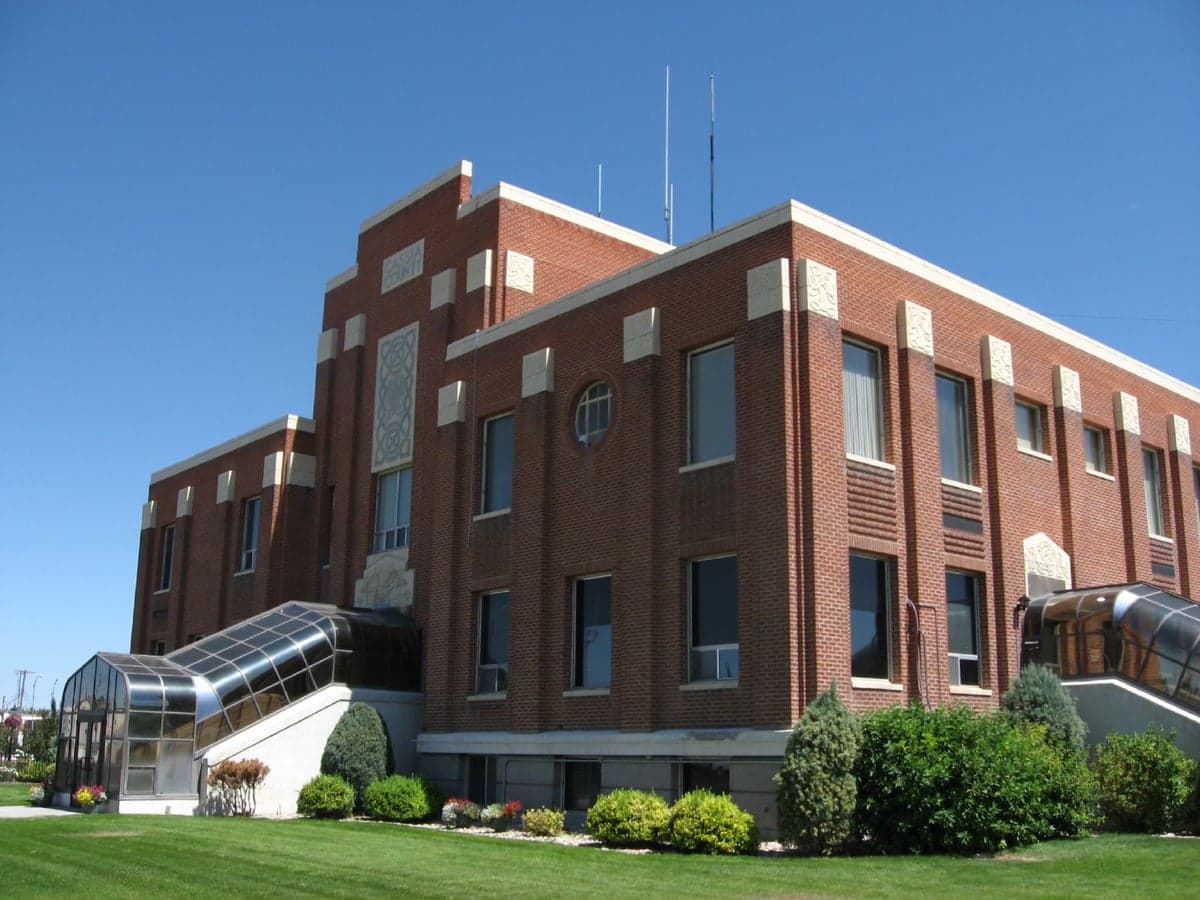
Photo: Wikipedia
Demographics of Burley, ID
Affluence Level in Burley, ID
A middle-class area roughly in line with national averages across income, home values, education, and employment.
People of Burley, ID
Burley, Idaho, is a small agricultural city of 11,721 residents where the population is nearly evenly split between a white non-Hispanic majority (54.5%) and a large Hispanic community (38.0%), creating a distinctive bicultural character rare in the rural Intermountain West. The city’s identity is rooted in its role as a regional processing and transportation hub for the Magic Valley’s dairy, potato, and sugar beet industries, giving it a working-class, family-oriented feel. With only 16.1% of adults holding a college degree, Burley remains a place where blue-collar livelihoods and tight-knit neighborhoods define daily life, rather than the amenity-driven growth seen in Boise or Coeur d’Alene. The foreign-born population stands at 8.4%, a figure driven almost entirely by immigration from Latin America, with negligible East/Southeast Asian (0.3%) and Indian subcontinent (0.1%) communities.
How the city was settled and grew
Burley was founded in 1905 as a railroad town on the Oregon Short Line, built specifically to serve the newly irrigated farmland of the Minidoka Project, a federal reclamation scheme that turned the arid Snake River plain into productive cropland. The original settlers were predominantly white homesteaders from the Midwest and Great Plains—many of German, Scandinavian, and English stock—who arrived to farm potatoes, sugar beets, and alfalfa. These early families built the Historic Downtown Burley district along Overland Avenue, where brick storefronts and the old railroad depot still stand, and established the North Burley neighborhood of modest frame houses near the rail yards. A second wave came during the 1910s and 1920s, when Basque sheepherders from the Pyrenees were recruited to work the open ranges; their descendants remain a small but distinct presence, with the Basque Block area near 15th Street once housing boarding houses and social halls. The city’s population grew steadily through the mid-20th century, reaching about 6,000 by 1960, as the agricultural economy expanded with the rise of large-scale dairy operations and the J.R. Simplot Company’s potato-processing plants.
Modern era (post-1965)
The most significant demographic shift in Burley began in the 1970s and accelerated through the 1990s, as the region’s meatpacking and food-processing industries—particularly the Simplot plant and later the McCain Foods facility—drew a large labor force from Mexico and Central America. This wave settled primarily in the South Burley neighborhoods south of the railroad tracks, an area of older, smaller homes and rental duplexes that became the city’s Hispanic heartland. By 2000, the Hispanic share of Burley’s population had risen to roughly 25%, and it has since climbed to 38.0%, with many families moving into the West End district near the high school and the newer subdivisions along Hiland Avenue. Unlike some rural Idaho towns where immigrant populations remain transient, Burley’s Hispanic community has put down deep roots: Spanish-language signage is common along Overland Avenue, and the annual Fiesta de la Independencia celebration draws thousands. The white non-Hispanic population, meanwhile, has aged and thinned in the original East Burley neighborhoods near the golf course, where many longtime residents have retired or moved to larger cities. The city’s Black population is effectively zero (0.0%), and East/Southeast Asian and Indian communities are statistically negligible, making Burley’s diversity almost entirely a story of white and Hispanic coexistence.
The future
Burley’s population is projected to continue growing slowly, driven by natural increase within the Hispanic community and by continued in-migration of Latin American workers for the dairy and processing industries. The city is not homogenizing into a single cultural bloc; rather, it is tribalizing into distinct enclaves, with South Burley becoming more uniformly Hispanic and North Burley and East Burley remaining predominantly white non-Hispanic. The Hispanic share is likely to approach or exceed 50% within the next 10–15 years, given the younger median age of that population (roughly 26, compared to 42 for white non-Hispanics) and higher birth rates. This demographic trajectory is already reshaping local politics and schools: the Burley School District now offers dual-language programs, and city council races increasingly reflect the growing Latino electorate. However, the city’s low college attainment rate (16.1%) and reliance on low-wage processing jobs may limit upward mobility, potentially creating a bifurcated community where economic opportunity lags behind cultural integration.
For someone moving to Burley today, the city offers a stable, family-oriented environment with a genuine bicultural character—but one where the two main groups still largely live in separate neighborhoods and social circles. The next decade will test whether Burley evolves into a more integrated community or solidifies its current pattern of parallel enclaves. Either way, the city’s future is unmistakably tied to the Hispanic families who now form its demographic engine, while the white non-Hispanic population continues a slow, steady decline in relative share.

* Values derived from national, state, county, city and local statistics and may differ in a specific area. Last updated: 2026-04-21T09:15:47.000Z
Narrative content on this page is AI-generated and may contain mistakes. Verify any details that matter before acting on them.
ReloMaps may earn a commission from affiliate links at no extra cost to you.

