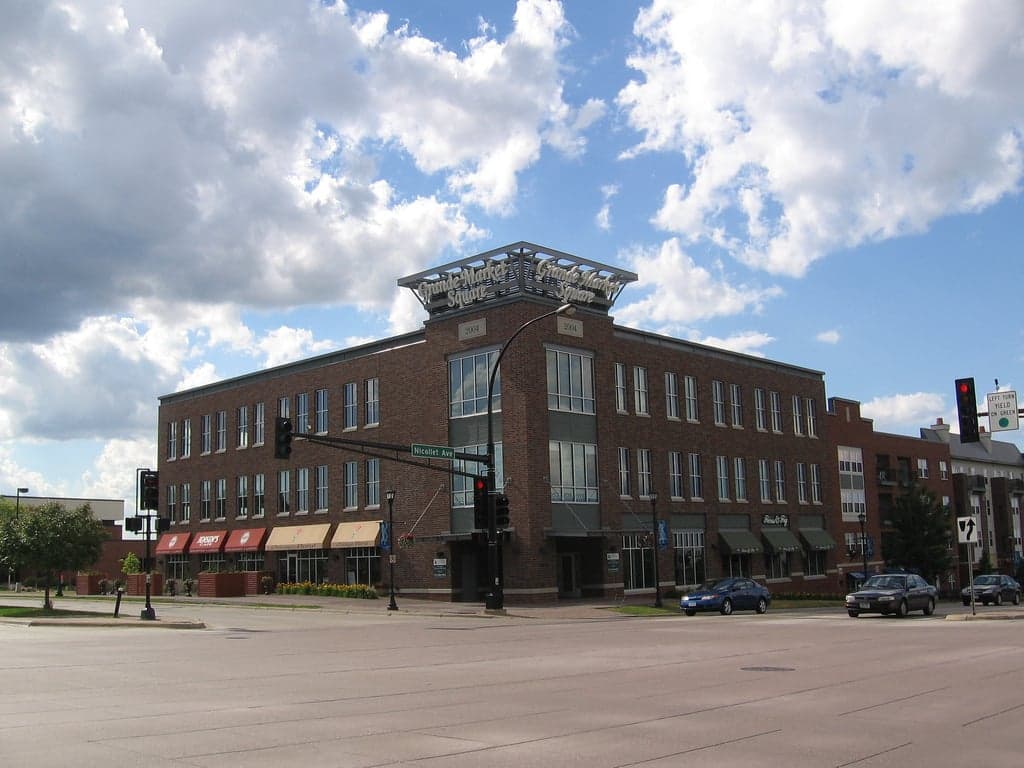
Photo: Wikipedia
Demographics of Burnsville, MN
Affluence Level in Burnsville, MN
A middle-class area roughly in line with national averages across income, home values, education, and employment.
People of Burnsville, MN
Burnsville, Minnesota, is a suburban city of 64,295 residents that blends a historically white, working-to-middle-class foundation with growing racial and ethnic diversity. Its population is denser than many Twin Cities suburbs, with a distinctive identity shaped by rapid post-war development, a wave of domestic in-migration, and more recent immigrant settlement. Today, the city is 63.2% white, 12.8% Black, 11.9% Hispanic, and 4.3% East/Southeast Asian, with a foreign-born share of 5.0% and a college-educated rate of 39.9%.
How the city was settled and grew
Burnsville was originally settled in the 1850s by European-American farmers, primarily of German and Irish stock, drawn by the fertile land along the Minnesota River. The city remained a small agricultural hamlet for over a century, with no significant population boom until the 1960s. The turning point came with the construction of Interstate 35W, which connected Burnsville directly to Minneapolis and St. Paul. This highway access, combined with the post-World War II housing shortage and the availability of cheap farmland, triggered a suburban explosion. The first major residential developments were in Burnsville Center area and the Heart of the City district, where single-family homes on large lots attracted young white families from Minneapolis and inner-ring suburbs. These early subdivisions—such as Burnsville Highlands and Skyline Village—were built by local contractors and filled with veterans using GI Bill mortgages. By 1970, the population had surged from 6,000 to over 19,000, almost entirely white and native-born.
Modern era (post-1965)
The post-1965 Immigration and Nationality Act had a delayed effect on Burnsville. Unlike Minneapolis or St. Paul, which saw immediate waves of Hmong, Somali, and Latino arrivals, Burnsville remained overwhelmingly white through the 1980s. The first significant non-white influx began in the 1990s, driven by two forces: Black families moving out of Minneapolis’s North Side and Powderhorn neighborhoods seeking better schools and lower crime, and Hispanic workers drawn to construction and service jobs in the booming south metro. These groups settled primarily in the Burnsville Center area and the apartment-heavy corridors along County Road 42 and Nicollet Avenue. The 2000s saw a second wave: East/Southeast Asian families (Hmong and Vietnamese) moved into the Burnsville Highlands and Skyline Village neighborhoods, often buying the aging 1960s ramblers that original white owners were selling. The Black population grew from 2.3% in 1990 to 12.8% today, while the Hispanic share rose from 1.5% to 11.9%. The East/Southeast Asian share reached 4.3%, and the Indian subcontinent population (0.9%) remains small but concentrated in the newer Burnsville Center area townhomes. Notably, the white population declined from 92% in 1990 to 63.2% today, a shift driven by both out-migration of older white residents to exurbs and natural demographic change.
The future
Burnsville’s population is heading toward a more diverse but potentially fragmented future. The city is not homogenizing; rather, distinct enclaves are solidifying. The Heart of the City district and the older Burnsville Highlands remain predominantly white and older (median age 42), while the apartment zones near County Road 42 are increasingly Hispanic and Black, with younger families. The East/Southeast Asian population appears to be plateauing, as second-generation Hmong and Vietnamese families move to larger homes in Lakeville or Prior Lake. The Indian subcontinent community, though small, is growing slowly via professional migration to nearby medical and tech employers. The Hispanic population is the fastest-growing segment, driven by both births and continued migration, and is likely to reach 15-18% by 2035. The Black population is stable but aging, with fewer new arrivals from Minneapolis. The foreign-born share (5.0%) is low compared to the metro average (10.5%), suggesting Burnsville is not a primary immigrant gateway but a secondary settlement area for families already established in the U.S.
For a conservative-leaning mover today, Burnsville offers a middle ground: a historically stable, family-oriented suburb that is becoming more diverse without the rapid demographic churn of inner-ring suburbs. The city’s identity is shifting from a white, post-war bedroom community to a multi-ethnic, multi-generational suburb where enclaves coexist but do not fully integrate. New arrivals should expect a place where neighborhood character varies significantly by block, and where the schools, parks, and civic life reflect a population that is still negotiating its new composition.

* Values derived from national, state, county, city and local statistics and may differ in a specific area. Last updated: 2026-05-04T11:23:12.000Z
Narrative content on this page is AI-generated and may contain mistakes. Verify any details that matter before acting on them.
ReloMaps may earn a commission from affiliate links at no extra cost to you.

