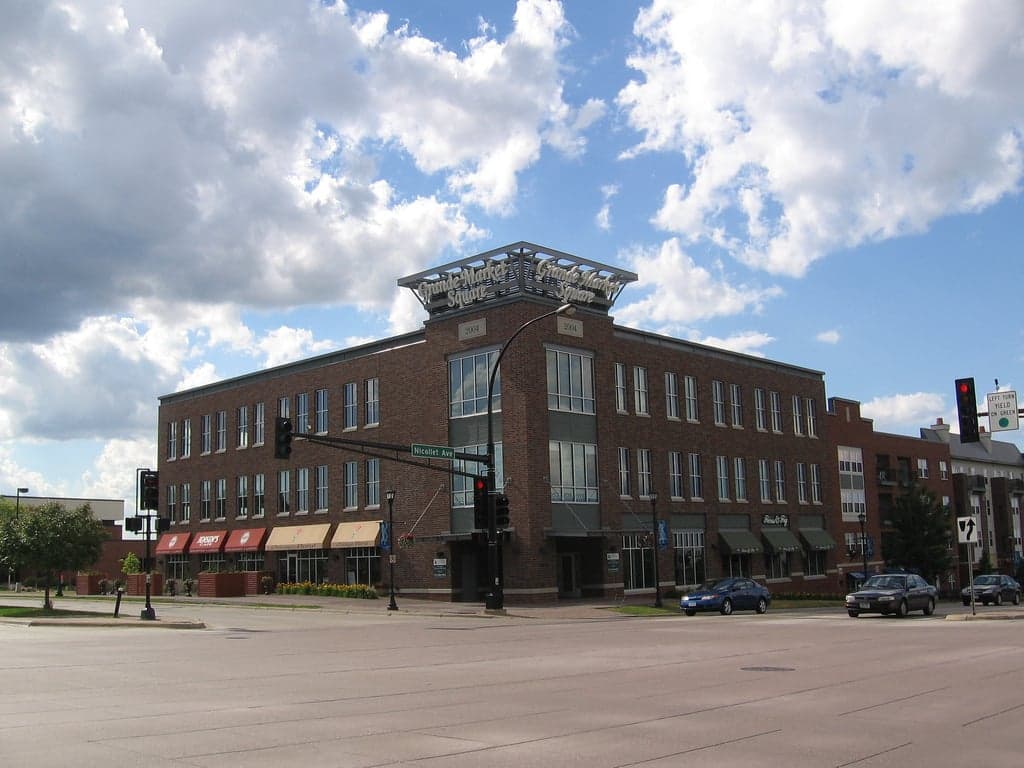
Photo: Wikipedia
Personal Sovereignty in Burnsville, MN
Viable for self-reliance. Generally workable, though some barriers may limit total independence.
What does Personal Sovereignty tell us?
Personal Sovereignty measures your capacity for self-reliance and independence with minimal government friction. Higher scores mean fewer barriers between you and the way you want to live... but it assumes you have the space you need and good neighbors.
What does this tell us?
Personal Sovereignty measures your capacity for self-reliance and independence with minimal government friction. Higher scores mean fewer barriers between you and the way you want to live... but it assumes you have the space you need and good neighbors.
State Policy
Energy independence: Importer (20% of energy produced in-state)
Personal Liberty
Homesteading

Personal Liberty Analysis
For the individualist or prepper evaluating Burnsville, Minnesota, personal sovereignty is a mixed bag—a suburban environment where state-level overreach often trumps local common sense, yet where the practical realities of daily life still offer more breathing room than the urban core of Minneapolis. Located just 15 miles south of downtown, Burnsville sits in Dakota County, a region that leans left politically but retains a suburban character that can be leveraged for self-reliance. The key tension here is between Minnesota’s aggressive state mandates—on taxes, energy, and health—and the quieter, more autonomous pockets of life that a strategic resident can carve out. For a conservative-leaning individual or family, the calculus involves accepting certain unavoidable state impositions while maximizing the local advantages of space, zoning, and community networks.
Tax burden and regulatory posture: how much the state takes and controls
Minnesota’s tax burden is among the highest in the nation, and Burnsville residents feel it directly. The state income tax tops out at 9.85%, and combined state and local sales tax in Burnsville hits 8.125% (7.125% state plus 1% local). Property taxes in Dakota County are also above average, with effective rates around 1.2% of assessed home value—meaning a $350,000 home costs roughly $4,200 annually in property tax alone. This is a significant bite for anyone trying to maximize retained earnings for prepping or investment. On the regulatory front, Minnesota’s state government is aggressive: it mandates renewable energy standards, imposes strict building codes (including energy efficiency requirements that can complicate off-grid setups), and has a robust environmental review process that can delay or block property modifications. For the survivalist, this means any major project—like installing solar panels, building a root cellar, or adding a workshop—requires navigating permits and inspections that a freer state like Texas or South Dakota would not demand. The silver lining is that Burnsville itself, as a suburb, has a more business-friendly local government than Minneapolis, with fewer commercial restrictions and a relatively streamlined process for home-based businesses. Still, the overall regulatory posture is one of control, not liberty.
Self-defense and gun law specifics: what you can and cannot do
Minnesota is a “shall issue” state for concealed carry permits, and Burnsville residents can obtain one with a clean background check and a short training course. However, the state has no constitutional carry—you must have a permit to carry a handgun in public. This is a significant limitation for the prepper who believes in immediate self-defense without government permission. Furthermore, Minnesota has a “red flag” law (Extreme Risk Protection Order) that allows law enforcement or family members to petition a court to temporarily remove firearms from an individual deemed a risk. For those wary of government overreach, this is a direct threat to the Second Amendment, as it bypasses due process. On the positive side, Burnsville has no additional local gun restrictions beyond state law, and the city’s police department is generally professional and responsive. Long guns and shotguns are unregulated for purchase (no permit needed), and private sales of firearms are legal without a background check, though the state does require a permit to purchase for handguns. For the survivalist, the takeaway is that you can own and store a substantial arsenal at home, but carrying in public and defending against potential state confiscation are real concerns. The political climate in Dakota County is mixed, but the state legislature in St. Paul is reliably anti-gun, meaning future restrictions are likely.
Self-reliance and homesteading viability: lot sizes, zoning, and off-grid feasibility
Burnsville is a fully developed suburb, so the classic homesteading dream of a large, self-sufficient property is limited. Most residential lots are between 0.2 and 0.5 acres, with a few older neighborhoods offering up to 1 acre. Zoning is primarily R-1 (single-family residential), which allows for gardens, small sheds, and even chickens (with a permit and setback requirements), but prohibits livestock like goats or pigs. Off-grid living is essentially illegal: the city requires connection to municipal water and sewer, and building codes mandate grid-tied electrical systems for new construction. Solar panels are allowed but must be grid-tied and permitted. For the serious prepper, this means Burnsville is not a place to bug out to—it’s a place to bug in, with a focus on urban survival skills: food storage, water filtration, and community networking. The nearby Minnesota River Valley offers some public land for foraging and hunting (deer, turkey), but it’s not private acreage. If self-reliance means growing your own food and storing supplies, Burnsville works. If it means living off the land with no municipal ties, look farther out to rural Dakota County or beyond, where 5-10 acre parcels are available and zoning is looser.
Personal liberties: parental rights, medical autonomy, speech, and property
Minnesota’s state government has been aggressive in asserting control over personal liberties, and Burnsville residents are subject to these mandates. Parental rights have been eroded: the state passed a law in 2023 that allows minors to consent to certain medical procedures (including gender-affirming care) without parental notification, and the state’s education system has adopted curriculum that many conservatives find intrusive. Medical autonomy is also constrained—Minnesota has strict vaccine mandates for school attendance (though exemptions exist for medical and conscientious reasons), and during the COVID-19 pandemic, the state imposed mask mandates and business closures that were among the longest in the Midwest. Free speech is protected under the First Amendment, but local governments in the Twin Cities metro have been known to enforce “disorderly conduct” ordinances broadly, and the state has no specific protections for political speech on private property (e.g., signs). Property rights are relatively strong: eminent domain is rarely used for private development, and homeowners can generally modify their property within code. However, the state’s environmental regulations can restrict land use, and the city’s nuisance ordinances can be used to target prepper activities like storing large quantities of supplies or maintaining an unkempt yard. For the individualist, the message is clear: you have more freedom than in Minneapolis or St. Paul, but less than in rural Minnesota or states like Idaho or Montana.
Overall, Burnsville offers a moderate level of personal sovereignty for a suburban environment, but it is not a haven for the hardcore survivalist or libertarian. The state’s high taxes, aggressive gun control, and intrusive mandates on health and education are significant drawbacks. However, the city’s suburban character—with decent lot sizes, a functional police force, and a relatively stable community—provides a foundation for self-reliance if you are willing to work within the system. Compared to the urban core, Burnsville is a clear step up in autonomy. Compared to rural Minnesota or freer states, it is a compromise. For the conservative individual or family who values community and infrastructure but wants to maintain a prepper mindset, Burnsville is viable—but only if you are prepared to navigate the state’s overreach and focus on what you can control within your own four walls.

* Values derived from national, state, county, city and local statistics and may differ in a specific area. Last updated: 2026-05-04T11:23:12.000Z
Narrative content on this page is AI-generated and may contain mistakes. Verify any details that matter before acting on them.
ReloMaps may earn a commission from affiliate links at no extra cost to you.

