Photo: Wikipedia
Demographics of Shasta County
Affluence Level in Shasta County
A middle-class area roughly in line with national averages across income, home values, education, and employment.
People of Shasta County
Shasta County’s 181,554 residents today form a predominantly white, native-born population with a strong rural and small-town character, anchored by the city of Redding and shaped by waves of 19th-century mining and railroad settlement, 20th-century timber and government employment, and a recent influx of retirees and remote workers seeking lower costs and outdoor recreation. The county is notably less diverse than California as a whole, with a foreign-born share of just 2.3% and a population that is 76.5% white, 11.3% Hispanic, 2.9% East and Southeast Asian, and 0.9% Black. Distinctive markers include a politically conservative tilt, a high proportion of veterans, and a cultural identity rooted in logging, ranching, and the Sacramento River corridor. Understanding who lives here now requires tracing the human history that deposited each group in specific towns and neighborhoods.
Settlement & growth (pre-1960)
The original inhabitants of Shasta County were the Wintu, Yana, and Pit River peoples, who lived along the Sacramento River, the McCloud River, and the foothills for thousands of years before European contact. Their population was decimated by disease and violence following the California Gold Rush, and today their descendants are concentrated in small tribal communities around Redding and the remote communities of Montgomery Creek and Big Bend. Spanish and Mexican colonization had minimal direct impact on Shasta County, as the area lay north of the mission system and was only lightly traversed by fur trappers and explorers.
The first major American settlement wave began in the late 1840s and 1850s with the California Gold Rush. Prospectors, overwhelmingly white men from the eastern United States, Europe, and China, poured into the Trinity River and Sacramento River drainages. The boomtowns of Shasta (now a state historic park), French Gulch, and Horsetown sprang up almost overnight. Chinese miners, who arrived in significant numbers during the 1850s and 1860s, worked claims abandoned by white miners and built small Chinatowns in Shasta and later in Redding. Anti-Chinese violence and the 1882 Chinese Exclusion Act drove most of this population out by the early 20th century, leaving little trace today.
The second major wave came with the construction of the Central Pacific Railroad in the 1870s and 1880s. The railroad terminus at Redding, founded in 1872, transformed the county seat from the declining mining town of Shasta to the new commercial hub. Irish and Italian laborers, many of whom had worked on the railroad, settled in Redding and along the rail corridor through Anderson and Cottonwood. The timber industry, which boomed from the 1890s through the 1950s, drew additional white migrants from the Midwest and the South, particularly from Missouri, Arkansas, and Oklahoma. These Dust Bowl-era migrants, often called "Okies," settled in mill towns like Burney, McArthur, and Fall River Mills, where logging and sawmill work provided steady employment through the mid-20th century.
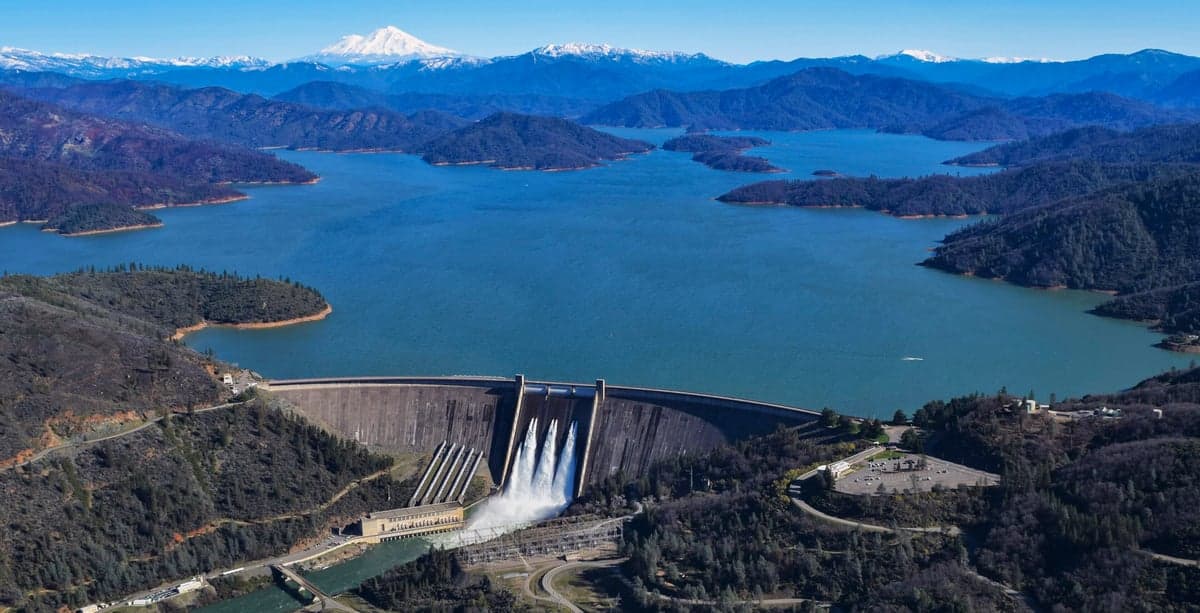
By 1960, Shasta County was overwhelmingly white, native-born, and working-class, with a population of about 50,000. The economy was dominated by timber, mining, and agriculture, with a growing government presence from the Shasta-Trinity National Forest and the Bureau of Reclamation, which built Shasta Dam in the 1940s. The county had no significant Black population, as the timber and mining industries were largely closed to African Americans, and the small Hispanic population was mostly composed of seasonal agricultural workers in the Sacramento Valley bottomlands around Anderson and Cottonwood.
Modern era (post-1965)
The 1965 Hart-Cellar Act had a muted effect on Shasta County compared to coastal California. The county’s foreign-born share remained below 3% through the 1990s and into the 2020s, as the region lacked the large-scale agricultural or manufacturing employers that drew immigrants to the Central Valley or the tech economy that attracted them to the Bay Area. The most notable post-1965 immigrant group has been East and Southeast Asian communities, particularly Hmong and Vietnamese refugees who resettled in Redding and Anderson in the 1980s and 1990s, drawn by affordable housing and existing social service networks. Today, the 2.9% Asian share is concentrated in Redding’s central neighborhoods and in the unincorporated community of Palo Cedro, where several Hmong families have established small farms.
The more transformative demographic shift since 1965 has been domestic migration. Beginning in the 1970s and accelerating after 2000, Shasta County has attracted white retirees and families from the Bay Area, Los Angeles, and the Central Valley, seeking lower housing costs, a slower pace of life, and outdoor recreation on Shasta Lake and the Trinity River. This influx has driven population growth from about 100,000 in 1970 to 181,554 today, and has shifted the county’s political character to the right, as many newcomers were fleeing high taxes and liberal policies in coastal areas. The Hispanic population has grown from under 5% in 1980 to 11.3% today, driven by natural increase and migration from Mexico and Central America into the agricultural and service sectors. These Hispanic residents are concentrated in Redding’s south side, in Anderson, and in the rural community of Cottonwood, where they work in construction, landscaping, and food processing.
Suburbanization has reshaped the county’s settlement pattern. Redding has grown outward from its historic downtown into master-planned subdivisions in the west and south, while the smaller towns of Shasta Lake City and Palo Cedro have absorbed much of the new housing. The Black population remains tiny at 0.9%, concentrated in Redding’s older neighborhoods and in the prison workforce at the California Correctional Center in Susanville (just outside the county line). The Indian subcontinent population, at 0.4%, is a recent arrival, mostly professionals working in healthcare at Redding’s Mercy Medical Center and Shasta Regional Medical Center.
The future
Shasta County is projected to become slightly more diverse over the next 10-20 years, but it will remain one of California’s least diverse counties. The Hispanic share is expected to rise to 15-18% by 2040, driven by higher birth rates and continued migration into service and construction jobs. The East and Southeast Asian share may grow modestly as Hmong families expand and as some Asian professionals are drawn to Redding’s lower cost of living. The white share will decline gradually, from 76.5% today to perhaps 70-72% by 2040, but whites will remain the overwhelming majority. The Black and Indian subcontinent populations will likely remain below 2% each, as the county lacks the economic magnets or social networks that attract larger numbers of these groups.
Domestic migration will continue to shape the county more than international immigration. Retirees and remote workers from the Bay Area and Southern California will keep arriving, drawn by housing prices that are roughly half of the state median. This will further concentrate growth in Redding, Palo Cedro, and the Shasta Lake corridor, while the more remote towns of Burney, Fall River Mills, and McArthur will see slower growth or population decline as timber jobs continue to shrink. The county’s cultural identity will remain strongly conservative, rural, and outdoor-oriented, though the influx of coastal transplants may gradually moderate some of its most libertarian edges. For someone moving in now, Shasta County offers a predominantly white, native-born community with a stable population, low crime relative to the state average, and a lifestyle centered on the Sacramento River, Shasta Lake, and the surrounding national forest.

* Values derived from national, state, county, city and local statistics and may differ in a specific area. Last updated: 2026-10-17T13:24:08.000Z
Narrative content on this page is AI-generated and may contain mistakes. Verify any details that matter before acting on them.
ReloMaps may earn a commission from affiliate links at no extra cost to you.

