
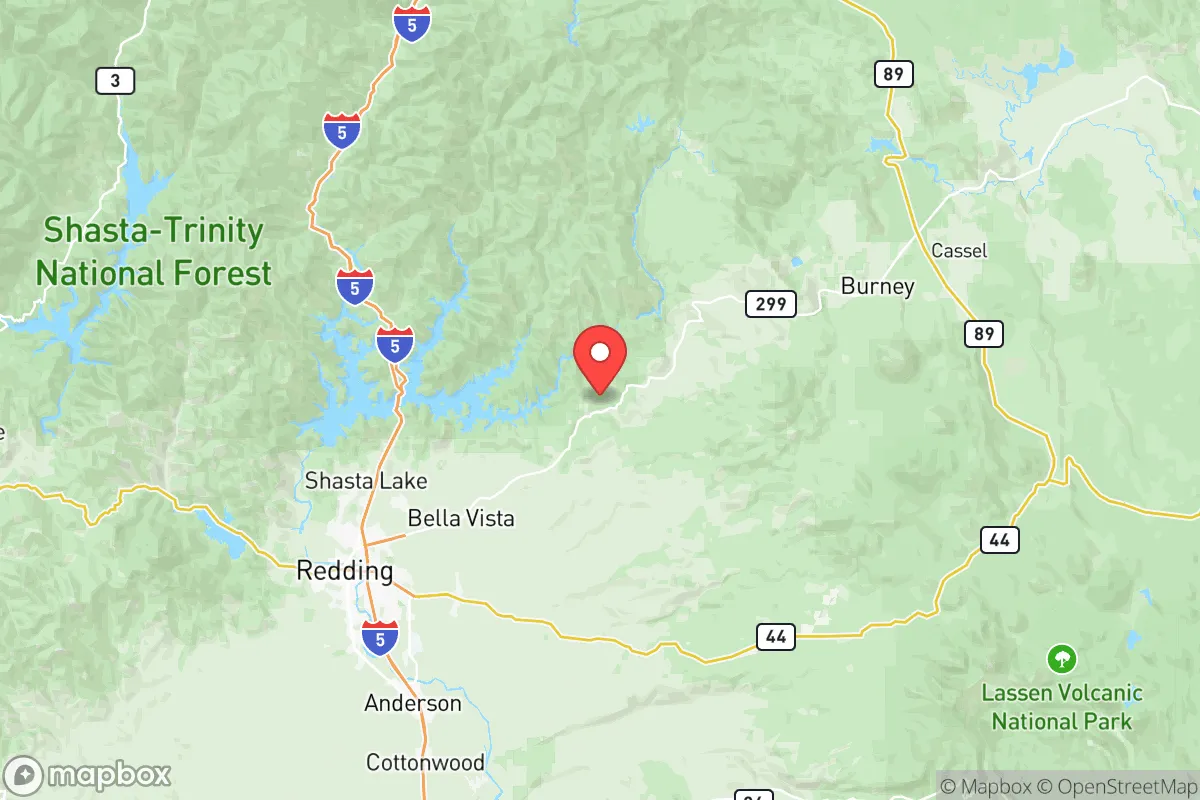
Photo: Wikipedia
Personal Sovereignty in Shasta County
Viable for self-reliance. Generally workable, though some barriers may limit total independence.
What does Personal Sovereignty tell us?
Personal Sovereignty measures your capacity for self-reliance and independence with minimal government friction. Higher scores mean fewer barriers between you and the way you want to live... but it assumes you have the space you need and good neighbors.
What does this tell us?
Personal Sovereignty measures your capacity for self-reliance and independence with minimal government friction. Higher scores mean fewer barriers between you and the way you want to live... but it assumes you have the space you need and good neighbors.
State Policy
Energy independence: Importer (33% of energy produced in-state)
Personal Liberty
Homesteading

Personal Liberty Analysis
Shasta County offers one of the strongest personal sovereignty environments in California, combining a low-tax, light-touch regulatory posture with a deeply ingrained culture of self-reliance and firearm ownership. While still subject to California’s statewide legal framework, the county’s local governance, zoning flexibility, and community norms create a markedly different autonomy landscape than what residents would find in the Bay Area or Sacramento. For individuals and families who prioritize personal freedom, the trade-off is clear: Shasta County provides a high degree of day-to-day independence, but with the understanding that state-level constraints on medical autonomy, parental rights, and certain business regulations remain in place.
Tax burden and regulatory posture in Shasta County vs. the rest of California
Shasta County benefits from California’s Proposition 13 property tax caps, which limit annual increases to 2% and keep effective rates around 0.77% of assessed value — roughly half the national average. The county’s sales tax rate is 7.25%, the state minimum, and there are no local add-ons for transit or special districts, unlike in Sacramento or Los Angeles. The regulatory environment is notably lighter than in coastal California: the county’s planning department processes building permits for single-family homes in 30–60 days on average, compared to 6–12 months in the Bay Area. Redding, the county seat, has a streamlined permitting process for accessory dwelling units (ADUs) and small-scale agricultural structures, while the unincorporated areas around Anderson and Cottonwood have even fewer zoning hurdles. However, the California Environmental Quality Act (CEQA) still applies to larger projects, and state-level energy codes mandate solar panels on new homes. For a conservative-leaning reader, the local posture is permissive within state constraints — a pragmatic balance rather than a libertarian free-for-all.
Self-defense and gun law specifics in Shasta County
Shasta County is one of California’s most firearm-friendly jurisdictions, with a sheriff’s office that historically issued concealed carry permits (CCWs) under a “shall-issue” policy even before the 2022 Supreme Court decision in Bruen forced the rest of the state to follow suit. As of 2025, the Shasta County Sheriff’s Office processes CCW applications in roughly 60–90 days, with no requirement for a “good cause” statement beyond self-defense. The county has a strong culture of open carry of unloaded firearms and private property carry without a permit. However, California’s statewide restrictions still apply: magazine capacity is limited to 10 rounds, assault weapon bans are enforced, and all firearm purchases require a 10-day waiting period and a background check through the California Department of Justice. Redding has multiple gun shops and indoor ranges, while the rural areas around Shasta Lake and Burney have a higher density of private shooting ranges and BLM land where recreational shooting is legal. For a reader prioritizing self-defense, Shasta County offers the best legal environment available in California, but it is not a constitutional carry state — that distinction belongs to Alaska, Arizona, and others.
Self-reliance and homesteading viability: lot sizes, zoning, and off-grid feasibility
Shasta County is one of the most viable places in California for off-grid and homesteading lifestyles, particularly in the unincorporated areas. Minimum lot sizes in agricultural zones (A-1 and A-2) are 5 to 20 acres, depending on the specific district, and the county allows for a wide range of agricultural uses including livestock, orchards, and small-scale farming without special permits. In the areas around Palo Cedro, Millville, and the remote stretches of Highway 299 east of Redding, off-grid living is common: residents use solar panels, propane, and well water, and the county does not require connection to municipal utilities. The county’s building code allows for composting toilets and greywater systems under state Title 24 standards, and there are no county-level bans on rainwater catchment. However, California’s statewide fire codes require defensible space (100 feet of clearance around structures) and may restrict certain building materials in high-fire zones, which cover much of the county. For a family seeking a self-sufficient homestead, the area between Redding and Burney offers the best combination of affordable land (prices around $5,000–$15,000 per acre as of 2025) and permissive zoning. The city of Redding itself is more restrictive, with standard suburban lot sizes of 6,000–10,000 square feet and requirements for sewer connections.
Personal liberties: parental rights, medical autonomy, speech, and property
Shasta County’s school board elections and local government have been a battleground for parental rights, with the Shasta County Board of Education and the Redding Elementary School District both adopting policies that emphasize parental notification for curriculum changes and opt-out rights for sex education. In 2023, the county’s Board of Supervisors passed a resolution declaring Shasta County a “Second Amendment Sanctuary” and a “Constitutional County,” though these resolutions are symbolic and do not override state law. Medical autonomy is constrained by California’s statewide vaccine mandates for school attendance and healthcare workers, but Shasta County has a higher rate of medical freedom advocacy than most of the state, with several private clinics offering direct-primary-care models and cash-pay services. Property rights are strong: the county does not have rent control, and there are no county-level eviction moratoria. Free speech is robust, with regular political rallies at the Redding Civic Auditorium and the Shasta County Courthouse lawn, and the local newspaper, the Redding Record Searchlight, covers both sides of the political spectrum. For a reader who values personal liberties, Shasta County offers a local environment that is significantly more permissive than California’s urban centers, but it operates within the state’s legal framework — a fact that frustrates some residents but is unlikely to change without statewide reform.
Overall, Shasta County ranks among the top 5% of California counties for personal sovereignty, alongside Modoc, Siskiyou, and Tehama counties. For a conservative-leaning individual or family, the trade-off is clear: you gain a low-tax, gun-friendly, homestead-viable environment with strong local governance, but you remain subject to California’s statewide constraints on medical choice, educational curriculum, and firearm capacity. Compared to states like Texas or Idaho, Shasta County’s sovereignty is moderate; compared to the Bay Area or Los Angeles, it is a significant upgrade. The county’s real appeal lies in its balance: enough local autonomy to make self-reliant living practical, without the extreme isolation of more remote counties. For the reader who wants to live independently but still have access to a regional hospital, an airport, and a Costco, Shasta County is a strong contender.

* Values derived from national, state, county, city and local statistics and may differ in a specific area. Last updated: 2026-10-17T13:24:08.000Z
Narrative content on this page is AI-generated and may contain mistakes. Verify any details that matter before acting on them.
ReloMaps may earn a commission from affiliate links at no extra cost to you.

