 Popular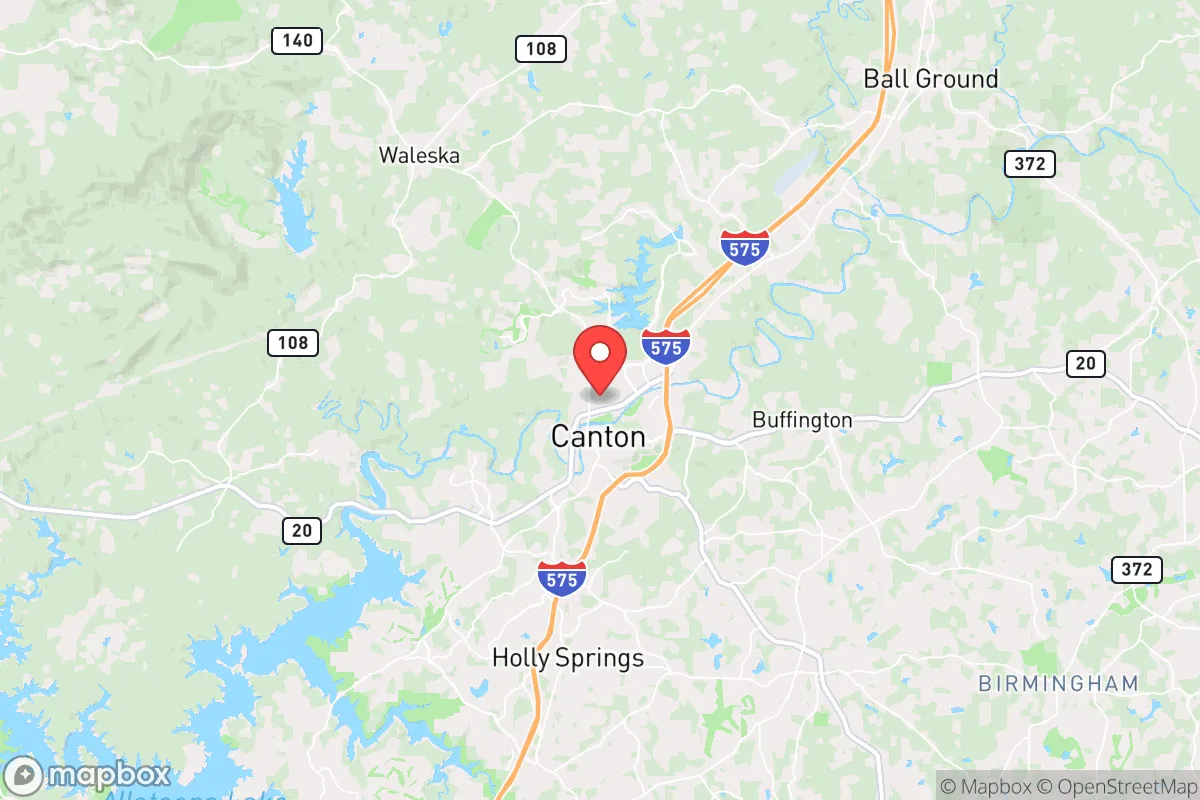
Photo: Wikipedia
Political ClimatePolitical Climate in Canton, GA
District shown is the primary district for this city’s centroid. Cities may span multiple districts.
Local Political AnalysisPolitical Analysis of Canton, GA
Canton, Georgia, sits squarely in a deep-red corner of the state, with a Cook PVI of R+12 that tells you pretty much everything you need to know about its default political lean. This isn't a purple suburb that flips back and forth; it's a place where conservative values have been the bedrock for generations, and the local culture still reflects that. But I've lived here long enough to see the winds shifting, and while the overall vote totals still favor Republicans by a wide margin, the character of that conservatism is changing, and not always for the better.
How it compares
Drive ten minutes south to Woodstock, and you'll feel a noticeable difference. Woodstock has gotten younger, more transient, and its politics have drifted toward a softer, more suburban Republicanism—think tax cuts but also bike lanes and splash pads. Head east to Cumming in Forsyth County, and you're back in solid, traditional conservative territory, though even there you see more development pressure. The real contrast is north toward Jasper or Ellijay, where the politics are still the old-school, "leave me alone" kind. Canton used to feel like that, but the Atlanta exurban sprawl has brought in folks from Cobb and Fulton counties who bring their voting habits with them. The R+12 PVI masks a growing internal tension: the native population still votes red, but the newcomers are more likely to be "never Trump" Republicans or even soft Democrats, especially in the newer subdivisions off Highway 20.
What this means for residents
For now, the practical effect is that Canton's local government remains reliably conservative on the big-ticket items—zoning, taxes, and law enforcement. The city council and county commission still lean heavily Republican, so you're not seeing the kind of progressive overreach you'd find in Atlanta proper or even parts of Cobb County. But the warning signs are there. The school board has become a battleground, with activists pushing for more "equity" initiatives and critical race theory-adjacent curriculum changes. The library board has faced pressure to remove certain books. These fights are still being won by the conservative side, but they're happening at all, which would have been unthinkable fifteen years ago. The biggest concern I have is the creeping influence of state-level policies that feel like they're eroding local control—things like the state preempting local zoning decisions or mandating certain tax policies. It's a double-edged sword: sometimes that preemption protects us from Atlanta's nonsense, but other times it feels like the state is telling us how to run our own town.
Culturally, Canton still has a strong sense of community rooted in church, family, and the outdoors. The Riverstone Corners development brought in some chain restaurants and a movie theater, but the real heart of the town is still the Friday night football games at Cherokee High and the Saturday morning farmers market. The biggest policy distinction you'll notice is the near-total absence of any serious gun control measures—this is a place where open carry is common and nobody bats an eye. Property taxes are reasonable compared to metro Atlanta, and the county has resisted the kind of density-boosting zoning changes that have transformed Alpharetta and Johns Creek. Looking ahead, the long-term trajectory depends on how many more people move here from blue areas. If the growth continues at the current pace, Canton will likely become a more moderate Republican stronghold, but it will take a generation of demographic change to flip it blue. For now, if you value personal freedom, low taxes, and a government that mostly stays out of your business, Canton is still a good bet—just keep an eye on the school board meetings.

State Political ClimatePolitical Climate in Georgia
State Political AnalysisPolitical Environment in the State
Georgia has transformed from a reliably Republican stronghold into a fiercely competitive battleground state over the past two decades, with a partisan lean that now sits roughly even at the presidential level—Donald Trump lost the state by just 11,779 votes in 2020, and the 2024 race was similarly tight. The dominant coalition is a tug-of-war between a rapidly growing, diverse, and increasingly progressive Atlanta metro area and a deeply conservative, rural, and exurban base that still holds significant legislative power. Over the last 10-20 years, the trajectory has been a slow but steady shift leftward in statewide races, driven by massive in-migration and demographic change, though the state legislature and many local governments remain firmly in Republican hands.
Urban vs. rural divide
The political map of Georgia is a textbook case of the urban-rural chasm. The Atlanta metro—including Fulton, DeKalb, Cobb, and Gwinnett counties—is the engine of Democratic growth. Fulton County alone delivered over 70% of its vote to Joe Biden in 2020, while DeKalb was even higher at 85%. These counties are home to a diverse, college-educated, and increasingly professional-class population that has shifted the state's center of gravity. In contrast, rural and small-town Georgia remains overwhelmingly Republican. Counties like Murray in the northwest and Bacon in the southeast routinely vote 80%+ for GOP candidates. The exurban ring—places like Forsyth County (north of Atlanta) and Paulding County (west)—have become critical battlegrounds; Forsyth, once a GOP stronghold, has seen its margins shrink as new residents arrive, while Paulding still leans red but is under pressure. The 2020 flip of Cobb County (a longtime GOP suburb that went for Biden) was a seismic event, signaling that the Atlanta suburbs are no longer safe for conservatives. Meanwhile, cities like Augusta and Savannah are Democratic-leaning but not as lopsided as Atlanta, while Columbus and Macon are more purple, with significant Black populations that vote reliably Democratic.
Policy environment
Georgia's policy environment is a mixed bag for conservatives. On the plus side, the state has a flat income tax rate of 5.49% (down from 6% in recent years, with a path to 4.99% by 2029), a relatively low corporate tax rate, and a right-to-work law that keeps union influence weak. The state legislature has passed significant election integrity measures, including the controversial SB 202 (2021), which tightened voter ID requirements for absentee ballots, limited drop box locations, and restricted third-party ballot collection—moves that conservatives see as necessary safeguards but progressives decry as suppression. On education, Georgia has a robust school choice program with the Georgia Promise Scholarship Act (2024), offering up to $6,500 for private school tuition or homeschooling expenses, a major win for parental rights. However, the state's healthcare landscape is a concern: Georgia did not expand Medicaid under the ACA, leaving a coverage gap, but the state's private insurance market is relatively stable. On the downside, the state has a burdensome occupational licensing regime that can stifle entrepreneurship, and property taxes can be high in fast-growing counties like Forsyth and Gwinnett, where assessments have soared. The regulatory posture is generally business-friendly, but local zoning battles in the Atlanta suburbs are increasingly contentious, with some cities pushing for more density and transit-oriented development that can feel like government overreach to homeowners.
Trajectory & freedom
Georgia's trajectory on personal freedom is a two-steps-forward, one-step-back story. On the positive side, the state has expanded gun rights significantly: the 2022 "Constitutional Carry" law (SB 319) allows permitless carry of a concealed firearm for anyone 21 or older who can legally possess a gun, a clear win for Second Amendment advocates. Parental rights were bolstered by the 2022 "Parents' Bill of Rights" (HB 1178), which requires schools to notify parents of any changes to a student's mental, emotional, or physical health—a direct response to concerns about transgender policies in schools. On the concerning side, the state has seen a push for more government control in the name of "public health" and "equity." Atlanta's city government has implemented a $15 minimum wage for city contractors and pushed for more progressive zoning, while the state legislature has preempted local efforts to raise the minimum wage or enact rent control—a mixed bag that limits local freedom but preserves a uniform business climate. Medical freedom took a hit during the pandemic, with Governor Brian Kemp issuing a state of emergency and mask mandates, though he later resisted federal vaccine mandates. The 2023 "Medical Freedom" law (HB 128) prohibits employers from requiring COVID-19 vaccines as a condition of employment, a step in the right direction. Property rights are generally strong, but the state's use of eminent domain for economic development projects (like the proposed "Cop City" training center in Atlanta) has sparked fierce opposition from both left-wing activists and some property-rights conservatives.
Civil unrest & political movements
Georgia has been a flashpoint for political activism on both sides. The 2020 election aftermath saw massive protests in Atlanta, including the "Stop the Steal" rally that turned violent at the state capitol, and the ongoing "Cop City" controversy in DeKalb County has drawn national attention, with activists occupying the proposed training site and clashing with law enforcement. Immigration politics are heated: Georgia is not a sanctuary state, and the 2011 HB 87 law (the "Arizona-style" immigration law) remains on the books, though parts were struck down. However, the Atlanta metro has seen a surge in immigrant populations, particularly in Gwinnett County, which has a large Hispanic and Asian community, leading to cultural tensions and debates over local enforcement. Election integrity remains a hot-button issue: the 2021 voting law (SB 202) sparked boycotts from Major League Baseball (moving the All-Star Game out of Atlanta) and corporate backlash, but it has also energized conservative voters who see it as a necessary safeguard. Organized activist movements include the Georgia Republican Assembly (a conservative grassroots group) and the Georgia Democratic Party's coordinated campaign machine, which has become a national model for voter mobilization. Visible flashpoints for a new resident would include the ubiquitous political yard signs in suburban neighborhoods, the constant presence of campaign canvassers in swing districts, and the occasional protest at the state capitol in downtown Atlanta.
Projection
Over the next 5-10 years, Georgia is likely to become even more competitive, with a slight but persistent drift leftward at the statewide level. The Atlanta metro's growth shows no signs of slowing, with Forsyth County and Gwinnett County adding tens of thousands of new residents annually, many of whom are from blue states like California and New York. This demographic shift will continue to pressure Republican margins in the suburbs, potentially flipping more counties like Cherokee or Henry in the next decade. However, the rural and exurban base remains deeply entrenched, and the state legislature's Republican supermajority (thanks to gerrymandered maps) will likely persist, creating a divided government where the governor's mansion and the legislature are controlled by different parties. The wild card is the 2026 gubernatorial election: if a Democrat wins, expect a push for Medicaid expansion, more progressive tax policies, and a rollback of some election integrity measures. If a Republican holds the seat, the state will likely continue its current path of incremental conservative reforms. For a conservative moving in now, the practical takeaway is that Georgia offers a relatively low-tax, gun-friendly, and business-friendly environment, but the political winds are shifting, and the cultural landscape in the Atlanta suburbs is becoming more diverse and less reliably conservative. The state is not Texas or Florida in terms of conservative dominance, but it's also not California—it's a true battleground where your vote matters more than almost anywhere else.
Bottom line for a new resident: Georgia is a state in transition. If you're a conservative looking for a place where your values are still reflected in state law—especially on guns, taxes, and parental rights—you'll find a lot to like here. But be prepared for a political environment that is increasingly contested, with the Atlanta metro driving a cultural shift that may feel like a slow-motion takeover. The key is to choose your location wisely: the exurbs like Forsyth and Paulding still offer a conservative lifestyle, while the core Atlanta counties are firmly progressive. Your vote will count, your voice will be heard, and the fight for the state's soul is far from over.
* Values derived from national, state, county, city and local statistics and may differ in a specific area. Last updated: 2026-04-30T00:36:50.000Z
Narrative content on this page is AI-generated and may contain mistakes. Verify any details that matter before acting on them.
ReloMaps may earn a commission from affiliate links at no extra cost to you.

