Photo: Wikipedia
Demographics of Caribou, ME
Affluence Level in Caribou, ME
A middle-class area roughly in line with national averages across income, home values, education, and employment.
People of Caribou, ME
The people of Caribou, Maine, today number 7,427, forming a tight-knit, predominantly white community with a distinct Franco-American heritage. With 92.3% of residents identifying as white and only 1.0% foreign-born, the city retains a strong ethnic homogeneity that traces directly to its 19th-century settlement patterns. The population is older and less diverse than the national average, with 28.6% holding a college degree, reflecting a community shaped by agricultural roots and a quiet, self-reliant character.
How the city was settled and grew
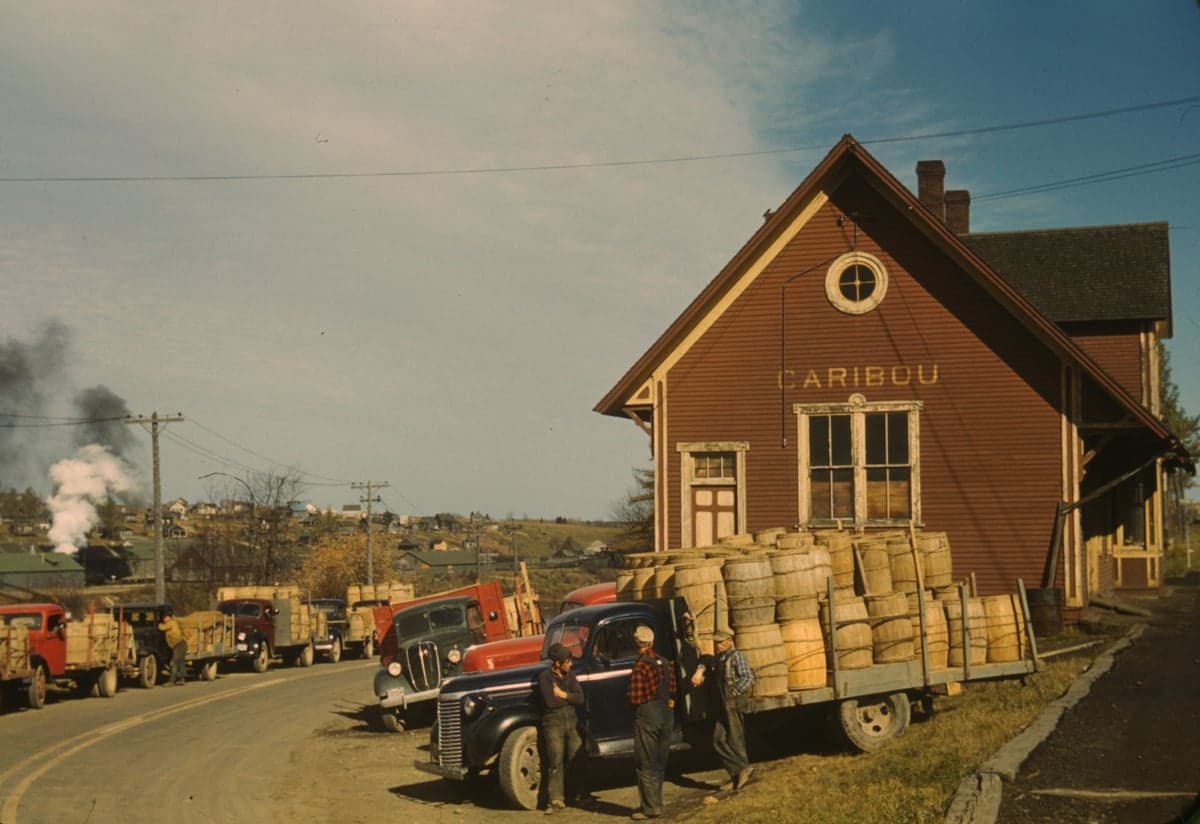
Caribou was originally settled in the 1820s and 1830s by Anglo-American farmers from downstate Maine and New Hampshire, drawn by the fertile Aroostook River valley and the promise of land grants under the Maine Land Office. The first wave built homesteads in what is now the Washburn District and along the Sweden Street corridor, establishing a rural Yankee Protestant foundation. The defining demographic shift came after 1850, when French-Canadian families from Quebec—seeking work in the region's burgeoning lumber camps and potato fields—began arriving in large numbers. They clustered in the Lower Main Street area and around the Grimes Mill neighborhood, building St. Luke's Catholic Church (1871) as their cultural anchor. By 1900, French-speakers made up roughly half the population, and the city's character became a blend of Yankee thrift and Catholic, French-speaking traditions. The potato boom of the early 20th century solidified this Franco-American majority, with families like the Michauds and Dions becoming prominent in the Lyndon Street and Prospect Street neighborhoods.
Modern era (post-1965)
After the 1965 Immigration and Nationality Act, Caribou saw virtually no new international immigration. The foreign-born share remained below 2%, and the city's racial composition stayed overwhelmingly white. Instead, the major demographic story was out-migration: young adults left for college or jobs in Portland, Bangor, or southern New England, while retirees stayed put. The Collins Pond area and newer subdivisions off Route 161 attracted a small number of domestic in-migrants—mostly retirees from southern Maine and out-of-state hunters drawn by low property taxes and outdoor recreation. The Hispanic population (0.3%), Black population (0.1%), and East/Southeast Asian population (0.5%) are negligible and largely transient, often tied to seasonal agricultural work or the Loring Commerce Centre (the former Air Force base). The Indian subcontinent population is 0.0%. The city's Franco-American identity remains strong, though younger generations are increasingly English-dominant and secular.
The future
Caribou's population is projected to continue a slow decline, mirroring the broader Aroostook County trend of aging and out-migration. The city is not homogenizing further—it is already extremely homogeneous—but it is tribalizing in the sense that the remaining population is increasingly older, more rooted, and less connected to national demographic shifts. The small East/Southeast Asian community (0.5%) is stable but not growing, and no new immigrant enclaves are forming. The Washburn District and Lower Main Street neighborhoods are seeing the most turnover as older homeowners sell to younger families from within the region, but these buyers are overwhelmingly white and often have local roots. Over the next 10-20 years, Caribou will likely become even older and more dependent on healthcare and service-sector employment, with any population growth tied to remote workers or retirees seeking low-cost living—not to immigration or ethnic diversification.
For someone moving in now, Caribou offers a stable, culturally cohesive community where Franco-American traditions still shape daily life, but where economic opportunity is limited and the population is shrinking. The city is becoming a quieter, older version of itself—a place for those who value deep roots, low crime, and a slower pace over diversity or urban amenities.

* Values derived from national, state, county, city and local statistics and may differ in a specific area. Last updated: 2026-04-22T22:23:04.000Z
Narrative content on this page is AI-generated and may contain mistakes. Verify any details that matter before acting on them.
ReloMaps may earn a commission from affiliate links at no extra cost to you.

