
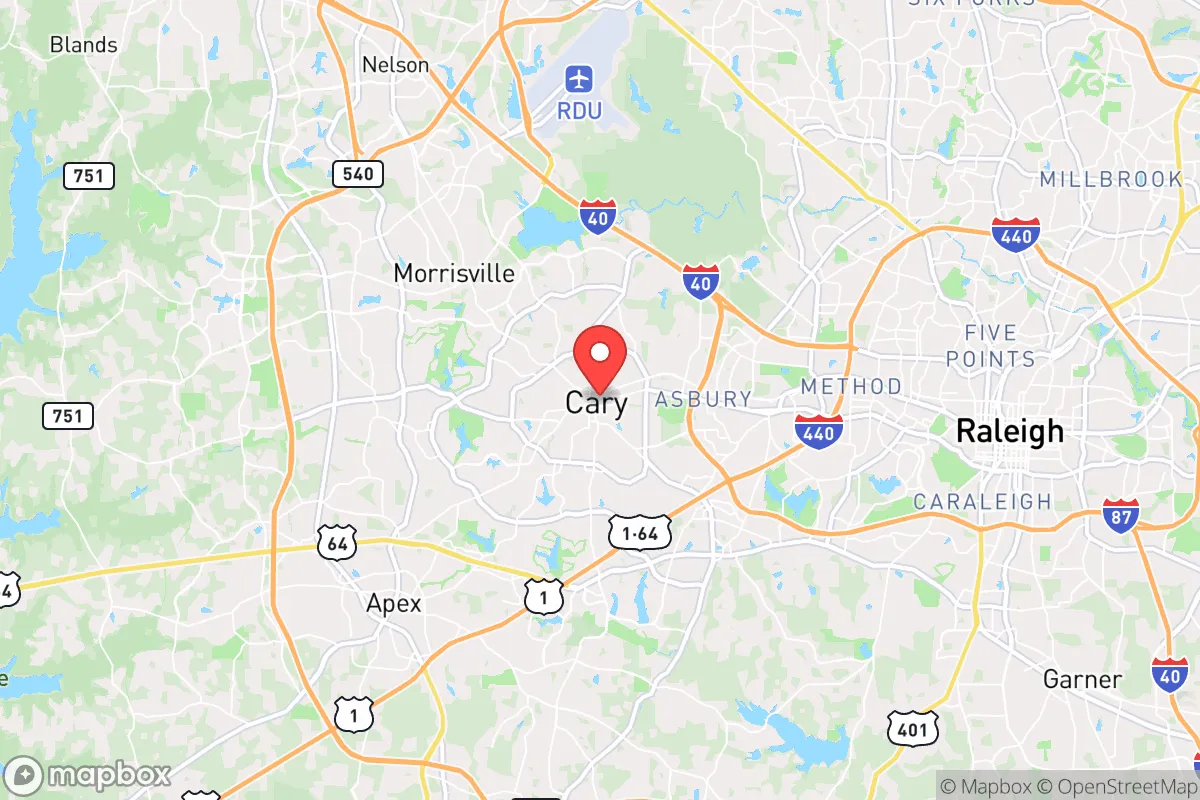
Photo: Wikipedia
Personal Sovereignty in Cary, NC
Viable for self-reliance. Generally workable, though some barriers may limit total independence.
What does Personal Sovereignty tell us?
Personal Sovereignty measures your capacity for self-reliance and independence with minimal government friction. Higher scores mean fewer barriers between you and the way you want to live... but it assumes you have the space you need and good neighbors.
What does this tell us?
Personal Sovereignty measures your capacity for self-reliance and independence with minimal government friction. Higher scores mean fewer barriers between you and the way you want to live... but it assumes you have the space you need and good neighbors.
State Policy
Energy independence: Importer (15% of energy produced in-state)
Personal Liberty
Homesteading

Personal Liberty Analysis
Cary, North Carolina, presents a mixed picture for those prioritizing personal sovereignty. While the town itself leans heavily into planned community governance with strict HOAs and a progressive local council, the broader state framework offers significant advantages for autonomy-minded individuals. The key is understanding that Cary’s local restrictions can be navigated, but the real sovereignty value lies in North Carolina’s state-level protections for gun rights, parental authority, and tax policy. For a survivalist or prepper, Cary is a compromise: you get the economic stability and infrastructure of a major Research Triangle suburb, but you must actively work around the local regulatory environment to maintain true self-reliance.
Tax burden and regulatory posture in Cary and Wake County
North Carolina’s flat income tax rate of 4.5% (scheduled to drop to 3.99% by 2027) is a clear win for fiscal sovereignty, keeping more money in your pocket compared to high-tax states like New York or California. However, Cary sits in Wake County, where the combined property tax rate is roughly 0.85% of assessed value — moderate for the region but not dirt cheap. The real sovereignty concern here is the regulatory posture: Cary’s town government is known for aggressive zoning enforcement and a thicket of permits for everything from fence heights to home-based businesses. If you want to run a small repair shop or keep a few chickens for eggs, expect pushback. The town’s Unified Development Ordinance is over 400 pages, and the planning department has a reputation for strict interpretation. For the prepper, this means you cannot simply buy land and do what you want; you must budget for legal fees or plan to operate under the radar. The silver lining is that North Carolina is a right-to-work state with no state-level business license requirement, so if you can work within Cary’s local rules, the state won’t add another layer of bureaucracy.
Self-defense and gun law specifics in Cary and North Carolina
North Carolina is a shall-issue state for concealed carry, meaning if you pass a background check and complete an 8-hour training course, the sheriff must issue your permit — no subjective discretion. This is a bedrock sovereignty protection. Cary itself is not a gun-friendly town in spirit; the local police department has been known to enforce “no firearms” signs on public property aggressively, and the town council has debated “sensitive places” restrictions that go beyond state law. However, state preemption law (NCGS 14-409.40) explicitly prohibits local governments from regulating the possession, ownership, or carrying of firearms. This means Cary cannot ban concealed carry in parks or pass its own assault weapon ban, no matter what the city council wants. For the survivalist, this is critical: your right to keep and bear arms is protected at the state level, and Cary’s local ordinances cannot override that. Stand-your-ground laws are in effect, and there is no duty to retreat in your home or vehicle. Magazine capacity is unrestricted, and suppressors are legal with a federal tax stamp. The only practical downside is that Cary’s dense suburban layout means you’ll likely be engaging in self-defense at close range, so a compact pistol and good home security are more relevant than a long-range rifle.
Self-reliance and homesteading viability in Cary
This is where Cary’s sovereignty profile takes a hit. The town’s zoning is heavily oriented toward suburban subdivisions with minimum lot sizes of 0.25 to 0.5 acres in most residential zones. That’s enough for a vegetable garden and a small shed, but not for serious homesteading. Raising livestock is effectively banned in most neighborhoods — chickens are allowed only with a permit and strict coop requirements, and no roosters are permitted. Pigs, goats, or bees are generally prohibited in residential zones. Off-grid living is nearly impossible: the town requires connection to municipal water and sewer in most areas, and solar panels must comply with HOA aesthetic guidelines that often ban ground-mounted arrays. Rainwater collection is legal but limited to 100 gallons per property without a permit. For the prepper who wants to be self-sufficient, Cary is a poor fit. You would need to look at the unincorporated areas of Wake County or neighboring Chatham County, where you can find 2-5 acre lots with fewer restrictions. The trade-off is that those areas lack Cary’s infrastructure and job proximity. If you’re committed to the Research Triangle region for work, consider buying a small piece of rural land within an hour’s drive as a bug-out location while living in Cary for the paycheck.
Personal liberties in Cary: parental rights, medical autonomy, speech, and property
North Carolina has strong parental rights protections under state law, including a Parents’ Bill of Rights passed in 2023 that requires schools to notify parents of any medical or mental health services offered to their children and prohibits instruction on gender identity and sexual orientation in K-4 classrooms. Cary’s school board has been resistant to these laws, but state preemption means the law stands. For parents concerned about government overreach into their children’s education, this is a meaningful safeguard. Medical autonomy is more complicated: North Carolina has not expanded Medicaid, which keeps the state’s healthcare system more market-driven, but it also means fewer options for low-income individuals. Vaccine mandates are not enforced at the state level, and there is no state-level mask mandate on the books. For the sovereignty-minded, this means you can largely make your own medical decisions without state coercion. Free speech is protected under the First Amendment, and Cary has not been a hotspot for censorship controversies, though the town’s public comment periods are tightly controlled. Property rights are the weakest link: Cary’s zoning board has broad authority to deny permits for anything outside the approved development plan, and the town has used eminent domain for redevelopment projects in the past. If you value the ability to use your land as you see fit, Cary’s regulatory environment will feel oppressive.
Overall, Cary offers a sovereignty profile that is strong at the state level but weak at the local level. For the survivalist or prepper, the calculus is clear: you get excellent gun rights, low state taxes, and strong parental authority, but you sacrifice the ability to live off-grid, raise livestock, or build without bureaucratic interference. Compared to deep-blue metros like Portland or Denver, Cary is a fortress of personal liberty. Compared to rural Texas or Idaho, it’s a gilded cage. The strategic move is to use Cary as an economic base — take advantage of the high-paying tech jobs and good schools — while maintaining a secondary property or network in a less-regulated county. If you’re willing to play the long game, Cary’s state-level protections give you a foundation to build on, but don’t expect to live like a mountain man within the town limits.

* Values derived from national, state, county, city and local statistics and may differ in a specific area. Last updated: 2026-04-15T23:28:05.000Z
Narrative content on this page is AI-generated and may contain mistakes. Verify any details that matter before acting on them.
ReloMaps may earn a commission from affiliate links at no extra cost to you.

