
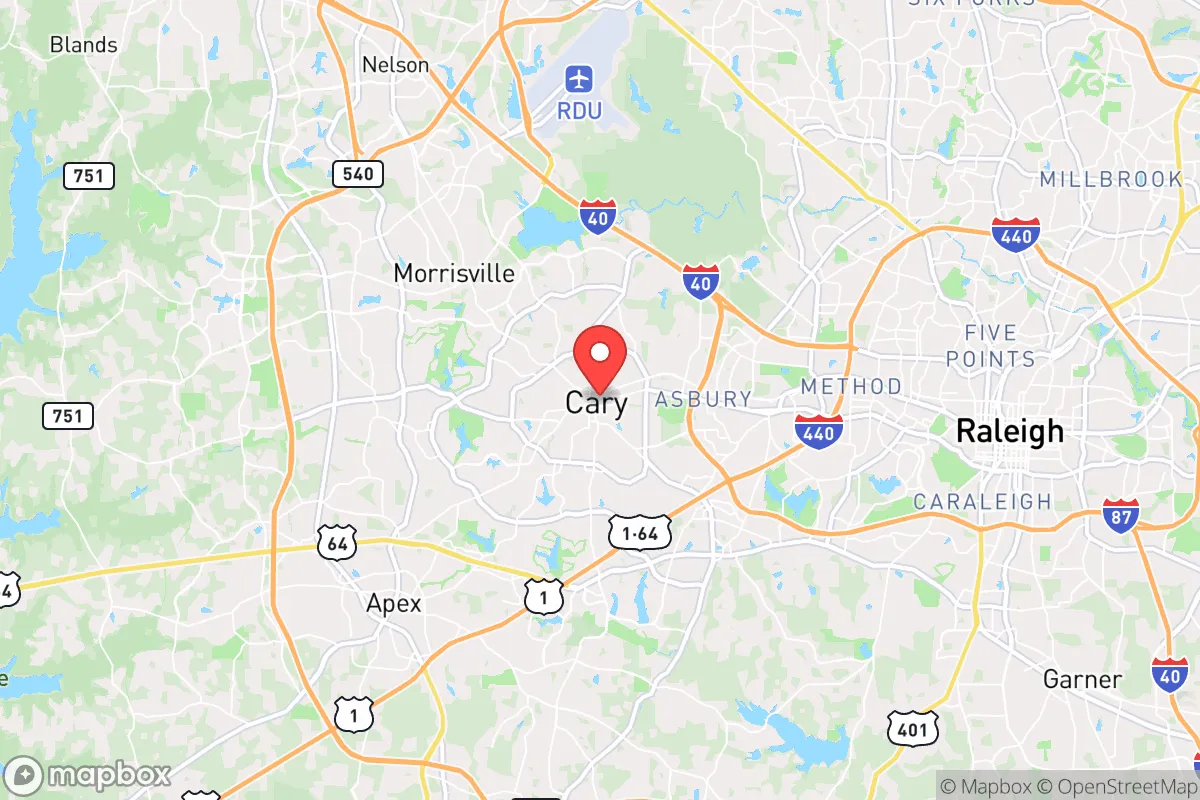
Photo: Wikipedia
Strategic Assessment of Cary, NC
Multiple tactical vulnerabilities. Population density, target proximity, or disaster risk are likely compounding. A retreat property and exit planning is required.
What does the Strategic Assessment tell us?
Our Strategic Assessment grades tactical survivability of an area. Major population centers, military targets, fallout zones, natural disasters, and border exposure all drive risk — lower exposure means a more defensible position in a crisis.
This is heavily inspired by Joel Skousen's Strategic Relocation book. Highly recommended you checkout the book ($)What does this tell us?
Our Strategic Assessment grades tactical survivability of an area. Major population centers, military targets, fallout zones, natural disasters, and border exposure all drive risk — lower exposure means a more defensible position in a crisis.
This is heavily inspired by Joel Skousen's Strategic Relocation book. Highly recommended you checkout the book ($)Strategic Pillars

Key Distances
Regional Safe Places
Below is our recommended "safe zones" in North Carolina and the surrounding area based on our strategic heuristics. For most people, it's unrealistic to live in a “safe zone” full-time due to work, family or other personal reasons. They tend to be more rural. However, many of these areas are perfect for second homes and retreat properties that double as a vacation home or even a short-term rental.

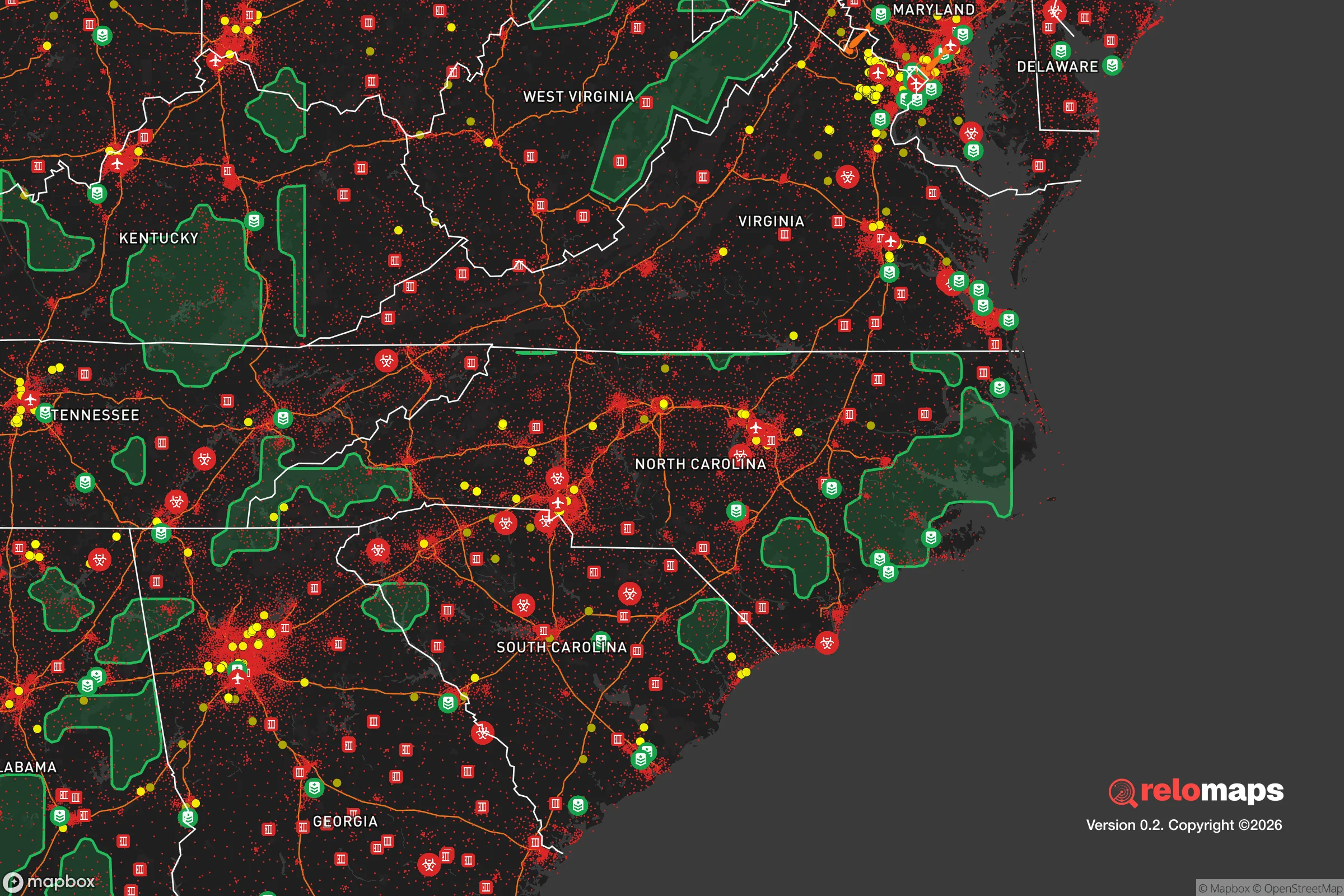


Important Note: For informational purposes only. This does not mean nothing bad ever happens in the green zones. Please use common sense. This is based on public data and modeled with AI. We tried to take a conservative approach but mistakes happen. We update this regularly as new information becomes available.
Solar Generator Recommendations
Backup power matters more here than in safer locations. We've picked three solar generators across budgets and capacity tiers — start with the budget unit if you only need a few essentials, or step up if you want to run a fridge and HVAC for days at a time.

Jackery Portable Power Station Explorer 300
Budget OptionPower on the Go: Weighing only 11 lbs, it's convenient to set up and store with book-sized foldable solar panels

BLUETTI Portable Power Station AC180
Designed for both indoor and outdoor scenarios, AC180 is highly capable as it has a robost capacity and continuous output power.

EF ECOFLOW DELTA Pro Ultra Power Station
Upgraded PickEcoFlow DELTA Pro Ultra is a whole-home energy system designed to grow with your family. Integrated with the Smart Home Panel 2, it scales to meet your evolving energy needs — keeping your home powered, intelligent, and secure through every stage of life.
We earn a commission, at no additional cost to you.
Strategic Assessment Analysis
Cary, North Carolina, often lands on "best places to live" lists for its schools and job market, but from a strategic relocation standpoint, its real value lies in its position as a resilient, resource-rich buffer zone. Nestled in the heart of the Research Triangle, Cary offers a unique blend of economic stability and geographic insulation that appeals to those planning for long-term security. Its proximity to major highways (I-40, I-540) and Raleigh-Durham International Airport provides critical logistical advantages, while its distance from the immediate coastline reduces exposure to hurricane storm surges. For a conservative-leaning individual or family prioritizing preparedness, Cary represents a calculated bet on stability—provided you understand its specific vulnerabilities and how to mitigate them.
Geographic position and natural advantages for long-term security
Cary’s location in the Piedmont region of North Carolina is its strongest asset. The area sits on a plateau of rolling hills, well above the flood-prone coastal plains, with an elevation averaging around 400 feet. This elevation, combined with the region’s clay-based soils, provides natural drainage and reduces the risk of catastrophic flooding seen in coastal communities. The climate is temperate, with four distinct seasons but no extreme temperature swings that would strain off-grid heating or cooling systems. The region’s abundant rainfall—averaging 45 inches annually—means water scarcity is rarely a concern, a critical factor for long-term self-sufficiency. Furthermore, the Triangle’s extensive network of state parks, including Umstead State Park and William B. Umstead State Park, offers immediate access to wooded terrain for hunting, foraging, and strategic retreat if needed. The area’s natural chokepoints—such as the narrow corridors along US-1 and US-64—could be monitored or controlled in a grid-down scenario, giving residents a defensive advantage over more sprawling, open terrain.
Risks, exposures, and proximity to fallout-relevant landmarks
The most significant strategic drawback of Cary is its proximity to high-value, high-risk targets. The Research Triangle Park (RTP), located just 10 miles north, houses major biotech and pharmaceutical facilities, including Pfizer, Merck, and the U.S. Environmental Protection Agency’s research campus. In a scenario involving civil unrest or a mass casualty event, these facilities could become focal points for looting, sabotage, or even targeted attacks. Additionally, Raleigh-Durham International Airport (RDU) is a major transportation hub that could be a vector for disease spread or a target for disruption. The presence of the Fort Bragg military installation (now Fort Liberty) 60 miles south adds another layer of risk—while the base provides a potential security buffer, it also makes the region a strategic military asset that could draw hostile attention. Cary itself is not a primary target, but its location within a 30-mile radius of these assets means residents must plan for secondary effects: roadblocks, checkpoints, and potential evacuation orders. The area’s dense suburban layout—with many neighborhoods connected by narrow, tree-lined roads—could become a liability if mass exodus is required, as choke points like the US-1/US-64 interchange near Cary Towne Center could gridlock quickly.
Practical resilience for a relocator: food, water, energy, and defensibility
For a relocator focused on practical preparedness, Cary offers a mixed bag. On the positive side, the region’s agricultural hinterland is robust. Within a 30-minute drive, you’ll find working farms, livestock operations, and farmers’ markets that could serve as supply lines in a crisis. The North Carolina State Farmers’ Market in Raleigh is a major distribution hub. Water is plentiful from the Cape Fear River basin and Jordan Lake, but note that Cary’s municipal water supply is treated and piped—meaning a prolonged power outage would disrupt it. A well on private property is a significant advantage, but many Cary homes are on city water. Energy-wise, the grid is relatively stable, but Duke Energy’s reliance on natural gas and coal means fuel shortages could hit hard. Solar panels with battery backup are a wise investment here, given the region’s 213 sunny days per year. Defensibility is moderate: Cary’s suburban layout with cul-de-sacs and greenways can be secured with basic perimeter measures, but the lack of natural barriers (mountains, rivers) means a determined group could approach from multiple directions. The local police presence is strong, but in a widespread crisis, law enforcement would be stretched thin. A better bet is to establish a neighborhood watch or mutual assistance group with like-minded neighbors—Cary’s high proportion of professionals and military retirees makes this feasible.
The overall strategic picture for Cary is one of calculated risk. It is not a remote bunker location, nor is it a high-risk urban core. It sits in a sweet spot: close enough to economic opportunity and medical infrastructure to thrive in normal times, yet far enough from the most obvious targets to offer a reasonable chance of weathering a crisis. The key for a conservative-minded relocator is to treat Cary as a base of operations, not a final redoubt. Secure a property with a well, solar capability, and a defensible layout. Build relationships with local farmers and gun clubs. Keep a vehicle with high ground clearance and a full tank of gas for rapid egress toward the mountains (the Blue Ridge Parkway is about 3 hours west) or the less-dense coastal plains south of Wilmington. Cary’s greatest strength is its community—educated, resourceful, and generally law-abiding—which in a crisis is worth more than any bunker. The greatest weakness is its reliance on a fragile supply chain and grid. Plan accordingly, and Cary can serve as a stable, strategic home base for the long haul.

* Values derived from national, state, county, city and local statistics and may differ in a specific area. Last updated: 2026-04-15T23:28:05.000Z
Narrative content on this page is AI-generated and may contain mistakes. Verify any details that matter before acting on them.
ReloMaps may earn a commission from affiliate links at no extra cost to you.

