
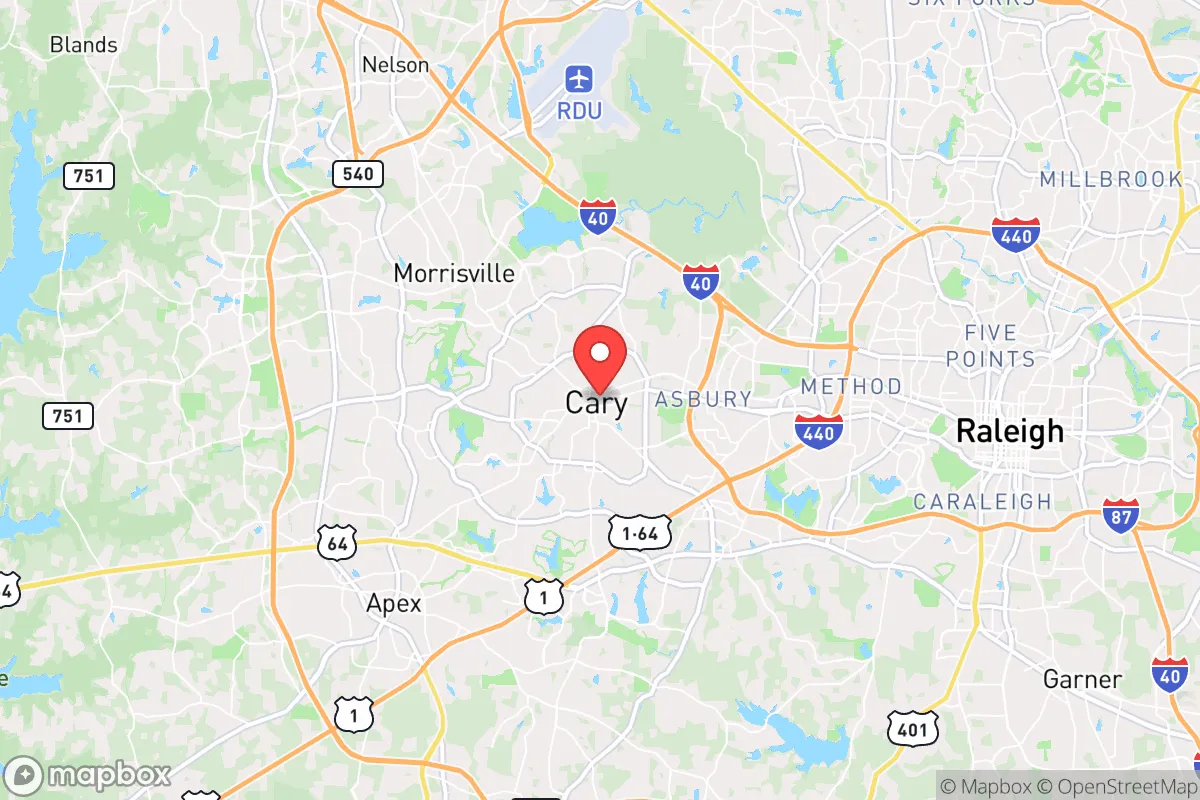
Photo: Wikipedia
Quality of Life in Cary, NC
Above-average quality of iife. The area offers a reasonable cost of living, decent mobility, and a mix of neighborhood amenities.
What does Quality of Life tell us?
Quality of Life blends cost of living, nearby amenities, socioeconomic signals, and neighborhood character. City-level scores represent the whole municipality; individual neighborhoods can differ.
What does this tell us?
Quality of Life blends cost of living, nearby amenities, socioeconomic signals, and neighborhood character. City-level scores represent the whole municipality; individual neighborhoods can differ.
Cost of Living
58% above national average
The Real Cost of Living in Cary, NC for 2026
| Tier | Individual | Family (4) |
|---|---|---|
| Survival | $26k | $49k |
| Comfortable | $102k | $150k |
| Luxury | $213k+ | $330k+ |
| Elite (Top 5%) | $250k+ | $388k+ |
86%
The Area Signal
A metric tracking the socioeconomic signals of the area.


Hobbies
Explore the areaGroceries
4 within 10 miles
Gas
0 within 10 miles
Hospital
3 within 20 miles
Airport
RDU — Raleigh-Durham International
Post Office
USPS — Durham, NC
Critical Amenities
Quality-of-Life Analysis
Cary, North Carolina, is an affluent, master-planned suburb of Raleigh that consistently ranks among the best places to live in the United States. With a cost of living index of 158 (58% above the national average), Cary attracts a demographic of well-educated professionals, executives, and families drawn to its top-tier schools, low crime rates, and high concentration of tech and pharmaceutical jobs. The town's population of roughly 180,000 is notably diverse for the Southeast, with a significant Asian American community and a median household income exceeding $100,000, creating a stable, upwardly mobile environment.
Cost of living, housing, and how Cary compares to Raleigh and Apex
Cary's cost of living is the highest in the Triangle region, driven almost entirely by housing. The median home value sits at $525,200, roughly 35% higher than the Raleigh median and nearly double the national figure. For renters, the median monthly rent of $1,621 is similarly elevated, though it remains below the rents seen in downtown Durham or Chapel Hill. The trade-off for these prices is exceptional property value retention: Cary homes appreciate steadily and rarely sit on the market long. While groceries and utilities are only slightly above average, transportation costs are mitigated by the town's walkable village centers and the fact that the average commute time is a manageable 22.7 minutes — notably shorter than commutes from outer suburbs like Holly Springs or Fuquay-Varina. For buyers seeking more space, neighboring Apex offers slightly lower per-square-foot prices, but Cary's proximity to Research Triangle Park (RTP) and Raleigh-Durham International Airport commands a premium that most residents consider worthwhile.
What daily life is like for families: schools, parks, and local amenities
Daily life in Cary revolves around its nationally recognized public schools, part of the Wake County Public School System. Schools such as Green Hope High School and Davis Drive Middle School are routinely ranked among the top in North Carolina, drawing families who prioritize education. The town itself is a web of greenways, with over 40 parks and the 150-acre Hemlock Bluffs Nature Preserve providing immediate outdoor access. The lifestyle is car-dependent but not car-dominated: the downtown Cary Park, the new Fenton mixed-use development, and the Cary Arts Center create walkable hubs for dining, shopping, and live performances. Residents also benefit from the proximity to Raleigh's museums, NC State University, and the region's burgeoning food scene. The rhythm is suburban but active — weekend mornings see packed farmers' markets and youth soccer leagues, while evenings are quiet, with low noise and light pollution. Crime rates are well below state and national averages, with property crime the primary concern but still significantly lower than in Raleigh proper.
Cary is best suited for professionals and families who value school quality, safety, and convenience over urban excitement or lower housing costs. Tech workers commuting to Cisco, SAS, or IBM in RTP will find the 15-minute drive a major advantage, as will medical professionals at Duke Raleigh Hospital or UNC REX. Empty-nesters downsizing from larger homes also appreciate the town's maintenance-free townhome communities and active adult programs. Those seeking a vibrant nightlife, historic architecture, or a lower cost burden should look to downtown Raleigh or Durham. For anyone who prioritizes a clean, well-run, and highly educated community with strong property appreciation, Cary delivers a quality of life that justifies its premium price tag.

Crime in Cary, NC
Lower crime rates than 85% of comparable U.S. locations.
Violent CrimeViolent Crime Analysis
Property CrimeProperty Crime Analysis
Crime Analysis
Cary, North Carolina, consistently ranks among the safest cities of its size in the United States, with violent crime rates dramatically lower than both state and national averages. The town's violent crime rate of 75.3 incidents per 100,000 residents is roughly one-tenth the national average, while property crime sits at 964.4 per 100,000, well below the national benchmark. However, as part of the Raleigh-Durham-Chapel Hill metropolitan area, Cary is subject to the broader criminal justice policies of Wake County, where progressive district attorneys and judges have implemented reforms that prioritize diversion and reduced sentencing for non-violent offenders.
Crime in context
Cary's crime statistics place it in an elite tier of safety. The violent crime rate of 75.3 per 100K is 89% lower than the U.S. average of roughly 380 per 100K, and significantly below North Carolina's state rate of approximately 350 per 100K. Property crime, while higher than violent crime, still sits 36% below the national average of about 1,500 per 100K. These figures reflect Cary's affluent demographics, strong local policing, and community-oriented design. However, readers should be aware that Wake County's elected district attorney has publicly embraced progressive prosecution models, including cash bail reform and reduced charging for drug possession. While these policies aim to reduce incarceration, they also result in more offenders remaining on the street pending trial, which can embolden property criminals who know the consequences are minimal.
What residents experience
In daily life, Cary residents report feeling very safe walking at night, leaving doors unlocked, and using parks and greenways. The most common crimes are theft from vehicles and package theft, particularly in apartment complexes and neighborhoods near major thoroughfares like US-1 and NC-55. Violent incidents are rare and typically isolated to domestic disputes or targeted altercations, not random attacks. The Cary Police Department maintains a strong community presence with neighborhood watch programs and a response time averaging under 6 minutes for priority calls. Still, the progressive tilt of the Wake County justice system means that even when arrests are made, many property crime offenders face plea deals that result in probation rather than jail time, a pattern that frustrates some long-term residents.
Neighborhood-level variation
Safety is not uniform across Cary. The western neighborhoods near the Preston Country Club and the newer developments around Carpenter Fire Station Road see near-zero violent crime and minimal property incidents. Conversely, areas closer to the US-1/US-64 interchange, including parts of central Cary near the old downtown, experience slightly elevated property crime rates, particularly auto break-ins. Apartments along Tryon Road and near Crossroads Plaza have reported higher theft rates. Overall, Cary remains an exceptionally safe town by any national measure, but the progressive criminal justice policies emanating from Raleigh's Wake County courthouse are a legitimate concern for those who prioritize strict enforcement and victim-centered justice.
* Values derived from national, state, county, city and local statistics and may differ in a specific area. Last updated: 2026-04-15T23:28:05.000Z
Narrative content on this page is AI-generated and may contain mistakes. Verify any details that matter before acting on them.
ReloMaps may earn a commission from affiliate links at no extra cost to you.

