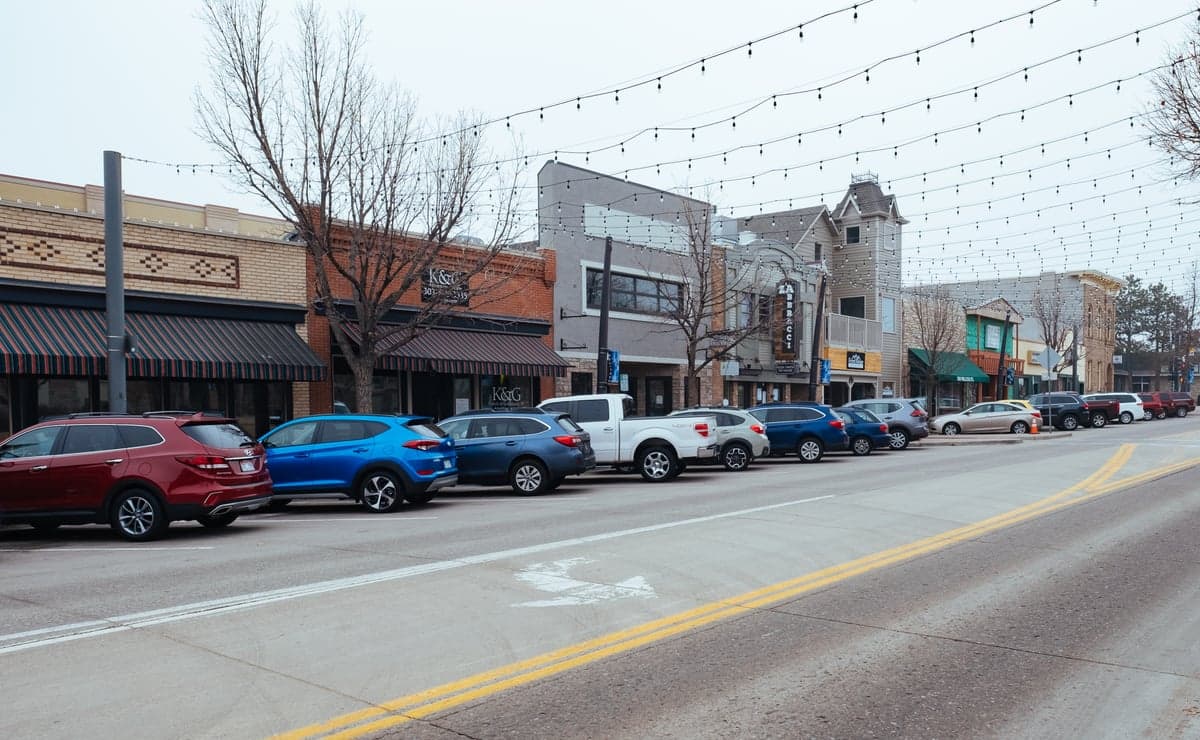
Photo: Wikipedia
Demographics of Castle Rock, CO
Affluence Level in Castle Rock, CO
An upper-middle-class area. Household wealth, education levels, and homeownership run ahead of national benchmarks.
People of Castle Rock, CO
Castle Rock, Colorado, is a predominantly white, highly educated, and family-oriented suburb of Denver, with a population of 76,614 that skews conservative and affluent. Its residents are characterized by a strong sense of community, a preference for newer housing and master-planned neighborhoods, and a demographic profile that is notably less diverse than the Denver metro area as a whole. The city's identity is rooted in its rapid late-20th-century growth as a bedroom community for Denver and Colorado Springs professionals, a wave that continues to shape its character today.
How the city was settled and grew
Castle Rock was founded in 1874 as a railroad town, named for the distinctive butte that rises above the site. The original population was drawn by the Denver and Rio Grande Railroad, which established a depot here, and by the area's rich rhyolite stone quarries. Early settlers were predominantly Anglo-American homesteaders and railroad workers, with a small number of European immigrants, particularly from Germany and Ireland, who built the town's first homes in the Founders District and along Wilcox Street. The town remained a small agricultural and quarrying center for nearly a century, with its population hovering around 1,500 through the 1950s. The original downtown, now the Historic Downtown area, was the heart of this community, with its brick storefronts and modest Victorian houses housing the families of merchants, railroad employees, and quarrymen.
Modern era (post-1965)
Castle Rock's modern transformation began in earnest after the 1965 opening of Interstate 25, which connected the town directly to Denver and Colorado Springs. The 1970s and 1980s saw the first wave of suburban in-migration, primarily white, middle-class families seeking larger lots and lower taxes than the Denver suburbs. This wave accelerated dramatically in the 1990s and 2000s, driven by Denver's booming economy and the construction of master-planned communities. The Meadows neighborhood, developed from the 1990s onward, became the primary landing zone for these new residents, offering a mix of single-family homes and amenities like parks and schools. The Terrain and Red Hawk neighborhoods followed, attracting families with newer housing stock and proximity to the Castle Rock outlet malls and the Philip S. Miller Park. This period cemented Castle Rock's identity as a white-collar, family-centric suburb. The city's foreign-born population remains very low at 2.4%, and its racial composition is overwhelmingly white at 79.4%. The largest minority group is Hispanic or Latino at 11.3%, a population that has grown steadily but remains concentrated in older, more affordable parts of town like the Founders District and some areas near the railroad tracks. East/Southeast Asian residents make up 1.4% of the population, and Indian-subcontinent residents account for 0.7%, with both groups dispersed across newer subdivisions rather than forming distinct ethnic enclaves. The Black population is minimal at 0.8%.
The future
Castle Rock's population is projected to continue growing, driven by ongoing residential development in the Castle Pines area (which straddles the city's northern edge) and the newer Crystal Valley neighborhood. The city is likely to remain predominantly white and highly educated—54.9% of adults hold a bachelor's degree or higher—as its housing prices and tax structure continue to attract affluent, conservative-leaning families. The Hispanic population is expected to grow modestly, but the city shows no signs of becoming a major immigrant destination. The foreign-born share is likely to remain well below the national average. Instead of tribalizing into distinct ethnic enclaves, Castle Rock is homogenizing into a broad, upper-middle-class, white-majority suburb, with new residents drawn from other parts of Colorado and the Midwest. The primary demographic tension will be between long-time residents in the historic core and newcomers in the master-planned communities, rather than between racial or ethnic groups.
For a prospective resident, Castle Rock offers a stable, safe, and politically conservative environment with excellent schools and a strong sense of community. The city is becoming more of a self-contained economic center, but its core identity remains that of a family-oriented, predominantly white suburb where newcomers are expected to assimilate into an established, homogeneous culture. Those seeking significant racial or ethnic diversity will find it elsewhere in the Denver metro area.

* Values derived from national, state, county, city and local statistics and may differ in a specific area. Last updated: 2026-04-21T18:57:08.000Z
Narrative content on this page is AI-generated and may contain mistakes. Verify any details that matter before acting on them.
ReloMaps may earn a commission from affiliate links at no extra cost to you.

