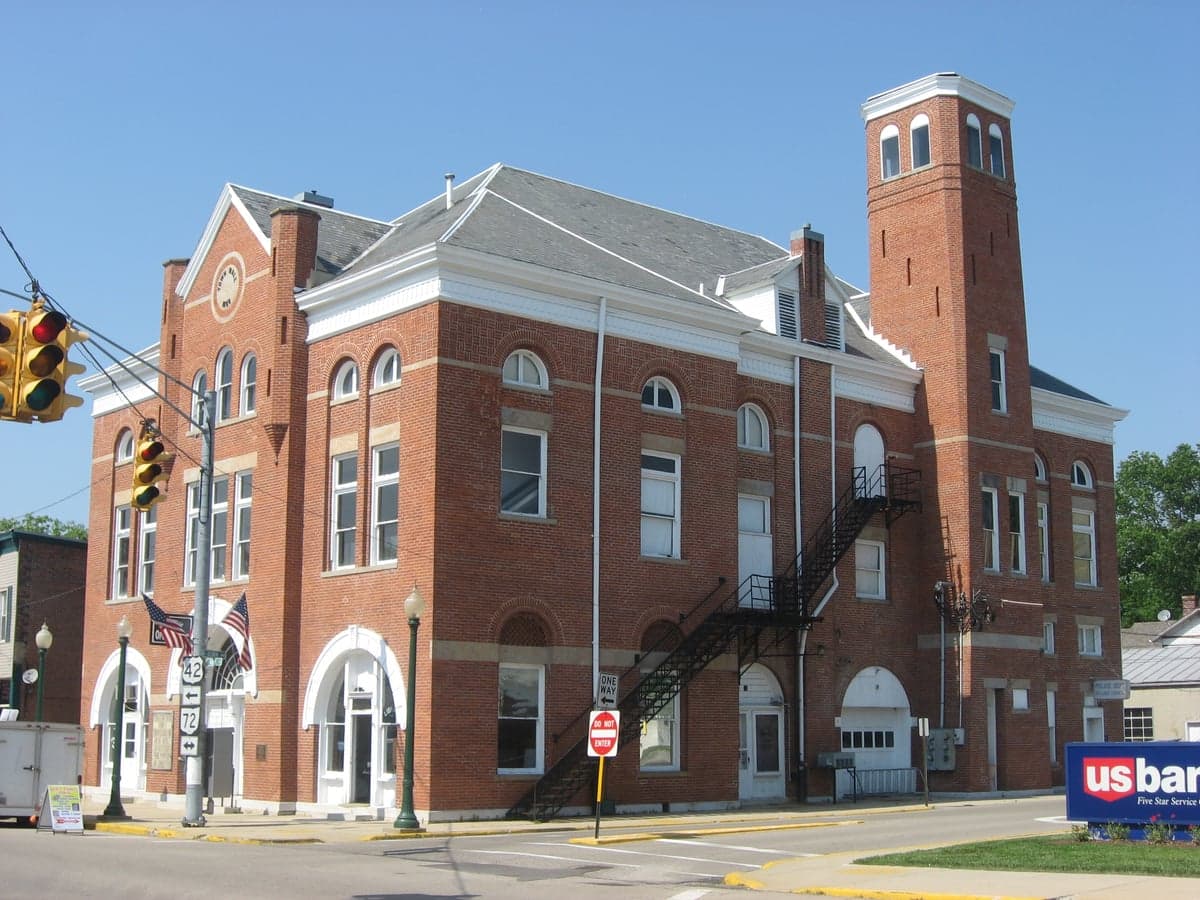
Photo: Wikipedia
Strategic Assessment of Cedarville, OH
Meaningful friction. Expect exposure to either population pressure, blast zones, or natural disaster risk. Consider buying a retreat property.
What does the Strategic Assessment tell us?
Our Strategic Assessment grades tactical survivability of an area. Major population centers, military targets, fallout zones, natural disasters, and border exposure all drive risk — lower exposure means a more defensible position in a crisis.
This is heavily inspired by Joel Skousen's Strategic Relocation book. Highly recommended you checkout the book ($)What does this tell us?
Our Strategic Assessment grades tactical survivability of an area. Major population centers, military targets, fallout zones, natural disasters, and border exposure all drive risk — lower exposure means a more defensible position in a crisis.
This is heavily inspired by Joel Skousen's Strategic Relocation book. Highly recommended you checkout the book ($)Strategic Pillars

Key Distances
Regional Safe Places
Below is our recommended "safe zones" in Ohio and the surrounding area based on our strategic heuristics. For most people, it's unrealistic to live in a “safe zone” full-time due to work, family or other personal reasons. They tend to be more rural. However, many of these areas are perfect for second homes and retreat properties that double as a vacation home or even a short-term rental.

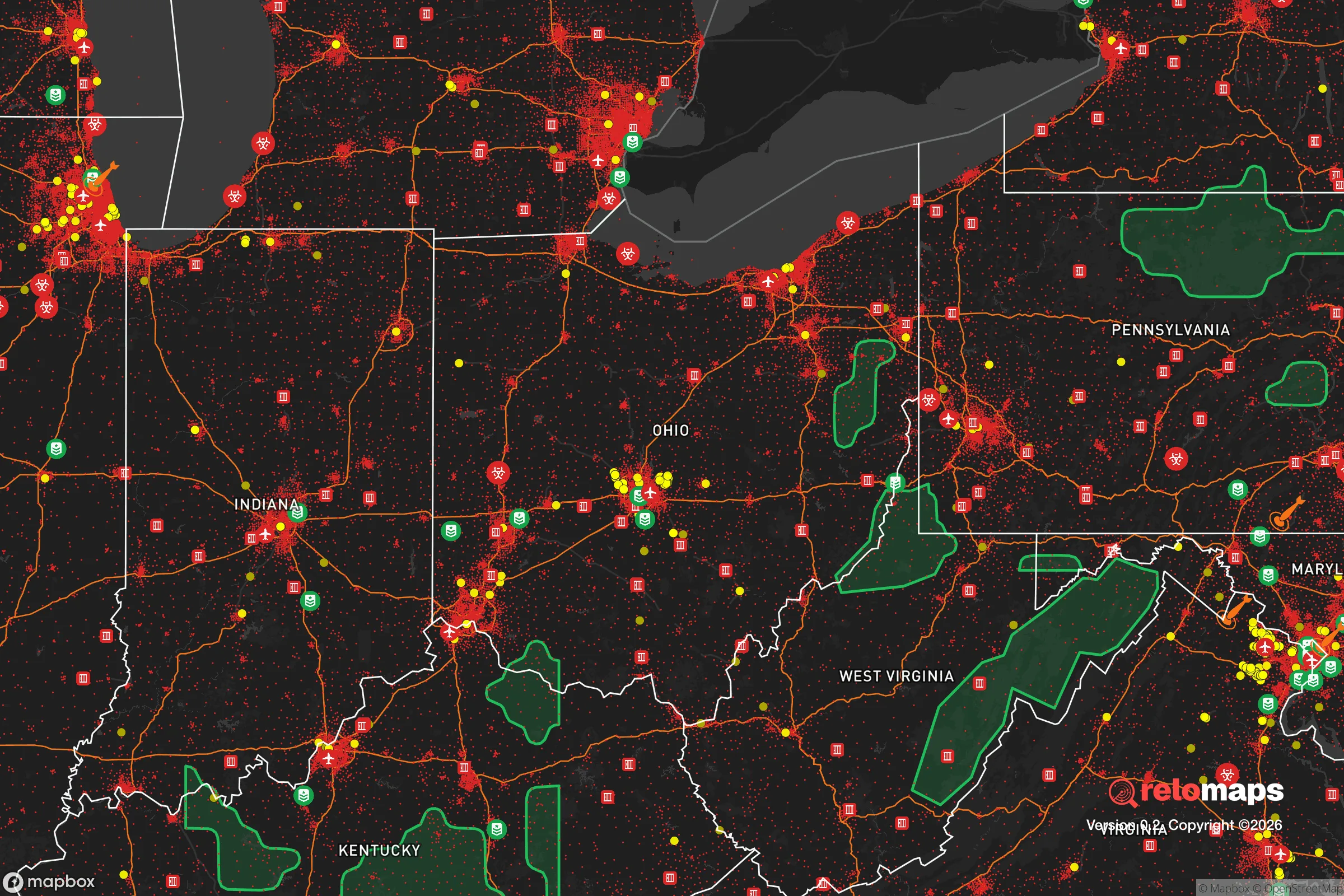


Important Note: For informational purposes only. This does not mean nothing bad ever happens in the green zones. Please use common sense. This is based on public data and modeled with AI. We tried to take a conservative approach but mistakes happen. We update this regularly as new information becomes available.
Solar Generator Recommendations
Backup power matters more here than in safer locations. We've picked three solar generators across budgets and capacity tiers — start with the budget unit if you only need a few essentials, or step up if you want to run a fridge and HVAC for days at a time.

Jackery Portable Power Station Explorer 300
Budget OptionPower on the Go: Weighing only 11 lbs, it's convenient to set up and store with book-sized foldable solar panels

BLUETTI Portable Power Station AC180
Designed for both indoor and outdoor scenarios, AC180 is highly capable as it has a robost capacity and continuous output power.

EF ECOFLOW DELTA Pro Ultra Power Station
Upgraded PickEcoFlow DELTA Pro Ultra is a whole-home energy system designed to grow with your family. Integrated with the Smart Home Panel 2, it scales to meet your evolving energy needs — keeping your home powered, intelligent, and secure through every stage of life.
We earn a commission, at no additional cost to you.
Strategic Assessment Analysis
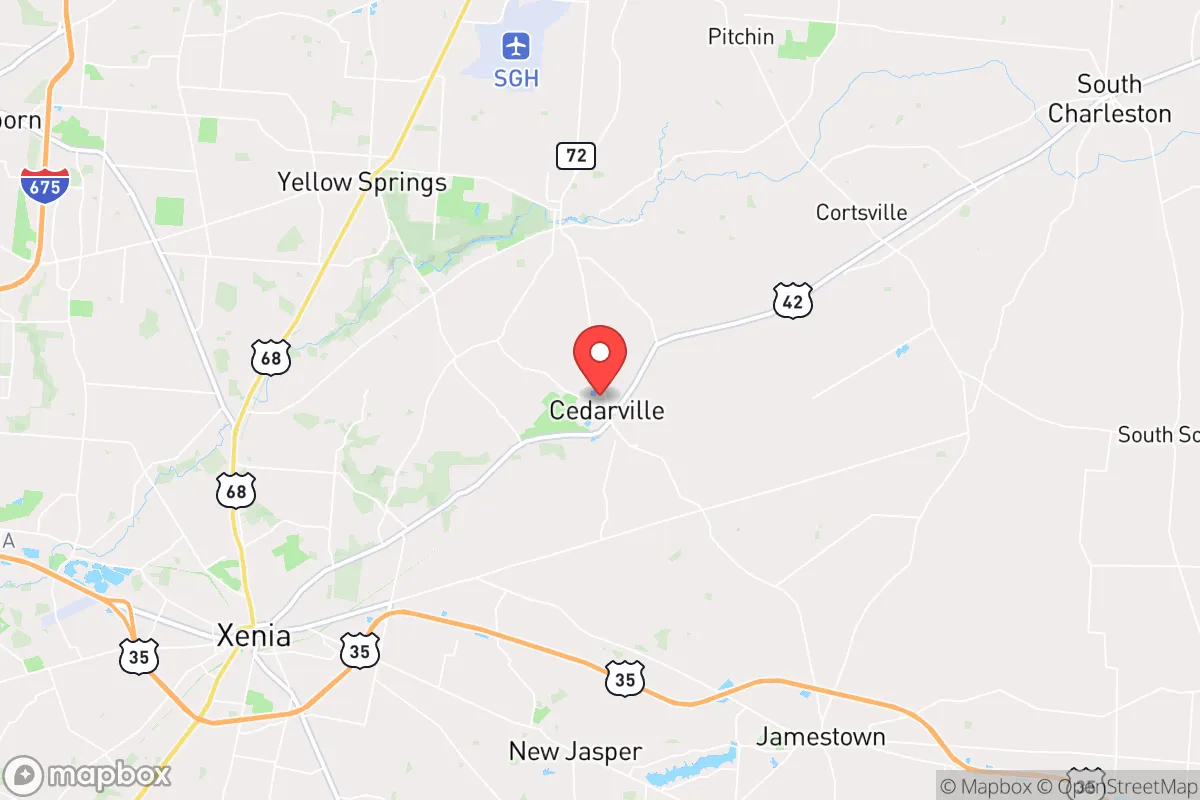
Cedarville, Ohio, presents a compelling case for the relocation-minded reader prioritizing resilience and self-sufficiency, balancing small-town stability with proximity to the logistical and economic resources of the Dayton-Springfield corridor. Located in Greene County, roughly 15 miles southeast of Springfield and 20 miles southwest of Columbus’s outer suburbs, Cedarville sits in a zone that is neither isolated nor dangerously exposed to the immediate blast effects of major metropolitan targets. Its position along the Little Miami River, within the fertile till plains of southwestern Ohio, offers a blend of agricultural potential, groundwater access, and a modest population density that supports a quiet, defensible lifestyle without sacrificing access to supply chains and medical infrastructure. For a family or individual thinking seriously about disaster readiness, Cedarville’s key advantage is its location in a region that is politically and economically stable, with a history of weathering economic downturns and natural events without systemic collapse.
Geographic position and natural advantages for long-term stability
Cedarville’s geographic setting is defined by its position on the eastern edge of the Miami Valley, a region shaped by glacial deposits that left behind deep, fertile soils and a reliable aquifer system. The Little Miami River, a National Scenic River, flows through the village, providing a surface water source that, while not potable without treatment, offers a significant advantage for irrigation and emergency supply. The surrounding terrain is gently rolling, with elevations around 1,000 feet, offering natural drainage and reducing flood risk compared to low-lying areas along the Great Miami River. The area’s agricultural base is strong: Greene County is among Ohio’s top producers of corn, soybeans, and hay, and the local Amish and Mennonite communities in nearby Clark and Madison counties provide a network of small-scale food producers and craftspeople who operate outside industrial supply chains. This agricultural density means that even in a prolonged disruption, Cedarville’s immediate region would retain a higher-than-average capacity for local food production. The climate is temperate, with four distinct seasons, moderate rainfall (about 38 inches annually), and no significant risk of hurricanes, earthquakes, or wildfires. The primary natural hazard is severe thunderstorms and occasional tornadoes, but the area’s topography and building codes (largely post-1970s construction) mitigate most risks. For a relocator, the key takeaway is that Cedarville sits in a zone where the land itself supports long-term habitation without extreme environmental stress.
Risks, exposures, and proximity to fallout-relevant landmarks
The most significant risk for Cedarville in a major national crisis is its proximity to several high-value targets within a 50-mile radius. Wright-Patterson Air Force Base, located about 20 miles northwest in Dayton, is a primary command and research center for the U.S. Air Force, housing the Air Force Life Cycle Management Center, the Air Force Research Laboratory, and the National Air and Space Intelligence Center. In a conflict involving strategic strikes, Wright-Patterson would be a likely target, and Cedarville lies within the moderate fallout zone for a ground burst on the base, depending on wind patterns. Similarly, the Defense Supply Center Columbus (DSCC), about 30 miles east, and the Honda manufacturing complex in Marysville (35 miles northeast) are secondary industrial targets. The village itself has no major military or industrial infrastructure, which is a positive for avoiding direct attack, but its location in the Miami Valley means that prevailing westerly winds could carry fallout from a strike on Wright-Patterson toward the Cedarville area. The population density of the Dayton-Springfield corridor (about 1.5 million people combined) also means that in a collapse scenario, Cedarville could face pressure from urban refugees moving southeast along U.S. Route 42 and State Route 72. The village’s small size (population roughly 4,000) and limited housing stock would make it difficult to absorb a large influx without strain. On the positive side, Cedarville is far enough from major interstates (I-70 is 12 miles north, I-71 is 20 miles east) to avoid being a natural chokepoint for evacuation traffic, and its rural character means that most residents have some degree of land and space for self-sufficiency.
Practical resilience for a relocator: food, water, energy, and defensibility
For a relocator focused on practical self-sufficiency, Cedarville offers a mix of strong fundamentals and notable gaps. Food security is the area’s strongest asset: the surrounding farmland is among the most productive in Ohio, and the village itself hosts a weekly farmers’ market from May to October, plus year-round access to local meat, dairy, and produce through nearby farms and the Cedarville University agricultural program. The university’s 400-acre farm includes livestock, orchards, and crop fields, and its presence creates a local knowledge base for small-scale farming. Water access is good but requires preparation: the village’s municipal water comes from groundwater wells, which are less vulnerable to surface contamination than river-fed systems, but a prolonged power outage would disable electric pumps. A relocator should plan for a backup well (hand-pump or solar) or rainwater catchment; the average annual rainfall of 38 inches makes the latter viable with proper storage. Energy resilience is moderate: the local grid is served by Dayton Power & Light (now AES Ohio), which has a history of storm-related outages, but the area’s tree canopy is less dense than in eastern Ohio, reducing line damage risk. Solar potential is good, with about 180 sunny days per year, and the state’s net metering policies (as of 2026) remain favorable for grid-tied systems. Wood heating is viable, with ample hardwood forests in the region, but air quality regulations in Greene County limit outdoor burning. Defensibility is Cedarville’s weakest point: the village is laid out along a main street (U.S. 42) with multiple access points, and its open farmland perimeter offers little natural cover. However, the village’s compact size and strong community institutions—including a well-regarded police department and a volunteer fire department—mean that organized neighborhood watch and mutual aid networks are feasible. The presence of Cedarville University (about 4,000 students and staff) adds a potential source of skilled labor and medical resources (the university has a nursing program and a health center), but also a large population that could become dependent on local supplies in a crisis.
The overall strategic picture for Cedarville is one of moderate resilience with a strong agricultural base and manageable risks, provided the relocator is proactive about water and energy backups. The area’s greatest vulnerability is its location within the shadow of Wright-Patterson Air Force Base and the Dayton metroplex, which elevates the risk of both direct fallout and refugee pressure. However, for a family or individual willing to invest in a well, solar panels, and a wood stove, Cedarville offers a defensible, productive environment that is far more resilient than a typical suburban subdivision. The local culture, shaped by a mix of conservative Christian values (Cedarville University is a Baptist institution) and rural pragmatism, supports self-reliance and community cooperation. The key is to treat Cedarville not as a bug-out location, but as a long-term homestead where daily life is already aligned with preparedness—growing food, storing water, and building relationships with neighbors who share the same mindset. For the reader who wants to be part of a functioning small town rather than a prepper enclave, Cedarville is a solid, unglamorous choice that balances access to civilization with the capacity to weather a crisis.

* Values derived from national, state, county, city and local statistics and may differ in a specific area. Last updated: 2026-08-19T02:05:25.000Z
Narrative content on this page is AI-generated and may contain mistakes. Verify any details that matter before acting on them.
ReloMaps may earn a commission from affiliate links at no extra cost to you.

