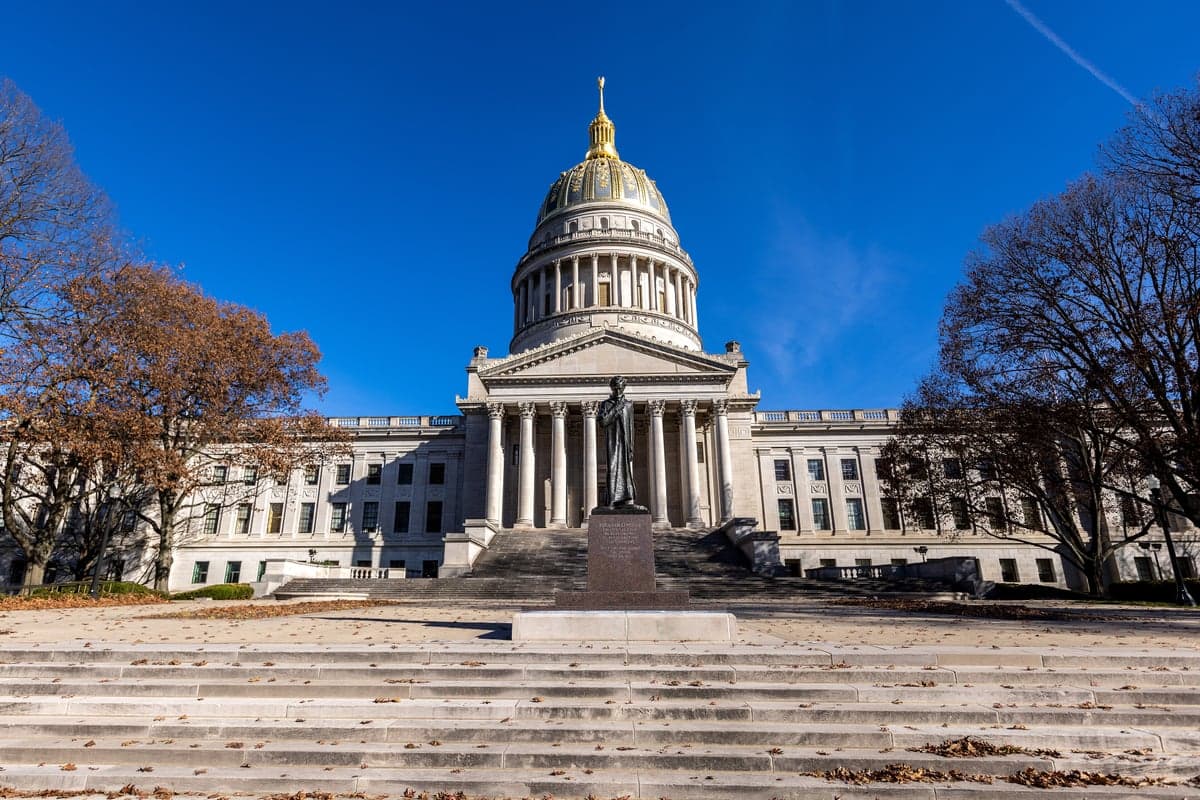
Photo: Wikipedia
Personal Sovereignty in Charleston, WV
Strong independent fundamentals that actively favor personal liberty and low regulation.
What does Personal Sovereignty tell us?
Personal Sovereignty measures your capacity for self-reliance and independence with minimal government friction. Higher scores mean fewer barriers between you and the way you want to live... but it assumes you have the space you need and good neighbors.
What does this tell us?
Personal Sovereignty measures your capacity for self-reliance and independence with minimal government friction. Higher scores mean fewer barriers between you and the way you want to live... but it assumes you have the space you need and good neighbors.
State Policy
Energy independence: Net exporter (200% of energy produced in-state)
Personal Liberty
Homesteading

Personal Liberty Analysis
For the individual or family prioritizing personal sovereignty—the ability to live, defend, and provide for themselves free from government overreach—Charleston, West Virginia, offers a rare and increasingly valuable environment. While no place is a perfect fortress against federal or state-level trends, the capital city sits in a state that has consciously resisted many of the encroachments seen elsewhere. The combination of a low tax burden, permissive self-defense laws, and a culture that still values self-reliance makes this area a serious consideration for those who view the current trajectory of the country with concern. The key is understanding that Charleston itself is a mixed bag—a blue dot in a deeply red state—but the surrounding county and state-level legal framework provide the real foundation for autonomy.
Tax burden and regulatory posture: How much of your income and property stays yours
West Virginia's tax structure is a significant draw for those seeking to maximize personal control over their earnings. The state has a progressive income tax with rates ranging from 3% to 6.5%, but crucially, Social Security benefits are not taxed, and there is a generous deduction for other retirement income. For a single individual or a family, this means more of your money stays in your pocket compared to many neighboring states. Property taxes are among the lowest in the nation, with effective rates around 0.5% to 0.7% of assessed value in Kanawha County, where Charleston sits. This is a direct check on local government's ability to extract wealth from your home. On the regulatory side, West Virginia has actively rolled back occupational licensing requirements and business regulations in recent years. The state's "right-to-work" status and lack of a state-level minimum wage above the federal floor mean fewer mandates on how you run your life or business. For the prepper, this translates to less bureaucratic friction when acquiring land, building a structure, or starting a side hustle to fund your preparedness efforts. The state government's posture is generally one of "leave us alone," which aligns well with a survivalist mindset.
Self-defense and gun law specifics: What you can own, carry, and where
This is where Charleston and West Virginia shine brightest for the sovereignty-minded. West Virginia is a constitutional carry state, meaning no permit is required to carry a concealed firearm for any law-abiding adult 21 or older. This is not a privilege granted by the state; it is recognized as a pre-existing right. There is no state-level registry, no "may issue" nonsense, and no waiting periods for long guns. The state also preempts local gun laws, meaning the city of Charleston cannot pass its own restrictions that are stricter than state law—a critical protection against local government overreach. Stand-your-ground laws are in full effect, with no duty to retreat in any place you are lawfully present. For the prepper, this means you can legally keep a defensive rifle in your vehicle, carry a sidearm while hiking or running errands, and defend your home or property without fear of prosecution for using force. The only significant restriction is that concealed carry is prohibited in certain posted areas like federal buildings and schools, but the state's overall legal framework is among the most permissive in the nation. This is a place where the government trusts the individual to be responsible for their own safety.
Self-reliance and homesteading viability: Lot sizes, zoning, and off-grid feasibility
Within Charleston's city limits, zoning is more restrictive, with standard residential lots often under a quarter-acre and regulations that can complicate keeping livestock or building alternative structures. However, the real opportunity lies in the surrounding Kanawha County and the broader region. Just 15 to 30 minutes outside downtown, you can find undeveloped land for $3,000 to $8,000 per acre, with many parcels having no zoning restrictions at all. This is where the prepper's dream becomes practical. Off-grid living is legally feasible: West Virginia has no state-level ban on rainwater collection, and many rural properties rely on private wells and septic systems. Solar panels are common, and the state offers tax credits for renewable energy systems. The biggest hurdle is the lack of a statewide building code in unincorporated areas—while this sounds like a freedom, it also means you need to be your own general contractor and inspector. For the serious homesteader, you can realistically buy 5 to 20 acres, build a pole barn or a small cabin, install a composting toilet, and live with minimal interaction with the county government. The local culture in these areas is still one of "mind your own business," which is a valuable asset when you want to build a root cellar or stockpile supplies without drawing unwanted attention.
Personal liberties: Parental rights, medical autonomy, speech, and property
West Virginia has been a battleground on several fronts, but the trend for personal liberty has been positive in recent years. Parental rights in education were strengthened in 2021 with a law requiring schools to notify parents of any changes in a child's services or monitoring related to mental, emotional, or physical health, effectively giving parents a veto over school-based interventions. The state also passed a "Medical Right to Refuse" law, allowing individuals to decline any medical treatment, including vaccines, without penalty from employers or the state—a critical protection for those wary of government-mandated health protocols. On speech, there are no state-level "hate speech" laws that criminalize opinion, and the state's public forums remain open. Property rights are protected by a strong eminent domain law that requires "public use" (not just "public benefit") and full market-value compensation. The one area of concern is that West Virginia still has a state income tax, which some see as a form of government overreach, but the rate is moderate and the state has been discussing further reductions. Overall, the legal climate here respects the individual's right to make decisions about their family, their body, and their property without the state acting as a nanny.
When you stack Charleston and its surrounding region against other relocation options for the sovereignty-minded, it holds its own against more famous destinations like Texas or Florida, but with a lower cost of entry and a less crowded landscape. The trade-off is that you are in a state with a struggling economy and aging infrastructure, which means you need to be more self-sufficient in terms of employment and services. But for the person who views government overreach as the primary threat to their freedom, West Virginia offers a legal framework that actively pushes back against that trend. The city itself may lean left, but the state's laws and the surrounding county's culture provide a buffer that allows you to live largely on your own terms. If your priority is maximizing personal sovereignty—from your right to keep and bear arms to your ability to build an off-grid homestead—this area deserves a serious look. It is not a utopia, but it is a place where the government is still, for the most part, on your side.

* Values derived from national, state, county, city and local statistics and may differ in a specific area. Last updated: 2026-05-01T18:25:21.000Z
Narrative content on this page is AI-generated and may contain mistakes. Verify any details that matter before acting on them.
ReloMaps may earn a commission from affiliate links at no extra cost to you.

