 Popular
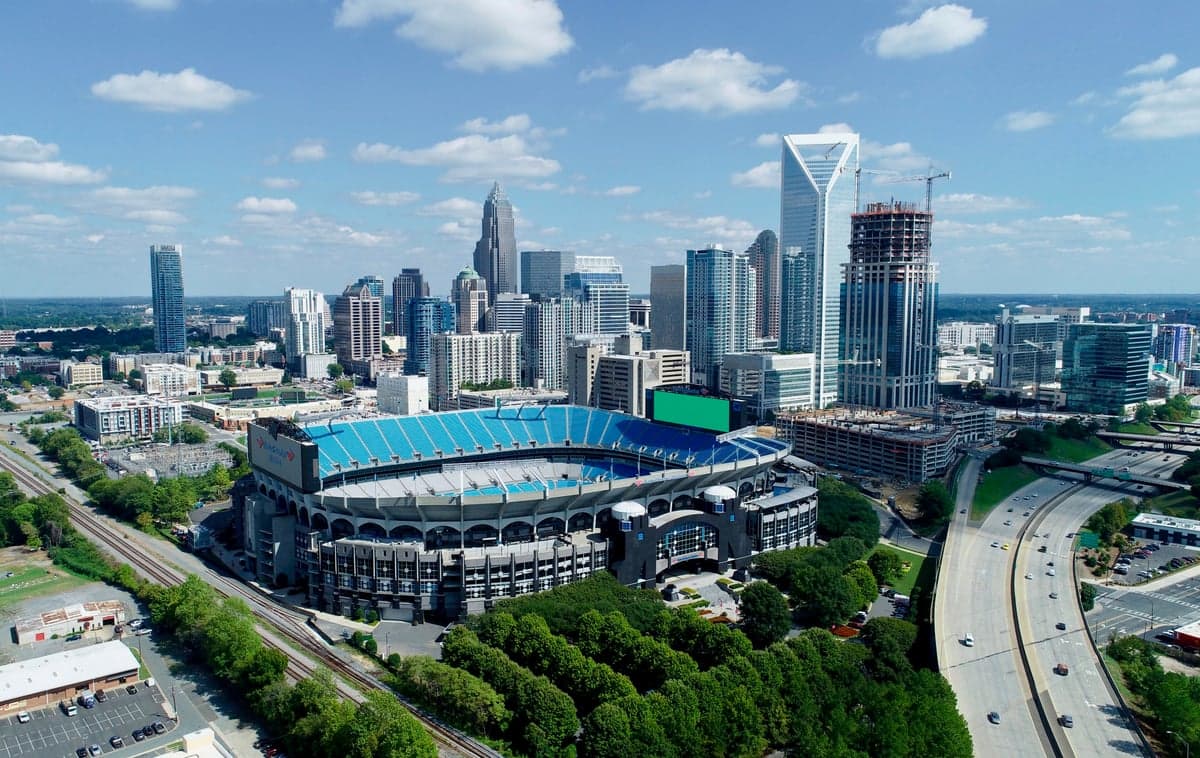
Photo: Wikipedia
Demographics of Charlotte, NC
Affluence Level in Charlotte, NC
A middle-class area roughly in line with national averages across income, home values, education, and employment.
People of Charlotte, NC
The people of Charlotte, North Carolina, today form a rapidly diversifying, majority-minority population of 886,283 residents, defined by a strong Black middle class, a surging Hispanic and East/Southeast Asian presence, and a white population that has fallen below 40%. The city is simultaneously a hub for upwardly mobile professionals—47.4% hold a college degree—and a destination for working-class immigrants, creating a dynamic but increasingly stratified social landscape. Distinctive identity markers include a banking-driven corporate culture, a deeply rooted African American political and civic establishment, and a growing number of ethnic enclaves that are reshaping once-homogeneous suburbs.
How the city was settled and grew
Charlotte’s founding population was overwhelmingly Scots-Irish and German settlers who arrived in the mid-1700s, drawn by the promise of cheap land along the Great Wagon Road. These early residents were small farmers and traders, and the city’s first neighborhoods—such as Fourth Ward and Elizabeth—were built by this Anglo-Protestant stock. The arrival of enslaved Africans in the late 18th and early 19th centuries created the city’s Black population, which remained largely rural until after the Civil War. The post-Reconstruction era saw a small but significant wave of Jewish immigrants, primarily German and later Eastern European, who settled in the Dilworth and Wesley Heights areas and established Charlotte’s early mercantile and banking foundations. The city remained a modest regional trading center until the 20th century, when the textile boom and the rise of the railroad drew a second wave of Black migrants from the rural Carolinas and a smaller number of Italian and Greek immigrants. By 1950, Charlotte was still roughly 70% white and 30% Black, with virtually no other ethnic groups.
Modern era (post-1965)
The 1965 Hart-Cellar Act and the simultaneous collapse of the textile industry fundamentally reshaped Charlotte’s population. The city’s banking sector—led by what became Bank of America and Wachovia—began recruiting heavily from the Northeast and Midwest, drawing a wave of white professionals who settled in SouthPark and Myers Park. At the same time, the Black population, which had been concentrated in Brooklyn (now the site of the government center) and Grier Heights, began a suburban push into University City and Mint Hill as urban renewal displaced historic Black neighborhoods. The Hispanic population, virtually nonexistent before 1980, grew explosively from the 1990s onward, driven by construction and service-sector jobs. Today, Eastland and Pawtuckett are the core of Charlotte’s Hispanic community, which now makes up 17.0% of the city. The East/Southeast Asian population—3.3% of the total—is concentrated in Ballantyne and the Arboretum area, largely composed of Chinese, Vietnamese, and Korean professionals in finance and tech. The Indian-subcontinent population (2.9%) is similarly clustered in Ballantyne and Weddington, with many working in banking, IT, and medicine. The white share has fallen from 58% in 1990 to 38.7% today, while the Black share has held steady at roughly 33-34% since 2000, indicating that growth is almost entirely driven by Hispanic and Asian immigration.
The future
Charlotte’s population is heading toward a tripartite structure: a white professional class concentrated in the center-city and southern suburbs, a Black middle and working class spread across the eastern and northern corridors, and a rapidly growing Hispanic and Asian population filling the western and southern edges. The foreign-born share, currently 11.2%, is likely to rise to 15-18% by 2040, driven by continued Hispanic immigration and a steady flow of Indian and East/Southeast Asian professionals. The city is not homogenizing; instead, it is tribalizing into distinct enclaves by income and ethnicity. Ballantyne is becoming a majority-Asian and Indian suburb, while Eastland is solidifying as a Hispanic hub. The Black population is dispersing but remains the most residentially integrated group. The white population is increasingly concentrated in the historic core and the wealthiest suburbs, a pattern that mirrors other Sun Belt banking centers. The next 10-20 years will likely see Charlotte become a majority-Hispanic-and-Asian city, with the white share falling below 30% and the Black share declining slightly as immigration outpaces domestic Black in-migration.
For someone moving to Charlotte now, the city offers a high degree of ethnic and economic diversity, but also clear geographic sorting by race and class. The banking economy ensures a steady influx of educated professionals, while the service sector draws working-class immigrants. The result is a city that is both upwardly mobile and deeply stratified—a place where a newcomer’s experience will depend heavily on which neighborhood they choose and which community they join.

* Values derived from national, state, county, city and local statistics and may differ in a specific area. Last updated: 2026-04-21T16:24:53.000Z
Narrative content on this page is AI-generated and may contain mistakes. Verify any details that matter before acting on them.
ReloMaps may earn a commission from affiliate links at no extra cost to you.

