Photo: Wikipedia
Demographics of Chicago, IL
Affluence Level in Chicago, IL
A middle-class area roughly in line with national averages across income, home values, education, and employment.
People of Chicago, IL
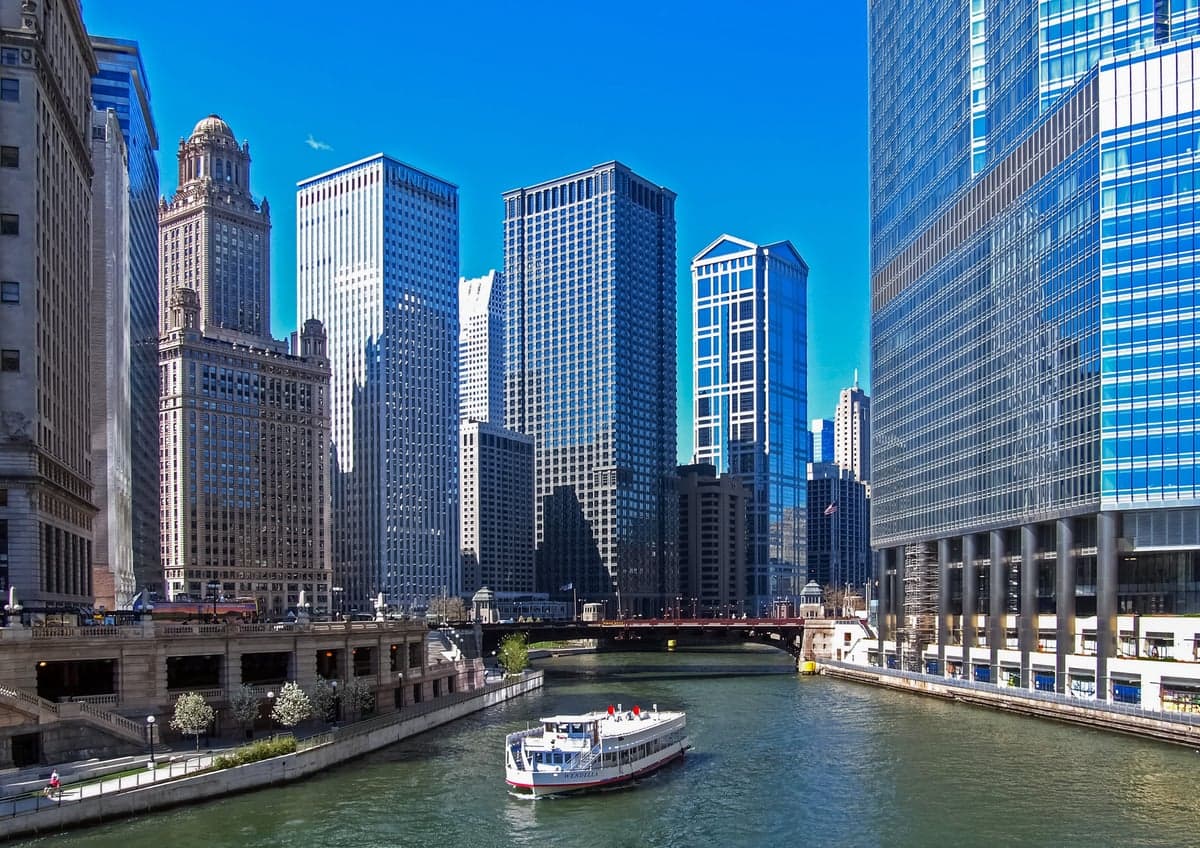
Chicago is a city of 2.7 million people defined by its stark racial and ethnic patchwork, where no single group holds a majority. Its population is roughly one-third White, one-third Hispanic, and one-quarter Black, with a growing East/Southeast Asian community and a smaller but notable Indian-subcontinent population. The city’s identity is shaped by deep-rooted neighborhood loyalties, a history of industrial-driven migration, and ongoing demographic shifts that are remaking its traditional ethnic enclaves.
How the city was settled and grew
Chicago’s explosive 19th-century growth was fueled by its position as a railroad hub and the nation’s center for meatpacking, grain trading, and lumber. The original population was a mix of Yankees from New England and German and Irish immigrants who dug the Illinois & Michigan Canal and built the stockyards. The Great Fire of 1871 accelerated rebuilding and drew waves of Eastern European Jews, Poles, and Italians, who clustered in neighborhoods like Bridgeport (Irish), Pilsen (Czech and later Mexican), and Little Italy near Taylor Street. The Great Migration (1910–1970) brought over 500,000 Black Americans from the rural South, settling primarily in the Bronzeville and Grand Boulevard neighborhoods on the South Side, creating a cultural and economic hub that rivaled Harlem. By 1950, Chicago was a majority-white, working-class industrial powerhouse, but the seeds of its modern fragmentation were already planted in these ethnic enclaves.
Modern era (post-1965)
The 1965 Hart-Celler Act reshaped Chicago’s demographics by opening immigration from Asia and Latin America. The city’s Hispanic population surged, with Mexicans and Puerto Ricans anchoring communities in Little Village (the largest Mexican neighborhood in the Midwest) and Humboldt Park (historically Puerto Rican). East/Southeast Asian immigrants—primarily Chinese and Vietnamese—established a strong presence in Chinatown on the South Side and along Argyle Street in Uptown. The Indian-subcontinent population, though smaller at 2.0%, concentrated in suburbs like Westmont and Naperville, with a growing urban footprint in the Lakeview and Edgewater neighborhoods. Meanwhile, the Black population, which peaked at 40% in 1980, has declined to 28.0% due to suburban flight and out-migration to the South. White flight to the suburbs accelerated after the 1968 riots and the demolition of public housing projects like Cabrini-Green, leaving the city’s racial geography more segregated than ever. Today, the city’s foreign-born share stands at 10.7%, down from a peak of 21% in 1910, reflecting a shift from European to Latin American and Asian immigration.
The future
Chicago’s population is slowly declining—down from 2.9 million in 2000—and is projected to continue shrinking modestly over the next decade. The city is not homogenizing; instead, it is tribalizing into more distinct enclaves. The Hispanic share is rising steadily, driven by both immigration and higher birth rates, and is expected to surpass the White share within the next 10–15 years. The Black population is likely to continue its gradual decline as younger families move to suburbs or the South. East/Southeast Asian and Indian communities are growing, but from a small base, and are more likely to settle in the suburbs than in the city proper. Gentrification is reshaping neighborhoods like Logan Square and Humboldt Park, displacing long-time Hispanic and Black residents with younger, whiter, college-educated transplants (43.3% of Chicagoans now hold a bachelor’s degree). The city’s future is one of increasing economic and educational stratification, where the downtown and North Side prosper while the South and West Sides struggle with population loss and disinvestment.
For someone moving to Chicago now, the city offers a dense, walkable urban experience with world-class amenities, but it demands a clear-eyed understanding of its segregated geography. The neighborhoods that are growing—Lincoln Park, Wicker Park, the West Loop—are overwhelmingly white and affluent, while the neighborhoods losing population—Englewood, Austin, South Shore—are predominantly Black and poor. The city is becoming more Hispanic, more educated, and more polarized, making neighborhood choice the single most important decision for a new resident.

* Values derived from national, state, county, city and local statistics and may differ in a specific area. Last updated: 2026-04-13T20:10:41.000Z
Narrative content on this page is AI-generated and may contain mistakes. Verify any details that matter before acting on them.
ReloMaps may earn a commission from affiliate links at no extra cost to you.

