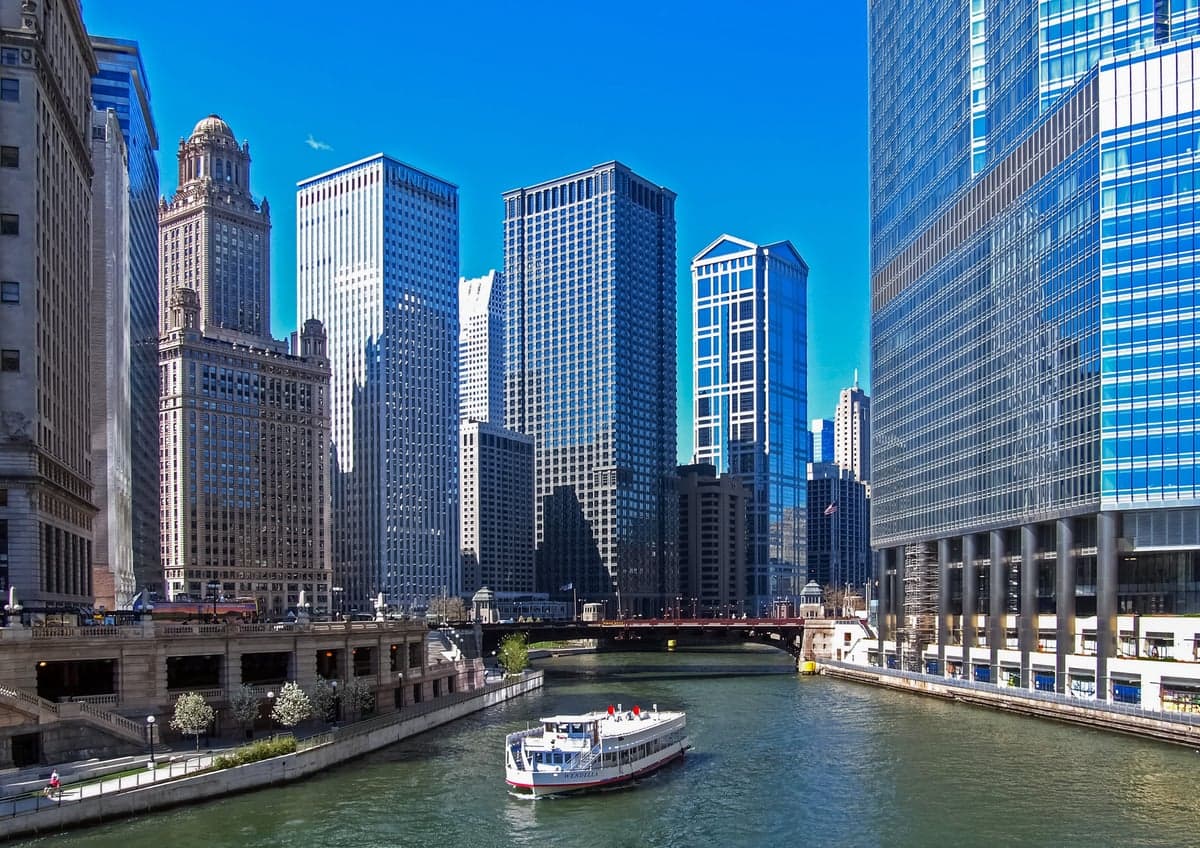
Photo: Wikipedia
Political ClimatePolitical Climate in Chicago, IL
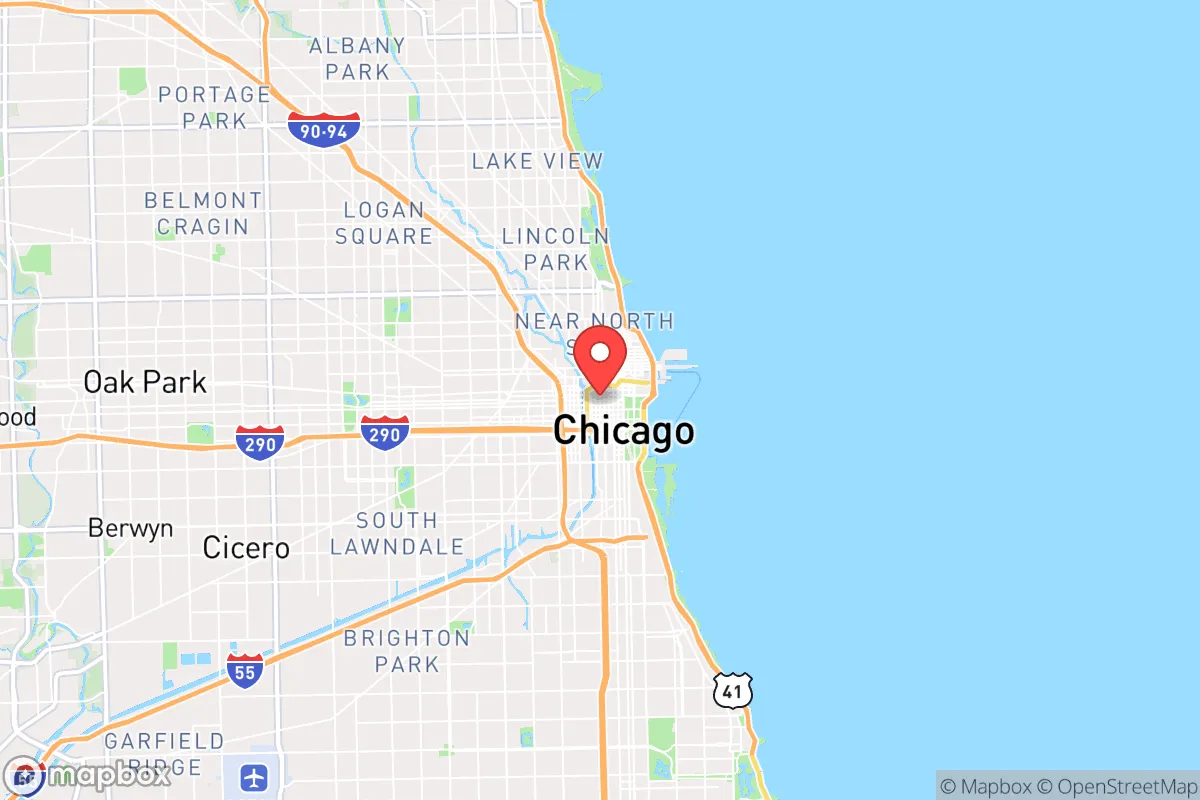
District shown is the primary district for this city’s centroid. Cities may span multiple districts.
Local Political AnalysisPolitical Analysis of Chicago, IL
Chicago is about as deep blue as it gets in American politics, with a Cook PVI of D+34 that makes it one of the most lopsided Democratic strongholds in the country. That number means the city votes 34 points more Democratic than the national average, and it’s been that way for decades—but the shift under the surface is what really matters. Back in the 1990s and early 2000s, you had a mix of moderate Democrats and even some Republicans in the suburbs and wards, but now it’s a one-party machine where progressive activists call the shots. The trajectory is clear: the city has moved hard left, and it’s not slowing down.
How it compares
If you drive just 30 miles west to places like Naperville or Wheaton, you’ll find a completely different political world—those areas lean Republican, with DuPage County voting +8 R in 2024. Even closer in, the suburban collar counties like Lake and McHenry have pockets of red, but Chicago itself is an island of progressive dominance. The contrast is stark: while the city’s aldermen push for defunding police and sanctuary city policies, towns like Orland Park and Tinley Park in the southwest suburbs are fighting to keep property taxes low and schools focused on basics. The state legislature in Springfield is also deep blue, so there’s no real check on Chicago’s agenda from the rest of Illinois—rural counties downstate might as well be a different country politically.
What this means for residents
For the average person living here, the political climate translates into some real headaches. Property taxes are among the highest in the nation, and they keep climbing because the city and county governments can’t stop spending—pension obligations alone eat up a huge chunk of the budget. You’ve also got a mayor and city council that are increasingly cozy with progressive groups pushing things like ranked-choice voting, reparations task forces, and stricter gun control laws that go way beyond what the state requires. The crime situation is the most visible consequence: the city’s homicide rate hit 695 in 2024, and the response from City Hall has been to cut police funding while expanding social programs. If you value personal freedoms like the right to self-defense or keeping more of your paycheck, Chicago is a tough place to live. The government here doesn’t just tax heavily—it also regulates everything from short-term rentals to plastic bags to the type of light bulbs you can buy.
On the cultural side, Chicago has always been a union town and a blue-collar city, but that identity is fading fast. The old-school Democratic machine of Daley and Burke is gone, replaced by a younger, more ideological crowd that’s less interested in patronage and more interested in social engineering. The city’s sanctuary status means local police can’t cooperate with federal immigration enforcement, which has created tension in neighborhoods where residents feel less safe. Looking ahead, I’d expect more of the same: higher taxes, more regulations, and a government that sees itself as a social experiment rather than a service provider. If you’re thinking of moving here, just know that your vote won’t change much—the machine is too entrenched. But if you can afford the cost of living and don’t mind the politics, the food and culture are still world-class. Just don’t expect the city to get more conservative anytime soon.

State Political ClimatePolitical Climate in Illinois
State Political AnalysisPolitical Environment in the State
Illinois has long been a solidly blue state in presidential elections, voting Democratic by double digits in every cycle since 1992, but its political climate is far more complex than that top-line number suggests. The state is dominated by the Chicago metropolitan area, which accounts for roughly two-thirds of the population and drives the statewide Democratic lean, while the rest of Illinois—particularly downstate and the collar counties—has shifted sharply to the right over the past two decades. For a conservative considering a move here, the reality is a tale of two states: a deep-blue urban core that sets policy for the entire state, and a growing red resistance in the rural and exurban areas that feels increasingly powerless against Springfield’s one-party rule.
Urban vs. rural divide
The political map of Illinois is a textbook example of the urban-rural chasm. Cook County, home to Chicago, casts roughly 40% of the state’s votes and reliably delivers margins of 60-70% for Democrats. Surrounding collar counties—DuPage, Lake, Kane, McHenry, and Will—were once Republican strongholds but have trended blue in recent cycles, with DuPage County flipping to Biden in 2020 after decades of GOP dominance. Meanwhile, downstate regions like southern Illinois (think Marion, Carbondale, and the Metro East area near St. Louis) and central Illinois (Peoria, Bloomington-Normal, Springfield) have become deeply red, with many counties voting 70% or more for Trump in 2024. The divide is stark: drive 90 minutes southwest of Chicago’s Loop and you’re in territory where Trump flags fly from pickup trucks and local GOP offices are packed for meetings. The Chicago metro’s sheer population weight means downstate conservatives have little say in statewide elections, a frustration that fuels talk of secession—more on that later.
Policy environment
Illinois’s policy environment is a cautionary tale for anyone wary of government overreach. The state has the second-highest property tax burden in the nation (averaging over 2% of home value annually) and a flat income tax rate of 4.95% that’s been creeping upward—voters rejected a progressive income tax amendment in 2020, but the legislature keeps finding ways to raise revenue. The regulatory posture is heavy: Illinois is one of only a handful of states with a state-level assault weapons ban (passed in 2023 after the Highland Park parade shooting), and it requires a Firearm Owner’s Identification (FOID) card for any gun purchase, a system critics call an infringement on the Second Amendment. Education policy is dominated by the Chicago Teachers Union, which has pushed for progressive curricula and defund-the-police rhetoric, though downstate districts often resist. Healthcare is heavily regulated, with a state-run insurance exchange and Medicaid expansion under the Affordable Care Act. Election laws are among the most liberal in the country: no-excuse mail-in voting, same-day registration, and automatic voter registration are all in place, which conservatives argue opens the door to fraud, though no major scandals have been proven. The bottom line: if you value low taxes, gun rights, and local control, Illinois’s policy environment will feel like a constant uphill battle.
Trajectory & freedom
Over the past decade, Illinois has become less free by almost any measure. The 2023 assault weapons ban (HB 5471) was a major flashpoint, with hundreds of counties passing resolutions declaring themselves “sanctuary counties” for the Second Amendment—a symbolic but powerful protest. The state also eliminated cash bail in 2023 under the SAFE-T Act, a reform that conservatives argue endangers public safety by releasing violent offenders without financial accountability. On the parental rights front, Illinois has become a haven for gender-affirming care for minors, with a 2023 law (HB 4664) shielding providers from out-of-state lawsuits, a move that alarms parents who want medical decisions kept within the family. Property rights have been eroded by the state’s aggressive use of eminent domain for private development, particularly in Chicago. Taxation has only increased: the gas tax is indexed to inflation and was raised again in 2024, and the state’s pension debt—over $140 billion—looms as a ticking time bomb that will likely require even higher taxes. For a conservative, the trajectory is clear: Springfield is moving in a progressive direction on guns, criminal justice, and family policy, with little sign of reversal.
Civil unrest & political movements
Illinois has seen its share of political flashpoints. The 2020 George Floyd protests in Chicago turned violent, with looting and property damage in the Loop and along the Magnificent Mile, leading to a lasting sense of insecurity among residents. The city’s sanctuary city status—codified in the 2017 Trust Act—has made it a magnet for illegal immigration, with busloads of migrants sent from Texas overwhelming shelters and schools in 2023-2024. On the right, the “Illinois Separation” movement has gained traction, with several downstate counties voting on non-binding referendums to explore seceding from Cook County and forming a new state. While legally impossible, the sentiment reflects deep alienation. Election integrity remains a hot-button issue: the 2020 election saw widespread use of mail-in ballots, and while no major fraud was proven, many conservatives remain skeptical of the state’s lax voter ID laws. The most visible flashpoint for a new resident would be the constant political tension between Chicago’s progressive machine and the rest of the state’s conservative resistance, visible in everything from yard signs to local news coverage.
Projection
Looking ahead 5-10 years, Illinois’s political trajectory is likely to continue its current path, but with growing friction. Demographic trends favor Democrats: Chicago’s population is declining (down 2% since 2020), but the suburbs are diversifying and trending blue, while downstate areas are aging and shrinking. In-migration is net negative—Illinois lost over 100,000 residents in 2023 alone, many of them conservatives moving to Texas, Florida, or Indiana—which only reinforces the state’s blue tilt. The pension crisis will force either massive tax hikes or service cuts, likely accelerating the exodus of businesses and families. However, the rural resistance is not going away; expect more county-level “sanctuary” resolutions, more legal challenges to state gun laws, and possibly a serious push for a constitutional amendment to allow county secession. For a conservative moving in now, the realistic expectation is that Illinois will remain a one-party state for the foreseeable future, with policies that feel increasingly out of step with your values.
For a new resident, the bottom-line implication is this: Illinois offers world-class amenities—top-tier universities, vibrant cultural institutions, and strong infrastructure—but at the cost of high taxes, heavy regulation, and a political climate that is actively hostile to conservative principles. If you’re willing to fight for your rights at the local level and can afford the tax burden, places like the collar counties (McHenry, Kendall) or downstate towns (Edwardsville, Quincy) offer like-minded communities. But if you’re looking for a state where your vote will actually move the needle on policy, Illinois is not that place. Come for the job or the family ties, but don’t expect the politics to change anytime soon.
* Values derived from national, state, county, city and local statistics and may differ in a specific area. Last updated: 2026-04-13T20:10:41.000Z
Narrative content on this page is AI-generated and may contain mistakes. Verify any details that matter before acting on them.
ReloMaps may earn a commission from affiliate links at no extra cost to you.

