Photo: Wikipedia
Demographics of Cincinnati, OH
Affluence Level in Cincinnati, OH
A below-average socioeconomic profile. Incomes, home values, and educational attainment trail the U.S., with higher poverty and unemployment.
People of Cincinnati, OH
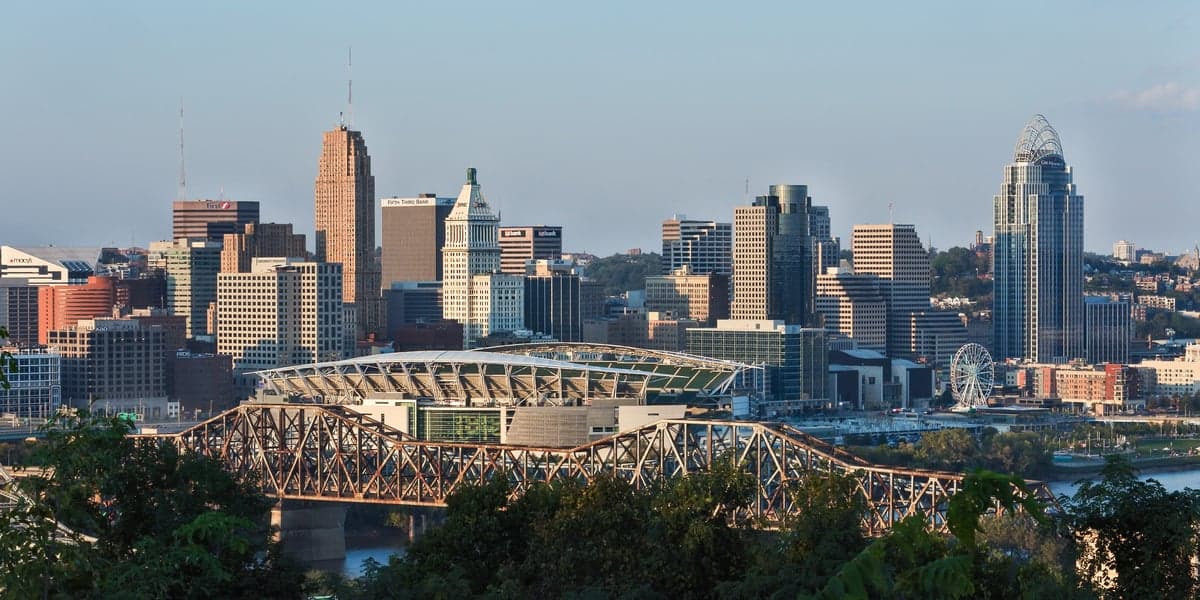
The people of Cincinnati today form a moderately dense, historically rooted urban population of 309,595, characterized by a near-even split between White (48.0%) and Black (38.5%) residents, with small but growing Hispanic (5.4%) and East/Southeast Asian (1.5%) communities. The city is notably less foreign-born (4.6%) than the national average, giving it a distinctly American-born, multi-generational character. Cincinnatians are relatively well-educated, with 41.3% holding a college degree, and they maintain a strong sense of neighborhood identity, from the historic German enclaves of Over-the-Rhine to the Appalachian-influenced hillsides of Price Hill.
How the city was settled and grew
Cincinnati’s population history begins with its 1788 founding as a frontier outpost on the Ohio River, drawing Yankee settlers from New England and Mid-Atlantic states via the Northwest Territory land grants. The real demographic explosion came with German and Irish immigration between 1830 and 1860, when the city became a manufacturing and pork-packing powerhouse. German immigrants built Over-the-Rhine into a dense, brewery-filled neighborhood that remains the city’s most intact 19th-century urban district, while Irish laborers settled in Mount Adams and along the riverfront. By 1900, Cincinnati was the nation’s 10th-largest city, with a population that was roughly 70% German-American. A second major wave came during the Great Migration (1910–1970), when Black families from the rural South moved north for industrial jobs in factories like Procter & Gamble and General Electric. They established communities in the West End and Avondale, which became the heart of Cincinnati’s Black cultural and civic life. Appalachian white migrants also arrived steadily from Kentucky and West Virginia, settling in Price Hill and Lower Price Hill, giving the city a distinct Southern-influenced working-class character that persists today.
Modern era (post-1965)
After the 1965 Hart-Cellar Act, Cincinnati saw only modest international immigration compared to coastal cities, with the foreign-born share remaining low at 4.6%. The most significant post-1965 shift was domestic: suburbanization and white flight drained the city’s population from a 1950 peak of 503,998 to 309,595 by 2020. The West End, once a thriving Black neighborhood, lost over half its population to highway construction and urban renewal, with many families relocating to Avondale and Roselawn. Hispanic growth has been steady but small, concentrated in Price Hill and Spring Grove Village, driven by Mexican and Central American immigrants working in construction and food service. East/Southeast Asian communities (1.5%) are primarily Chinese and Vietnamese, clustered near the University of Cincinnati in Clifton and in the northern suburbs. The Indian-subcontinent population (1.2%) is smaller and more dispersed, with professionals in healthcare and tech living in Hyde Park and Mount Lookout. The city’s Black population share has remained stable since 2000, while the White share has declined slightly as younger, college-educated whites move into gentrifying neighborhoods like Over-the-Rhine and Pendleton.
The future
Cincinnati’s population is slowly stabilizing after decades of decline, with the 2020 census showing a 4.2% gain from 2010—the first increase since 1950. The city is not homogenizing but rather tribalizing into distinct enclaves: gentrifying, predominantly white and college-educated neighborhoods (Over-the-Rhine, Oakley) contrast with persistently poor, majority-Black areas (Avondale, West End) and stable working-class white and Hispanic pockets (Price Hill). Immigrant communities are growing but from a very low base; the Hispanic share is projected to reach 7–8% by 2035, while East/Southeast Asian and Indian populations will likely remain small, driven by university and hospital employment. The biggest demographic story is the return of young professionals and empty-nesters to the urban core, attracted by the $6 billion in riverfront redevelopment and the revitalized streetcar line. However, this growth is concentrated and has not reversed the overall suburbanization of families with children, who continue to move to Anderson Township and Mason in the suburbs.
For someone moving to Cincinnati now, the city offers a racially diverse but highly segregated urban experience, with strong neighborhood identities and a population that is more rooted and less transient than in many peer cities. The low foreign-born share means less cultural diversity from immigration, but the city’s Black-white dynamic and Appalachian heritage give it a distinct American character. Newcomers should expect a place where neighborhood choice strongly determines daily life, from the walkable, brewery-filled streets of Over-the-Rhine to the quiet, family-oriented blocks of Oakley.

* Values derived from national, state, county, city and local statistics and may differ in a specific area. Last updated: 2026-04-21T22:54:56.000Z
Narrative content on this page is AI-generated and may contain mistakes. Verify any details that matter before acting on them.
ReloMaps may earn a commission from affiliate links at no extra cost to you.

