
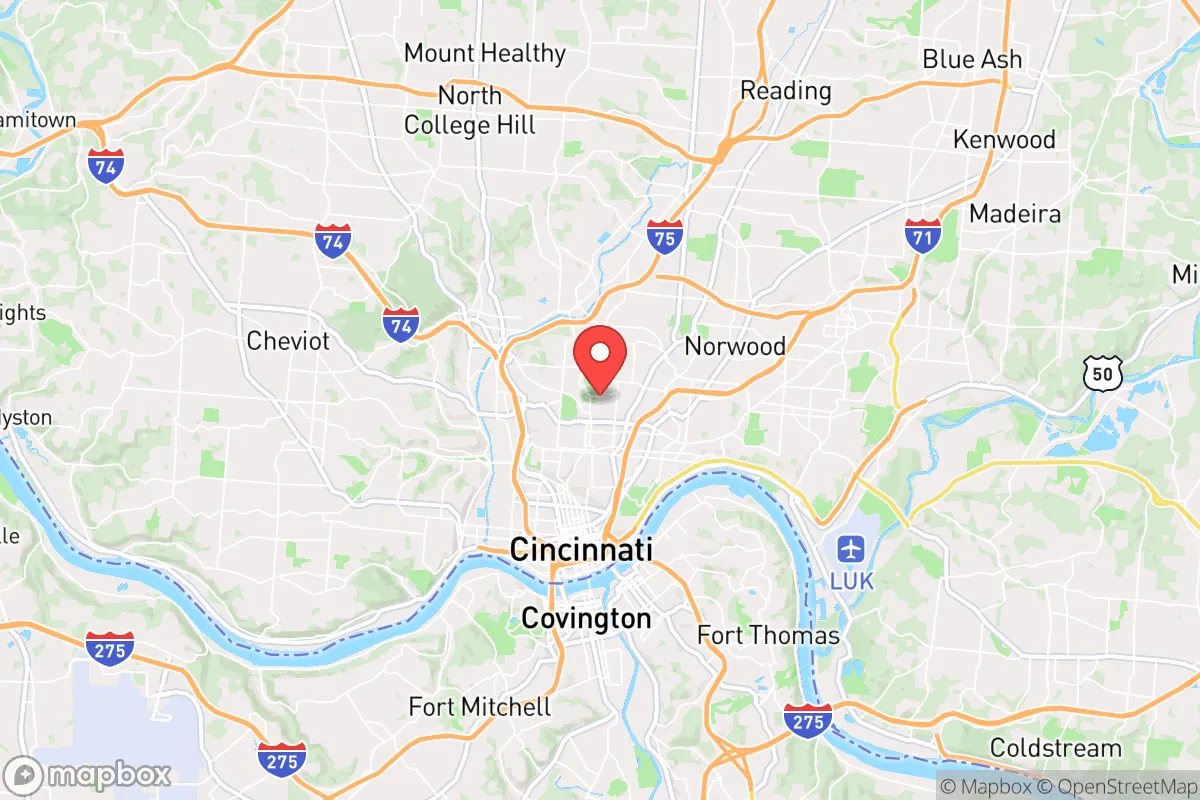
Photo: Wikipedia
Personal Sovereignty in Cincinnati, OH
Viable for self-reliance. Generally workable, though some barriers may limit total independence.
What does Personal Sovereignty tell us?
Personal Sovereignty measures your capacity for self-reliance and independence with minimal government friction. Higher scores mean fewer barriers between you and the way you want to live... but it assumes you have the space you need and good neighbors.
What does this tell us?
Personal Sovereignty measures your capacity for self-reliance and independence with minimal government friction. Higher scores mean fewer barriers between you and the way you want to live... but it assumes you have the space you need and good neighbors.
State Policy
Energy independence: Importer (40% of energy produced in-state)
Personal Liberty
Homesteading

Personal Liberty Analysis
Cincinnati offers a mixed bag for those prioritizing personal sovereignty, sitting in a state that generally respects individual rights while operating within a metropolitan area that leans left on governance. For the survivalist or prepper, the key takeaway is that Ohio’s state-level protections—particularly on gun rights and property use—provide a buffer against the more restrictive impulses of Hamilton County and Cincinnati city hall. However, the tax burden and regulatory climate here are heavier than in rural Ohio or neighboring Kentucky, meaning you’ll need to pick your neighborhood carefully to maximize autonomy. The city’s position on the Ohio River, with easy access to both blue and red states, offers strategic flexibility for those who value the option to relocate quickly if the political winds shift.
Tax burden and regulatory posture in Cincinnati
Ohio’s state income tax is a flat 3.5% as of 2026, which is moderate compared to high-tax states like New York or California, but Cincinnati adds a 2.1% city income tax on residents and a 1.8% tax on non-residents working within city limits. This double-layer taxation is a real hit to your disposable income—money that could otherwise go toward supplies, land, or self-reliance projects. Property taxes in Hamilton County average around 1.8% of assessed value, slightly above the national median, and the city’s zoning code is dense and bureaucratic. For the prepper, this means that anything beyond standard home improvements—like building a detached workshop, installing a large water cistern, or keeping chickens—requires permits and inspections that can be denied or delayed. The regulatory posture is distinctly urban: the city prioritizes density and development over individual property rights, so if you’re looking to run a small homestead or operate a home-based business without red tape, you’ll find more freedom in the surrounding townships like Colerain or Anderson.
Self-defense and gun law specifics in Ohio
Ohio is a constitutional carry state, meaning no permit is required to carry a concealed firearm for anyone legally allowed to possess one. This is a strong point for personal sovereignty—you can defend yourself without asking the government for permission. Cincinnati itself has a history of local gun control attempts, but state preemption laws block cities from passing their own restrictions, so the city’s anti-gun city council can’t ban magazines or require extra permits. Stand-your-ground laws are in effect, with no duty to retreat in any place you’re lawfully present. However, be aware that Hamilton County’s prosecutor tends to be more aggressive on self-defense claims than in rural counties, so if you use force, expect a thorough investigation. For the prepper, this means your legal right to defend your home and family is solid, but the political climate in Cincinnati may make you a target for scrutiny. The best bet is to keep a low profile and know your local laws inside out—especially around magazine capacity, which is unrestricted at the state level.
Self-reliance and homesteading viability in the Cincinnati area
Within Cincinnati proper, lot sizes are small—typically 0.1 to 0.25 acres in most neighborhoods—making serious homesteading difficult. Zoning restricts livestock, with chickens often limited to a few hens and no roosters, and larger animals like goats or pigs are outright banned in most residential zones. Off-grid living is nearly impossible inside city limits: building codes require grid-tied electrical systems, and rainwater collection is limited to 2,500 gallons without a permit. However, the surrounding suburbs and exurbs offer far more freedom. In Clermont County to the east or Warren County to the north, you can find 1- to 5-acre lots with agricultural zoning, allowing for gardens, small livestock, and even limited hunting on your own land. The cost per acre in these areas runs $10,000 to $25,000, which is reasonable compared to coastal states. For the serious prepper, the strategy is to buy land outside the city—say, in the hills near Batavia or Morrow—and commute in for work. This gives you the autonomy to build a self-sufficient setup while still accessing Cincinnati’s job market and supply chains.
Personal liberties in Cincinnati: parental rights, medical autonomy, speech, and property
Parental rights in Ohio are relatively strong: the state has a Parents’ Bill of Rights that requires schools to notify parents of medical or mental health services and prohibits instruction on sexual orientation in grades K-3. Cincinnati Public Schools, however, have been known to push back on these laws, so if you’re a parent, you’ll want to monitor your child’s curriculum closely or consider homeschooling, which is legal with minimal regulation—just a notification and an annual assessment. Medical autonomy is a mixed bag: Ohio has no vaccine mandate for adults, but COVID-era mandates from the city did cause friction, and the state’s medical freedom laws are weaker than in places like Idaho or Montana. Speech is protected under the First Amendment, but Cincinnati’s city council has passed resolutions that could be seen as chilling, like declaring certain viewpoints as “hate speech” in non-binding resolutions—though these have no legal force. Property rights are the biggest concern: the city has aggressive eminent domain powers and has used them for development projects, like the redevelopment of the West End. For the prepper, this means your home could theoretically be taken for a private development if the city deems it “blighted,” so owning land in a township with stronger property protections is a safer bet.
Overall, Cincinnati provides a baseline of personal sovereignty that is better than deep-blue cities like Chicago or Portland, but worse than rural Ohio or states like Texas or Florida. The state-level protections on guns and parental rights give you a foundation, but the city’s tax burden, zoning restrictions, and political culture create friction for anyone serious about self-reliance. For the strategic relocator, the smart play is to live in a surrounding county—like Clermont, Warren, or Butler—where you get lower taxes, fewer regulations, and more land, while still having Cincinnati’s infrastructure within a 30-minute drive. This hybrid approach lets you enjoy the economic opportunities of a major metro while keeping your autonomy intact, ready to weather whatever the future brings. If you’re looking for a place where you can truly be left alone, Cincinnati isn’t it—but the region around it offers a solid compromise for those who value both freedom and access.

* Values derived from national, state, county, city and local statistics and may differ in a specific area. Last updated: 2026-04-21T22:54:56.000Z
Narrative content on this page is AI-generated and may contain mistakes. Verify any details that matter before acting on them.
ReloMaps may earn a commission from affiliate links at no extra cost to you.

