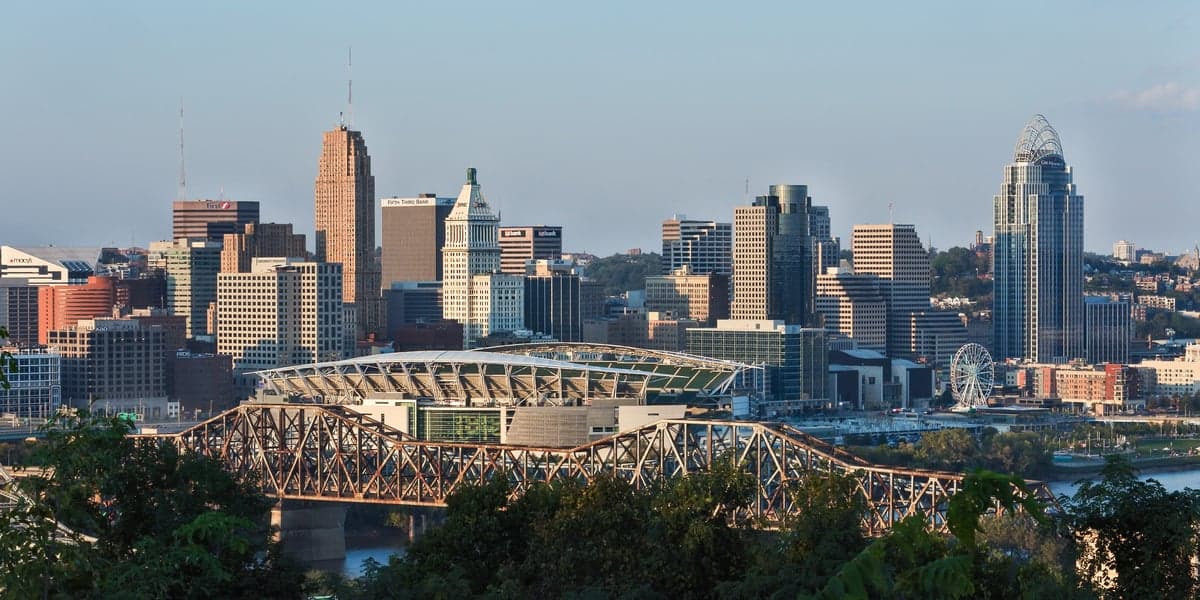
Photo: Wikipedia
Political ClimatePolitical Climate in Cincinnati, OH
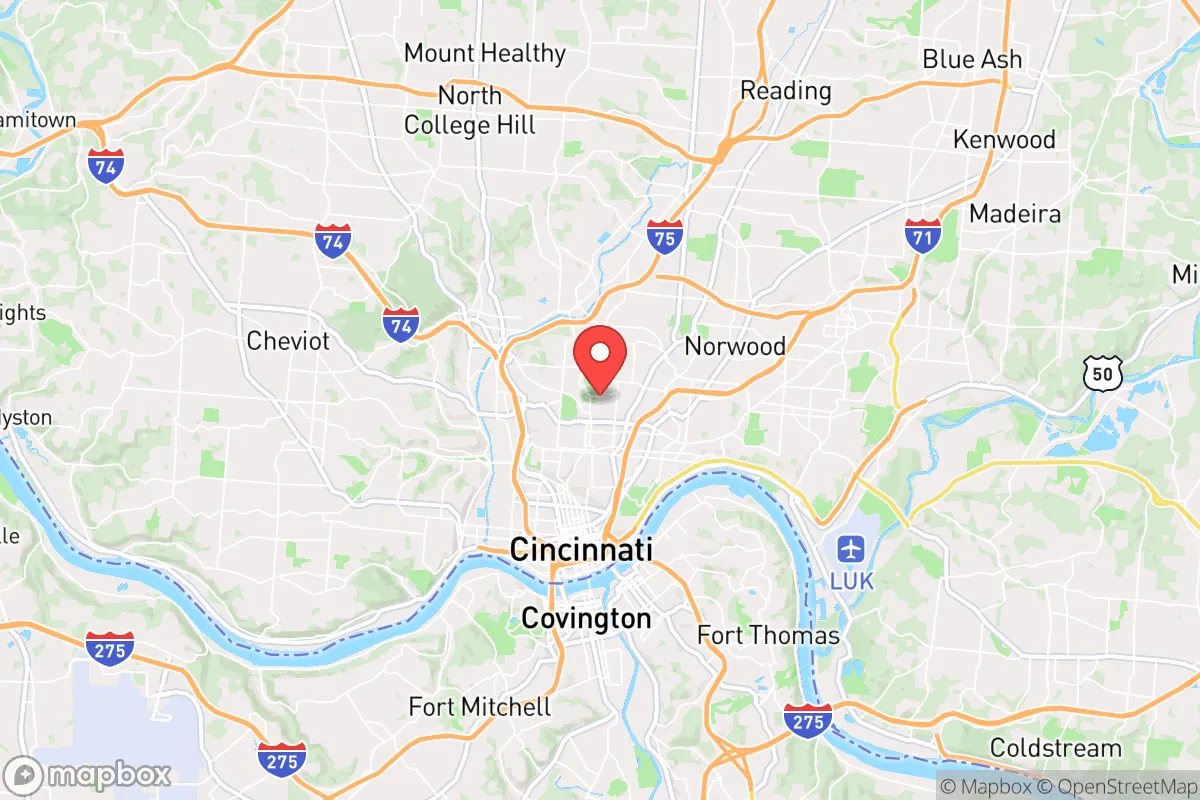
District shown is the primary district for this city’s centroid. Cities may span multiple districts.
Local Political AnalysisPolitical Analysis of Cincinnati, OH
Cincinnati sits in a political tug-of-war that’s gotten a lot more lopsided in recent years. The city itself leans left, with a Cook PVI of D+3, but that number doesn’t tell the whole story—it masks a deep divide between the urban core and the surrounding suburbs and exurbs where a lot of us actually live, work, and raise our kids. Twenty years ago, this was a reliably purple area where both parties had a real say; now, you can feel the shift toward progressive policies in city hall, and it’s making a lot of long-time residents nervous about where things are headed.
How it compares
If you drive just 15 minutes north to places like West Chester or Liberty Township, you’re in solidly red territory—those areas voted +20 points for Trump in 2020 and haven’t budged since. Same story east toward Loveland or south across the river into Northern Kentucky’s Boone County. But inside the 275 loop, especially in neighborhoods like Over-the-Rhine, Clifton, and Northside, the politics are aggressively progressive. The contrast is stark: you can go from a neighborhood where the city council is pushing defund-the-police rhetoric to a suburb where the biggest local controversy is a school board mask mandate. That split means the region’s political climate isn’t one thing—it’s a patchwork, and the city’s D+3 rating is really just an average of two very different worlds.
What this means for residents
For folks who value personal freedom and limited government, living inside Cincinnati proper has become a game of whack-a-mole with overreach. The city council has floated everything from mandatory paid leave mandates that hit small businesses hard to zoning changes that make it tougher to own a single-family home without jumping through bureaucratic hoops. There’s a real concern that the progressive majority sees government as the solution to every problem—whether it’s rent control proposals that economists say backfire or new taxes on plastic bags that feel more like a nanny-state move than environmental policy. Meanwhile, the suburbs are pushing back hard: Hamilton County’s rural townships have passed symbolic resolutions opposing state-level gun restrictions, and school boards in Mason and Kings Mills have fought to keep curriculum decisions local. The bottom line is that if you live inside the city limits, you’re increasingly subject to one-size-fits-all rules from a council that doesn’t always respect the diversity of opinion in its own backyard.
Culturally, Cincinnati has always been a bit of a conservative-leaning blue-collar town—think chili parlors, church picnics, and a strong union history that was more about wages than woke politics. But the last decade has brought a wave of transplants from coastal cities, drawn by low cost of living, and they’ve brought their politics with them. You see it in the push to rename streets, the fight over Confederate monuments (which, frankly, were never a big deal here), and the pressure on local businesses to adopt DEI quotas. The city’s 2021 police reform ballot measure, Issue 7, was a flashpoint—it would have stripped the police union of collective bargaining rights and mandated chokehold bans, and it passed by a narrow margin before being struck down by the state. That kind of thing makes you wonder: how long before the next overreach comes down the pike? If you’re looking for a place where the government stays out of your life and your wallet, the suburbs are still holding the line, but the city itself is a cautionary tale of how fast a purple town can turn blue when nobody’s watching.

State Political ClimatePolitical Climate in Ohio
State Political AnalysisPolitical Environment in the State
Ohio is a classic purple state with a distinct red tilt that has hardened over the past decade, voting for Donald Trump by 8 points in both 2020 and 2024 after backing Barack Obama twice by slim margins. The state’s political center of gravity has shifted decisively rightward since 2010, driven by a collapse of Democratic support in rural and exurban areas, even as the major metros of Columbus, Cleveland, and Cincinnati remain blue-leaning. For a conservative considering relocation, Ohio offers a mixed bag: a state government that has aggressively pursued conservative policy wins on taxes, guns, and parental rights, but with a persistent blue-voter base in the cities that keeps statewide races competitive and occasionally delivers surprises.
Urban vs. rural divide
The political map of Ohio is a textbook study in the urban-rural chasm. The three C’s — Columbus, Cleveland, and Cincinnati — are the Democratic strongholds, with Franklin County (Columbus) delivering 65% for Biden in 2020 and Cuyahoga County (Cleveland) hitting 67%. Hamilton County (Cincinnati) is more competitive but still leans blue, going 60% for Biden. Outside these islands, the state is overwhelmingly red. The rural counties of the Appalachian southeast — places like Meigs County and Vinton County — routinely give Republicans 75-80% of the vote. The western and northwestern farm counties, such as Mercer County and Auglaize County, are similarly deep red. The most dramatic shift has been in the exurban and small-city counties that once were swing areas. Delaware County, north of Columbus, went from a 52-46 Obama win in 2008 to a 60-38 Trump win in 2020. Butler County, north of Cincinnati, flipped from a 51-48 Obama win in 2008 to a 65-33 Trump win in 2020. The Mahoning Valley around Youngstown, once a Democratic stronghold, has become a bellwether — it voted for Obama twice, then flipped to Trump by 4 points in 2016 and 8 points in 2020. The divide is stark: the cities are blue, the suburbs are trending red, and the countryside is deep crimson.
Policy environment
Ohio’s state-level policy environment has been solidly conservative since 2011, when Republicans took full control of the legislature and governorship. The income tax has been cut repeatedly — the top rate dropped from 5.925% in 2021 to 3.5% in 2025, with a goal of elimination. The state has a right-to-work law for public employees (passed in 2011, upheld by voters in a 2011 referendum), though private-sector right-to-work was repealed by the legislature in 2017. Property taxes are a mixed bag — no state property tax, but local levies are common and can be high in the metros. Education policy has seen a major push for school choice: Ohio has one of the largest voucher programs in the country, the EdChoice Scholarship, which now covers families up to 400% of the federal poverty line. In 2023, the legislature expanded eligibility to all families regardless of income, making it effectively universal. The state also has a robust charter school sector, though oversight has been controversial. On healthcare, Ohio did not expand Medicaid under the ACA until 2014, and the program has been maintained, but the state has not pursued a state-based exchange or other progressive expansions. Election laws have tightened: voter ID requirements were strengthened in 2023, requiring a photo ID for in-person voting, and absentee ballot drop boxes were limited to one per county. Early voting hours were also standardized. The state has a Republican supermajority in both chambers, and the governor’s office has been held by Republicans since 2011 (John Kasich 2011-2019, Mike DeWine 2019-present). The state supreme court flipped to a 4-3 Republican majority in 2023 after a contentious election.
Trajectory & freedom
Ohio has been on a clear trajectory of expanding personal liberty in several key areas, though with some notable exceptions. On gun rights, Ohio became a constitutional carry state in 2022, allowing permitless concealed carry for adults 21 and older. The state also passed a “stand your ground” law in 2021, removing the duty to retreat before using deadly force. On parental rights, the legislature passed the “Parents’ Bill of Rights” in 2023, requiring schools to notify parents of any changes to a student’s health or well-being and prohibiting instruction on sexual orientation or gender identity in grades K-3. The law also requires schools to adopt policies on student privacy and parental access to curriculum. On medical autonomy, Ohio voters approved a constitutional amendment in 2023 legalizing recreational marijuana for adults 21 and older, though the legislature has since moved to regulate it heavily, including limiting home grow and capping THC potency. The same election saw voters reject a proposed amendment that would have enshrined abortion rights in the state constitution, though the issue remains contentious. On taxation, the trajectory is clearly toward lower rates, with the income tax on track for elimination. However, property taxes remain a concern, especially in the metros where school levies and local government taxes can push effective rates above 2%. The state has not passed a property tax cap or freeze, leaving homeowners exposed to rising assessments. Overall, Ohio is becoming more free on guns, parental rights, and taxes, but less free on marijuana regulation and property tax exposure.
Civil unrest & political movements
Ohio has seen its share of political flashpoints in recent years. The 2020 protests in Columbus and Cincinnati over the death of George Floyd were large but largely peaceful, though there were instances of property damage and looting in downtown Columbus. The state saw a significant uptick in organized activism on both sides. On the right, the “Ohio Freedom Alliance” and local “Moms for Liberty” chapters have been active in school board races and curriculum battles, particularly in suburban districts like Dublin and Mason. On the left, the “Ohio Organizing Collaborative” and “ProgressOhio” have pushed for criminal justice reform and expanded voting access. Immigration politics have been relatively quiet compared to border states, but there have been flashpoints over sanctuary policies. Cleveland and Columbus have declared themselves “sanctuary cities” in various forms, limiting cooperation with federal immigration enforcement. In 2024, the state legislature passed a law requiring local law enforcement to cooperate with ICE detainers and banning sanctuary policies, though it was vetoed by Governor DeWine and then overridden by the legislature. Election integrity has been a major issue since 2020, with the legislature passing the aforementioned voter ID law and limiting drop boxes. There have been no widespread fraud allegations that have held up in court, but the issue remains a rallying point for conservative activists. The most visible political movement in recent years has been the fight over Issue 1 in 2023, which would have raised the threshold for constitutional amendments to 60% — it was defeated by a 57-43 margin, a rare loss for the conservative coalition in a statewide vote.
Projection
Over the next 5-10 years, Ohio is likely to continue its slow drift rightward, but with significant caveats. The demographic trends are mixed: the state’s population is aging and growing slowly, with most growth concentrated in the Columbus metro and the Cincinnati suburbs. The rural counties are losing population, which will reduce their electoral weight over time. The in-migration patterns are not as dramatic as in Sun Belt states, but there is a noticeable inflow of conservatives from blue states like California and Illinois, particularly to the exurban counties around Columbus and Cincinnati. This will likely reinforce the red tilt in those areas. However, the urban cores are also growing, especially Columbus, which is attracting young professionals and immigrants. This could keep the state competitive at the statewide level. The most likely scenario is that Ohio remains a lean-Republican state, with Republicans holding the legislature and governor’s office, but with occasional Democratic wins in close races — similar to what we saw in the 2023 Supreme Court election and the 2024 Senate race (which was competitive but ultimately won by Republican Bernie Moreno). The policy trajectory will continue toward lower taxes, expanded school choice, and tighter election laws. The wild card is the marijuana issue: if the regulated market proves chaotic or leads to increased public health problems, there could be a backlash that strengthens the conservative coalition. For a new resident, the bottom line is that Ohio offers a stable, increasingly conservative policy environment, but with enough urban blue to keep things interesting. You’ll find a state that respects gun rights, parental authority, and low taxes, but you’ll also have to deal with high property taxes in the metros and the occasional progressive victory at the ballot box. It’s a solid bet for a conservative looking for a balanced, affordable place to live, but don’t expect a Texas-style red state — Ohio is still a purple state that leans red, not a deep red one.
For a conservative moving to Ohio, the practical takeaway is this: you’ll find a state government that largely shares your values on taxes, guns, and education, but you’ll need to be strategic about where you settle. The exurban counties like Delaware, Warren, and Medina offer the best combination of conservative politics, good schools, and affordable housing. The urban cores are blue and will remain so, but they also offer jobs and amenities. The rural areas are deeply red but often lack economic opportunity. Ohio is not a place where you can take conservative governance for granted — you’ll need to stay engaged in local politics, especially school board races and ballot initiatives, to protect the gains that have been made. But if you’re willing to put in that effort, Ohio offers a solid foundation for a conservative life.
* Values derived from national, state, county, city and local statistics and may differ in a specific area. Last updated: 2026-04-21T22:54:56.000Z
Narrative content on this page is AI-generated and may contain mistakes. Verify any details that matter before acting on them.
ReloMaps may earn a commission from affiliate links at no extra cost to you.

