Photo: Wikipedia
Demographics of Cleveland Heights, OH
Affluence Level in Cleveland Heights, OH
A middle-class area roughly in line with national averages across income, home values, education, and employment.
People of Cleveland Heights, OH
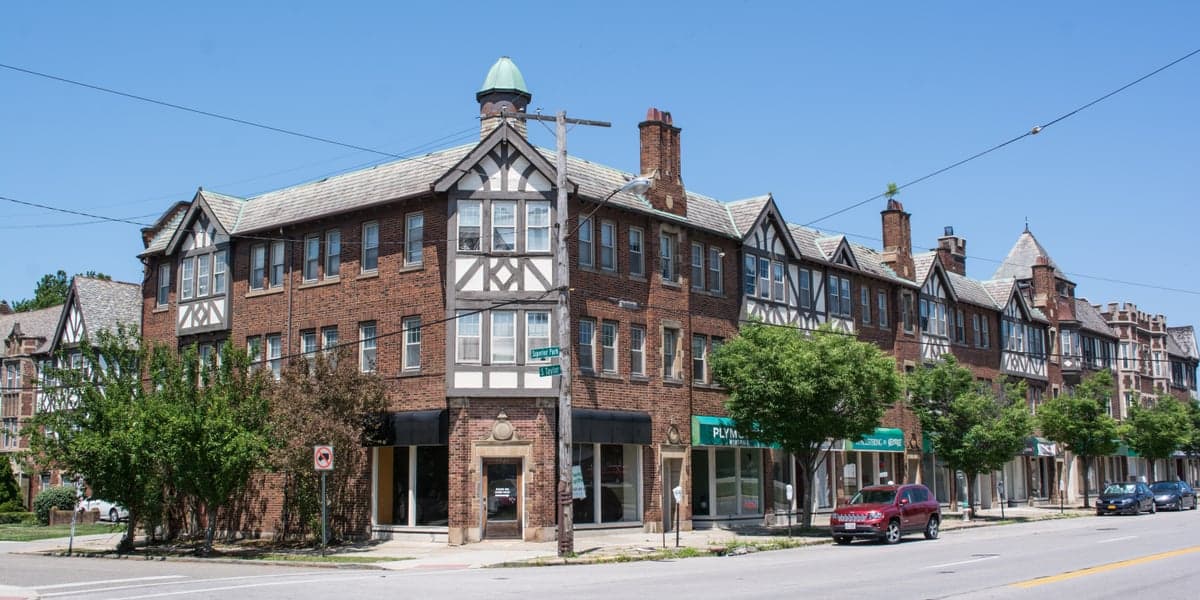
Cleveland Heights, Ohio, is a densely settled inner-ring suburb of 44,694 residents that blends historic pre-war architecture with a notably diverse and highly educated population. The city stands out for its racial balance—47.9% white and 39.2% Black—and its exceptionally high college attainment rate of 57.5%, nearly double the national average. Foreign-born residents make up just 4.0% of the population, with East/Southeast Asian communities at 3.2% and Indian-subcontinent residents at 2.3%, while Hispanic residents account for 2.8%. This is a place where old-money Cleveland families, Black professionals, and university-affiliated newcomers coexist in a walkable, transit-linked environment that feels more urban than suburban.
How the city was settled and grew
Cleveland Heights was not a colonial settlement but a planned streetcar suburb that boomed after 1900. Its original population was drawn by the construction of the Euclid Heights streetcar line in the 1890s, which opened the wooded heights above Cleveland to development. The earliest residents were affluent white Protestants and Jews fleeing the industrializing city center, building grand homes in the Euclid Heights and Fairmount Boulevard neighborhoods. A second wave came during the 1920s housing boom, when middle-class white families—many of German, Irish, and Italian descent—filled the Coventry Village and Noble neighborhoods with the duplexes and bungalows that still define those areas. By 1930, Cleveland Heights had grown to over 50,000 residents, nearly all white, and was one of the wealthiest suburbs in Ohio. The post-World War II era brought a third wave: Jewish families moving east from the city's Glenville and Mount Pleasant neighborhoods, settling heavily in the Taylor Road and Mayfield Road corridors, where synagogues and Jewish community institutions anchored a vibrant middle-class enclave through the 1960s.
Modern era (post-1965)
The 1965 Hart-Cellar Act and the broader Fair Housing movement reshaped Cleveland Heights dramatically. Black families, many from Cleveland's Hough and Glenville neighborhoods, began moving into the city in the late 1960s and 1970s, initially concentrated in the Noble and Monticello areas near the eastern border. White flight to outer-ring suburbs like Solon and Beachwood accelerated through the 1970s and 1980s, but Cleveland Heights avoided the complete racial turnover seen in neighboring East Cleveland. The city's housing stock—large, affordable century homes and duplexes—attracted a new wave of white college graduates and young professionals starting in the 1990s, particularly in Coventry Village and Cedar Fairmount, where walkable commercial districts and proximity to University Circle drew faculty, artists, and medical workers. Today, the city is racially integrated but geographically patterned: Black residents are more concentrated in the eastern and southern sections (Noble, Monticello), while white residents cluster in the western and central neighborhoods (Euclid Heights, Fairmount, Coventry). The East/Southeast Asian and Indian-subcontinent populations, though small, are dispersed but slightly more visible near the university-adjacent Cedar-Lee and Coventry areas.
The future
Cleveland Heights is not homogenizing; it is slowly tribalizing into distinct enclaves by income and lifestyle, though race remains a dividing line. The Black population has held steady near 39% for two decades, while the white share has stabilized after decades of decline. The foreign-born share remains low at 4.0%, and neither the East/Southeast Asian nor Indian-subcontinent communities show signs of rapid growth—these groups are likely to remain small, professional cohorts rather than forming ethnic enclaves. The most significant demographic trend is the influx of young, college-educated white renters and buyers drawn by the city's historic housing stock and proximity to Cleveland's job centers, which is gradually raising property values and pushing some long-term Black renters toward more affordable suburbs like Warrensville Heights or Bedford. Over the next 10–20 years, Cleveland Heights will likely become more economically stratified—a core of affluent professionals in the western neighborhoods, a stable Black middle class in the east, and a shrinking working-class presence citywide. The city's high tax burden and aging infrastructure may slow growth, but its walkable urbanism and cultural assets will continue to attract a niche but committed population.
For a conservative-leaning mover today, Cleveland Heights offers a dense, diverse, and politically progressive environment that rewards engagement with local institutions—schools, block clubs, and civic groups—rather than privacy and isolation. It is not a place of rapid growth or ethnic transformation, but of slow, deliberate change driven by educated professionals who value urban character over suburban convenience. The city is becoming more expensive and more stratified, but its core identity as a racially integrated, intellectually vibrant inner-ring suburb remains intact.

* Values derived from national, state, county, city and local statistics and may differ in a specific area. Last updated: 2026-04-21T18:21:56.000Z
Narrative content on this page is AI-generated and may contain mistakes. Verify any details that matter before acting on them.
ReloMaps may earn a commission from affiliate links at no extra cost to you.

