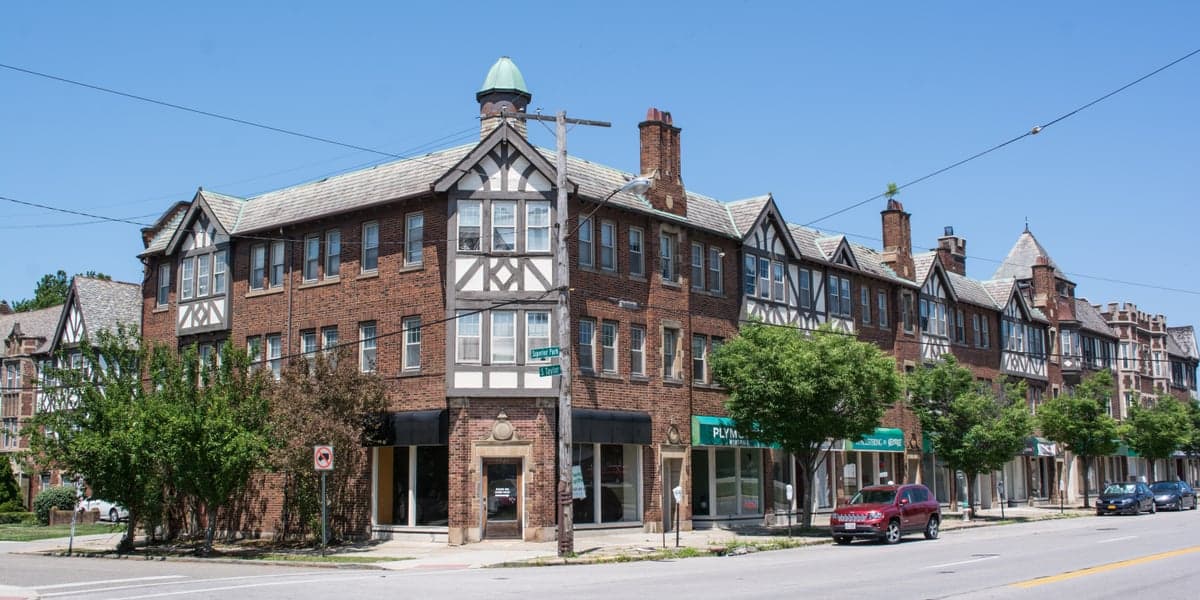
Photo: Wikipedia
Personal Sovereignty in Cleveland Heights, OH
Viable for self-reliance. Generally workable, though some barriers may limit total independence.
What does Personal Sovereignty tell us?
Personal Sovereignty measures your capacity for self-reliance and independence with minimal government friction. Higher scores mean fewer barriers between you and the way you want to live... but it assumes you have the space you need and good neighbors.
What does this tell us?
Personal Sovereignty measures your capacity for self-reliance and independence with minimal government friction. Higher scores mean fewer barriers between you and the way you want to live... but it assumes you have the space you need and good neighbors.
State Policy
Energy independence: Importer (40% of energy produced in-state)
Personal Liberty
Homesteading

Personal Liberty Analysis
Cleveland Heights, Ohio, presents a complex environment for personal sovereignty, where the local political culture often clashes with the individualist and survivalist mindset. As a dense, inner-ring suburb of Cleveland with a strong progressive governance structure, the city imposes a regulatory framework that can feel restrictive to those prioritizing autonomy, self-reliance, and minimal government overreach. While Ohio’s state-level preemption laws provide a floor for certain rights—particularly around firearms and property use—the city’s local ordinances, tax burden, and zoning codes create a landscape where personal freedom is frequently negotiated with municipal authority. For a conservative-leaning individual or family weighing relocation, the key question is whether the trade-offs of living in a high-tax, high-regulation environment are worth the community’s other attributes, or if the sovereignty calculus leans decisively toward less restrictive alternatives in the region.
Tax burden and regulatory posture: what you pay for local control
Cleveland Heights imposes a significant financial cost on residents, which directly impacts personal sovereignty by reducing disposable income and the capacity for self-directed investment. The city’s combined income tax rate is 2.25% (2.0% for residents, 0.25% for school district), applied to both earned income and business profits, with no credit for taxes paid to other municipalities—a notable burden for those who work outside the city. Property taxes are also high, with effective rates often exceeding 2.5% of assessed value, driven by the Cleveland Heights-University Heights City School District levy. This tax posture reflects a local government that funds extensive public services, including a robust police force, parks, and social programs, but it also means residents have less capital for private preparedness, land improvements, or emergency savings. The regulatory environment is similarly assertive: the city enforces strict rental registration and inspection programs, noise ordinances, and business licensing requirements that can feel like bureaucratic overreach to those accustomed to rural or exurban freedom. For a prepper or survivalist, the high tax burden is a direct subtraction from self-reliance capital, and the dense regulatory web means fewer opportunities to operate under the radar.
Self-defense and gun law specifics: state preemption vs. local culture
Ohio’s statewide preemption laws provide a critical safeguard for gun rights in Cleveland Heights, preventing the city from enacting its own bans on firearms ownership, concealed carry, or magazine capacity. This means that Ohio’s permitless carry law (effective June 2022) applies fully within city limits—any law-abiding adult 21 or older can carry a concealed handgun without a permit. Additionally, the state’s “stand your ground” and “castle doctrine” statutes are in effect, offering legal protection for the use of deadly force in self-defense when facing an unlawful intruder or imminent threat. However, the local political culture is decidedly anti-gun. The city council has passed symbolic resolutions supporting state-level gun control, and the police department is known for proactive enforcement of state laws like the duty to inform officers during traffic stops. While you cannot be prosecuted for legal carry, the social and administrative friction is real: finding a gun-friendly gunsmith, range, or retailer within the city is difficult, and many residents report a chilly reception when exercising their Second Amendment rights. For a survivalist, the legal framework is adequate, but the cultural hostility means you’ll likely need to travel to more gun-friendly suburbs or rural areas for training, supplies, and community.
Self-reliance and homesteading viability: lot sizes, zoning, and off-grid feasibility
Cleveland Heights is fundamentally a dense, urban environment, and its zoning code is a major obstacle to self-reliance and homesteading ambitions. The typical residential lot is 50 to 60 feet wide, with most homes on 0.1 to 0.25 acres—far too small for significant food production, livestock, or water independence. The city’s zoning ordinances explicitly prohibit keeping chickens, goats, bees, or any farm animals on residential lots under one acre, and even vegetable gardens are subject to setback and height restrictions. Rainwater collection is not prohibited by state law, but the city’s building code requires permits for any system that connects to the home’s plumbing, and large-scale cisterns are impractical on small lots. Off-grid energy generation, such as solar panels, is permitted but heavily regulated: you must obtain a building permit, comply with historic district design guidelines (if applicable), and interconnect with the grid—meaning true energy independence is not feasible. For a prepper seeking to reduce reliance on municipal systems, Cleveland Heights offers almost no room for meaningful self-sufficiency. The best you can do is container gardening, small-scale composting, and stocking supplies in a basement or garage. If homesteading is a priority, this city is a poor fit; you would need to look to outlying counties like Geauga or Medina for acreage and permissive zoning.
Personal liberties: parental rights, medical autonomy, speech, and property
On the spectrum of personal liberties, Cleveland Heights leans heavily toward collective decision-making over individual autonomy. Parental rights are constrained by the school district’s progressive policies: the Cleveland Heights-University Heights City School District has implemented comprehensive diversity, equity, and inclusion (DEI) curricula, gender identity support policies that allow students to use preferred names and pronouns without parental notification, and a strong stance on social-emotional learning that some parents view as overreach. Medical autonomy is similarly limited by local culture and state law: while Ohio has not enacted broad vaccine mandates, the city’s health department has historically supported aggressive public health measures, and finding a doctor willing to honor conscientious objections to standard treatments can be challenging. Free speech is protected by the First Amendment, but the city has a reputation for social conformity—publicly expressing conservative or dissenting views on local issues can lead to social ostracism or even harassment, particularly in neighborhood associations and school board meetings. Property rights are the most constrained area: the city has a robust rental inspection program, strict housing code enforcement, and a historic preservation commission that can veto exterior modifications to homes in designated districts. For a property owner, this means you cannot freely paint your house, replace windows, or add a fence without municipal approval. The cumulative effect is an environment where personal sovereignty is constantly negotiated with the state, and where the default assumption is that the community has a say in your private decisions.
In the broader context of Ohio and the Midwest, Cleveland Heights ranks low for personal sovereignty. Its high taxes, dense zoning, anti-gun culture, and progressive governance create a landscape where individual autonomy is secondary to collective priorities. For a survivalist or prepper, the city offers little room for self-reliance, and the constant regulatory friction can be exhausting. If you value minimal government interference, low taxes, and the ability to live as you see fit, you would be better served by exurban or rural communities in Ohio’s more conservative counties—places like Medina, Ashland, or Holmes counties, where property is cheaper, zoning is looser, and the political culture respects individual liberty. Cleveland Heights is a place for those who prioritize urban amenities, diversity, and community engagement over personal sovereignty; for the strategic relocator with a conservative, self-reliant mindset, it is likely a pass.

* Values derived from national, state, county, city and local statistics and may differ in a specific area. Last updated: 2026-04-21T18:21:56.000Z
Narrative content on this page is AI-generated and may contain mistakes. Verify any details that matter before acting on them.
ReloMaps may earn a commission from affiliate links at no extra cost to you.

