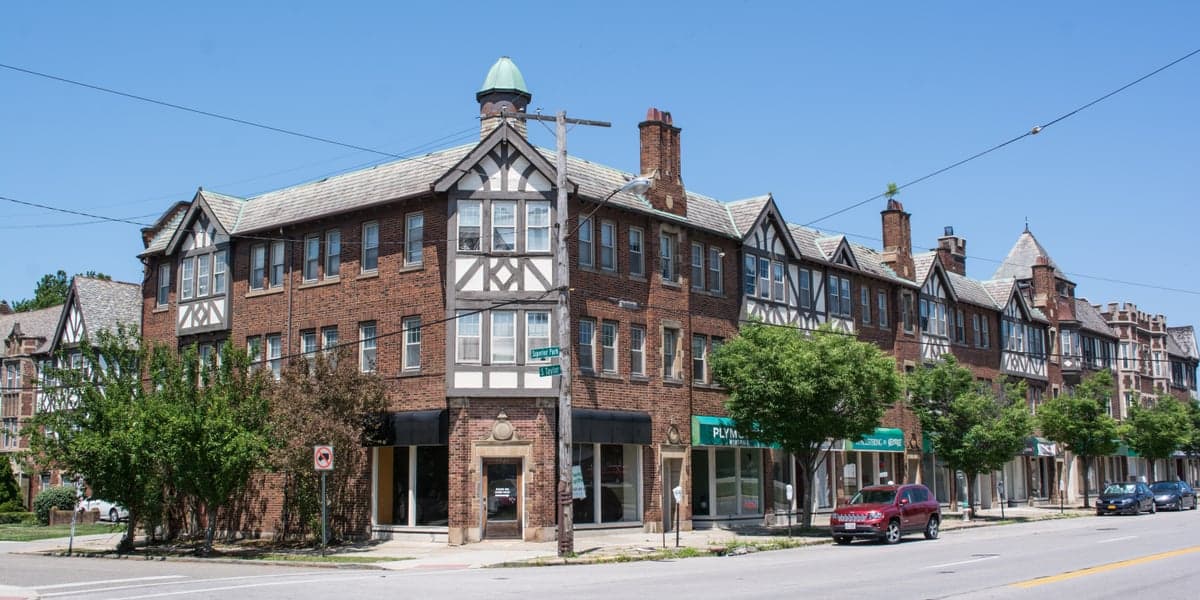
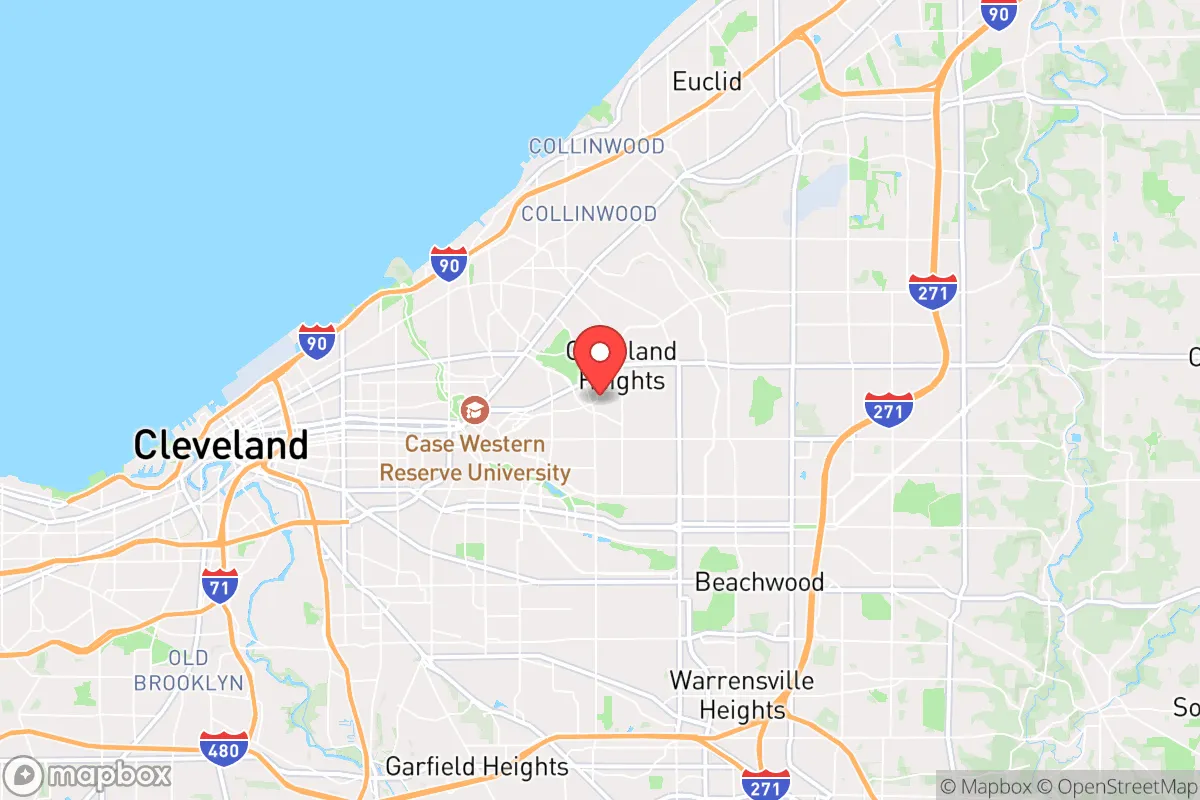
Photo: Wikipedia
Political ClimatePolitical Climate in Cleveland Heights, OH
District shown is the primary district for this city’s centroid. Cities may span multiple districts.
Local Political AnalysisPolitical Analysis of Cleveland Heights, OH
Cleveland Heights has been a deep-blue stronghold for decades, and it’s only getting bluer. The Cook PVI of D+28 tells you everything you need to know—this isn’t a purple suburb; it’s one of the most reliably progressive enclaves in all of Ohio. Back in the 80s and 90s, you could still find a mix of old-school Democrats and moderate Republicans at the local diner, but those days are long gone. Today, the city council, school board, and even the planning commission are dominated by activists who see government as the primary tool for reshaping daily life, from housing policy to how kids are taught.
How it compares
If you drive ten minutes south to Shaker Heights, you’ll find a similar political vibe—just a bit more polished and wealthy. But head east to South Euclid or west to Lakewood, and you start seeing more working-class voters who aren’t as eager to embrace every new social experiment. The real contrast is with suburbs like Strongsville or Medina, where you’ll still hear people talk about property rights and school choice without getting side-eyed. In Cleveland Heights, the local government has been aggressive about rent control measures, zoning changes that prioritize density over single-family homes, and police oversight boards that make it harder for officers to do their jobs. It’s the kind of place where a simple home renovation can get tangled in a dozen permit requirements because the city wants to “ensure equity.”
What this means for residents
For folks who value personal freedom—whether it’s choosing your own healthcare, deciding how to educate your kids, or keeping more of your paycheck—Cleveland Heights can feel suffocating. The city has a habit of passing ordinances that sound noble on paper but end up as bureaucratic headaches. For example, the push for “sanctuary city” policies means local police are limited in cooperating with federal immigration enforcement, which raises real safety concerns for long-time residents. Property taxes are high, and they keep climbing to fund social programs that don’t always deliver results. If you’re a small business owner, you’ll face layers of regulations that make it tough to just open your doors. The trajectory is clear: more mandates, more oversight, and less room for individual choice.
Cultural and policy distinctions worth knowing
One thing that stands out is how the city’s leadership treats dissent. At public meetings, residents who question progressive policies—like the push to remove police from schools or the heavy-handed approach to “equity” training—are often dismissed as out of touch. The local paper and social media echo chambers reinforce the idea that if you’re not on board with the latest progressive agenda, you’re part of the problem. Culturally, the city prides itself on being “inclusive,” but that inclusivity rarely extends to conservative viewpoints. If you’re considering moving here, just know that your voice on issues like school curriculum, housing freedom, or tax policy will likely be drowned out by a well-organized activist class. It’s a shame, because the tree-lined streets and strong sense of community used to be a draw—now, it feels like the government is always in your business.

State Political ClimatePolitical Climate in Ohio
State Political AnalysisPolitical Environment in the State
Ohio has long been the quintessential bellwether state, but over the past decade it has shifted from a classic purple swing state to a solidly red-leaning one, with Donald Trump carrying it by 8 points in 2020 and 11 points in 2024. The state’s political center of gravity now rests with a coalition of working-class voters in small cities and rural areas, combined with a growing conservative exurban base around Cincinnati and Columbus. While the major metros still lean blue, the state’s overall trajectory over the last 20 years has been a steady march rightward, driven by deindustrialization, cultural backlash, and a migration pattern that sees conservatives moving into the state’s affordable small towns and liberals clustering in the urban cores.
Urban vs. rural divide
The political map of Ohio is a tale of three distinct regions. The urban tri-county area of Cuyahoga County (Cleveland), Franklin County (Columbus), and Hamilton County (Cincinnati) reliably vote Democratic, with Cleveland and Columbus delivering margins of 60-70% for the party. But outside these islands, the state is overwhelmingly red. The rural southeast (Appalachian Ohio) and the northwest (the Maumee Valley and Lake Erie plains) are deep red, with counties like Mercer and Holmes routinely giving Republicans 75-80% of the vote. The real story is the suburbs: places like Delaware County (north of Columbus) and Warren County (north of Cincinnati) have become some of the most reliably conservative exurbs in the Midwest, flipping from purple to deep red over the last decade. Meanwhile, the once-competitive Mahoning Valley (Youngstown area) has swung hard right, with Mahoning County itself flipping from Obama in 2012 to Trump by 4 points in 2020. The divide isn’t just geographic—it’s cultural: urban Ohioans are increasingly secular and progressive, while the rest of the state is churchgoing, gun-owning, and skeptical of government overreach.
Policy environment
Ohio’s policy environment is a mixed bag for conservatives, but the trend is positive. The state has a flat income tax rate of 3.5% (down from 4.8% in 2020), and the sales tax is 5.75% with local add-ons. Property taxes are moderate, though they vary wildly by district—expect to pay more in wealthy suburbs like Upper Arlington than in rural Knox County. The state is a right-to-work state in practice if not in law, and union membership has declined sharply. On education, Ohio has a robust school choice program, including the EdChoice voucher system that lets families use public funds for private or religious schools—a huge win for parental rights. Healthcare policy is more mixed: the state expanded Medicaid under Obamacare, but Republican governors have pushed work requirements and managed care reforms. Election laws have tightened: voter ID is now required (with a free state ID available), and early voting windows have been standardized. The state also passed a 2023 law banning local governments from enacting their own gun restrictions, preempting cities like Cleveland and Columbus from imposing red-flag ordinances. Overall, the policy environment is friendly to business and individual liberty, but the legacy of Medicaid expansion and some urban progressive ordinances remain irritants.
Trajectory & freedom
Ohio is becoming more free for conservatives, but the battle is ongoing. The biggest win in recent years was the 2023 passage of House Bill 99, which eliminated the requirement for a permit to carry a concealed handgun (constitutional carry). This was a direct rebuke to urban mayors who had tried to restrict gun rights. On parental rights, the state passed House Bill 8 in 2023, which requires schools to notify parents of any changes to a student’s health or well-being—a direct response to the transgender activism in districts like Columbus City Schools. The state also banned gender-affirming care for minors in 2024 (overriding a veto by Governor Mike DeWine, who had initially sided with the medical establishment). On the downside, the state’s Issue 1 in 2023 enshrined abortion access in the state constitution, a major loss for pro-life advocates. And the state’s energy policy has been a mixed bag: while it’s a major natural gas producer, the Public Utilities Commission has been embroiled in the HB6 scandal, where a nuclear bailout was passed under questionable circumstances. The trajectory is clear: Ohio is moving right on guns, education, and medical freedom, but the abortion amendment shows that the urban-rural divide can still produce surprises at the ballot box.
Civil unrest & political movements
Ohio has seen its share of political flashpoints. The 2020 protests in Columbus and Cincinnati were large but largely peaceful, though the state saw property damage in the Short North district of Columbus. The 2020 election integrity controversy was a major issue here, with rural counties like Mercer and Auglaize passing resolutions calling for a forensic audit of the 2020 results. The state’s Stand Your Ground law, passed in 2021, was a direct response to fears of urban unrest. On the left, the Ohio Organizing Collaborative has been active in pushing for criminal justice reform and voting rights, but their influence is largely confined to the urban cores. Immigration politics are less heated than in border states, but the Springfield area (Clark County) has seen tensions over Haitian migrant populations, with local officials complaining about strains on schools and healthcare. The sanctuary city debate is mostly symbolic—no Ohio city has a formal sanctuary policy, though Cleveland and Columbus have non-cooperation ordinances that limit local police from enforcing federal immigration law. A new resident would notice the strong presence of Trump flags and thin blue line imagery in rural areas, while urban neighborhoods display Black Lives Matter and Pride flags. The cultural divide is visible and real.
Projection
Over the next 5-10 years, Ohio is likely to become more conservative, but with a twist. The in-migration pattern is heavily tilted toward red-leaning areas: people are moving to the exurbs of Delaware and Warren counties, and to small cities like Findlay and Wooster, which are growing faster than the urban cores. The state’s population is aging and becoming more rural, which favors the GOP. However, the urban cores are also growing younger and more diverse, and the abortion amendment showed that a well-funded progressive campaign can still win statewide. The biggest wildcard is the 2026 gubernatorial race: if a hardline conservative wins, expect further moves on school choice, tax cuts, and energy deregulation. If a moderate wins, the status quo holds. For a new resident, the bottom line is this: if you’re moving to a rural or exurban area, you’ll find a community that shares your values on guns, family, and limited government. If you’re moving to an urban core, you’ll be in a blue bubble that’s increasingly at odds with the state government. The state is not Texas or Florida yet, but it’s getting there—and the pace of change depends on who shows up to vote in the next few cycles.
For a conservative relocating to Ohio, the practical takeaway is that you’ll find a state that largely respects your freedoms—especially your Second Amendment rights and your right to choose your child’s education. The tax burden is moderate and falling, and the cost of living is low. But you’ll need to pick your county carefully: the urban-rural divide is stark, and the state government is your ally, but local governments in the cities will push back. If you want a place where your values are the norm, look at Delaware County or Warren County. If you want to be near a city but still have a conservative voice, the suburbs of Cincinnati (like Mason or West Chester) are your best bet. Ohio is a state in transition, and for now, the freedom-loving side is winning.
* Values derived from national, state, county, city and local statistics and may differ in a specific area. Last updated: 2026-04-21T18:21:56.000Z
Narrative content on this page is AI-generated and may contain mistakes. Verify any details that matter before acting on them.
ReloMaps may earn a commission from affiliate links at no extra cost to you.

