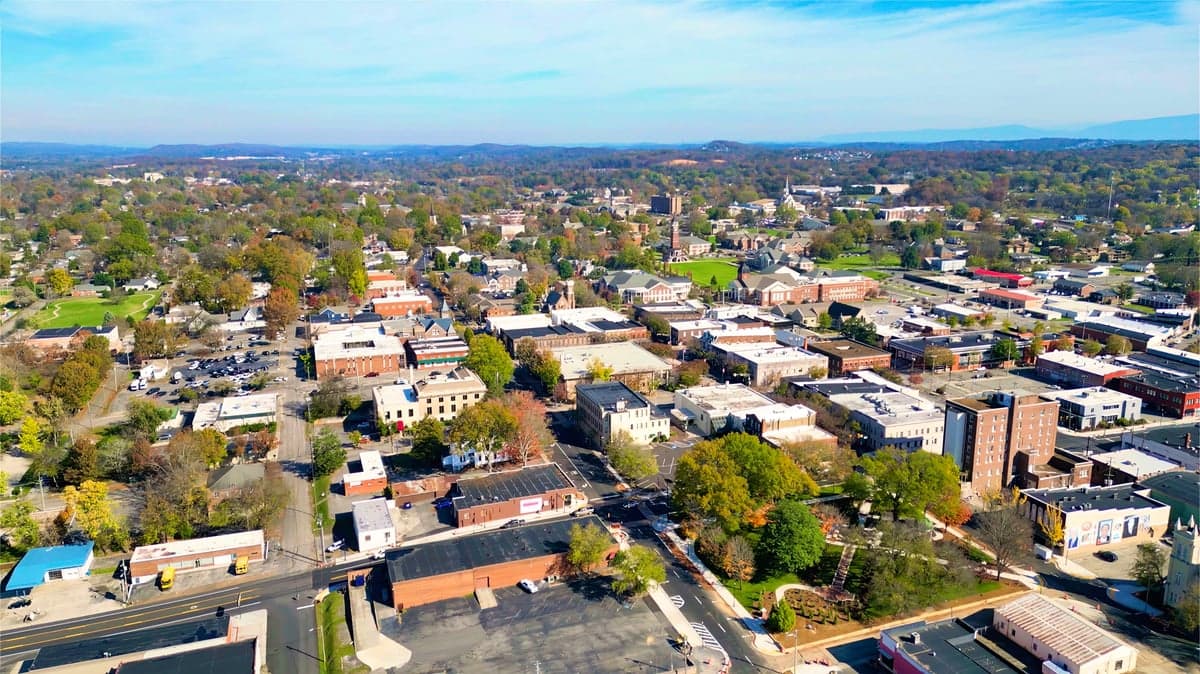
Photo: Wikipedia
Personal Sovereignty in Cleveland, TN
Viable for self-reliance. Generally workable, though some barriers may limit total independence.
What does Personal Sovereignty tell us?
Personal Sovereignty measures your capacity for self-reliance and independence with minimal government friction. Higher scores mean fewer barriers between you and the way you want to live... but it assumes you have the space you need and good neighbors.
What does this tell us?
Personal Sovereignty measures your capacity for self-reliance and independence with minimal government friction. Higher scores mean fewer barriers between you and the way you want to live... but it assumes you have the space you need and good neighbors.
State Policy
Energy independence: Importer (25% of energy produced in-state)
Personal Liberty
Homesteading

Personal Liberty Analysis
Cleveland, Tennessee, offers a notably high degree of personal sovereignty, particularly when viewed through a survivalist or prepper lens. The city sits in a state that consistently ranks among the most freedom-oriented in the nation, with a political culture that is deeply skeptical of federal overreach and protective of individual rights. For those prioritizing autonomy—whether from government mandates, economic instability, or societal breakdown—Cleveland provides a legal and cultural environment where self-reliance is not just tolerated but actively encouraged. The key question for the strategic relocator is whether this translates into practical, day-to-day control over one's life, property, and future.
Tax burden and regulatory posture: How Tennessee's fiscal policies protect your income and property
Tennessee’s tax structure is a major pillar of its sovereignty appeal. The state has no state income tax on wages, meaning every dollar you earn stays in your pocket, free from state-level confiscation. This is a critical advantage for anyone building a self-sufficient homestead or maintaining a cash-based emergency reserve. Property taxes in Bradley County are also relatively low, with an effective rate around 0.6% of assessed value, well below the national average. There is no state-level property tax, and the county’s assessment ratio is capped at 25% of appraised value. For the prepper, this means less of your land and improvements are vulnerable to tax-driven seizure. The regulatory posture in Cleveland is similarly light. The city does not impose heavy business licensing fees or zoning overlays that would complicate a home-based enterprise, such as a small farm, repair shop, or online trading operation. Tennessee is a right-to-work state with minimal union influence, and its state government has actively preempted local ordinances that would restrict firearm ownership, energy generation (like solar panels), or agricultural practices. This creates a predictable legal environment where you can plan for long-term self-sufficiency without fear of sudden regulatory shifts from city hall.
Self-defense and gun law specifics: What the Second Sanctuary status means for your rights
Cleveland sits in Bradley County, which has declared itself a Second Amendment Sanctuary. This is not a symbolic gesture; it means local law enforcement is directed to not enforce any federal gun laws that violate the Tennessee Constitution. For the survivalist, this is a concrete guarantee that your right to keep and bear arms will not be undermined by federal overreach. Tennessee law allows permitless carry (constitutional carry) for anyone 21 or older who is legally allowed to possess a firearm. There is no state-level registration, no waiting period for long guns, and no magazine capacity restrictions. The state also has a strong "Stand Your Ground" law, meaning you have no duty to retreat before using deadly force if you are in a place you have a right to be and reasonably believe force is necessary to prevent death or great bodily harm. For those building a defensive stockpile, the state’s preemption laws prevent local governments from banning specific types of firearms or ammunition. This legal framework gives Cleveland residents a level of personal security that is increasingly rare in the United States, allowing you to rely on your own capabilities rather than a potentially slow or unresponsive government response.
Self-reliance and homesteading viability: Lot sizes, zoning, and off-grid feasibility
The practical viability of a self-reliant lifestyle in Cleveland is strong, especially if you look just outside the city limits. Within the city, standard residential lots are typically one-quarter to one-half acre, which can support a substantial vegetable garden, a few fruit trees, and small livestock like chickens or rabbits, provided you check local ordinances (most allow chickens with a permit). The real opportunity lies in the unincorporated areas of Bradley County, where zoning is minimal and lot sizes of one to five acres are common and affordable. Here, you can legally keep goats, pigs, and even a cow for dairy, as well as maintain a large garden and rainwater collection system. Off-grid feasibility is high: Tennessee has no state-level prohibition on solar panel installation, and net metering is available, though the rates have become less favorable in recent years. Well water is accessible in most rural areas, and septic systems are standard. The county does not aggressively enforce building codes on agricultural structures, so you can construct a barn, workshop, or root cellar without excessive permitting. For the prepper, the key is to buy land with a well already in place or with a known water table depth—this is a non-negotiable for long-term independence. The local climate supports a 7-month growing season, and the soil in the valley is fertile, making it possible to produce a significant portion of your own food.
Personal liberties: Parental rights, medical autonomy, speech, and property protections
Tennessee has been at the forefront of protecting parental rights. The state’s "Parental Bill of Rights" (Tenn. Code Ann. § 49-6-7001) gives parents the explicit right to direct their child’s education, healthcare, and religious upbringing. This means you can opt your child out of any curriculum or activity you find objectionable, and you have the legal standing to challenge school policies that infringe on your authority. Medical autonomy is similarly strong: Tennessee has no state-level vaccine mandate for adults, and while school vaccine requirements exist, medical and religious exemptions are available and have been upheld. The state also passed a law in 2023 prohibiting the enforcement of any federal public health emergency order that would restrict individual liberties, such as mask mandates or business closures. Free speech is robustly protected under the Tennessee Constitution, which explicitly states that "the free communication of thoughts and opinions is one of the invaluable rights of man." Property rights are also well-guarded: Tennessee is a "Dillon's Rule" state, meaning local governments only have powers explicitly granted by the state, which limits their ability to impose restrictive land-use regulations. For the survivalist, this means your ability to build a bunker, store supplies, or maintain a defensive perimeter on your own land is unlikely to be challenged by local authorities, as long as you are not creating a public nuisance.
Overall, Cleveland, TN, offers a sovereignty profile that is significantly stronger than most of the United States, particularly when compared to coastal states or major metropolitan areas. The combination of no income tax, strong gun rights, minimal zoning in the county, and robust parental and medical autonomy creates a legal environment where a determined individual can build a genuinely independent life. The primary trade-off is that you are still within a two-hour drive of Atlanta and Nashville, meaning you are not completely isolated from the political and economic instability of larger population centers. However, for the strategic relocator who values personal control over government convenience, Cleveland represents a rare sweet spot: a community where the laws are written to empower the individual, not the state.

* Values derived from national, state, county, city and local statistics and may differ in a specific area. Last updated: 2026-05-01T08:07:25.000Z
Narrative content on this page is AI-generated and may contain mistakes. Verify any details that matter before acting on them.
ReloMaps may earn a commission from affiliate links at no extra cost to you.

