
Photo: Wikipedia
Demographics of Adams County
Affluence Level in Adams County
A middle-class area roughly in line with national averages across income, home values, education, and employment.
People of Adams County
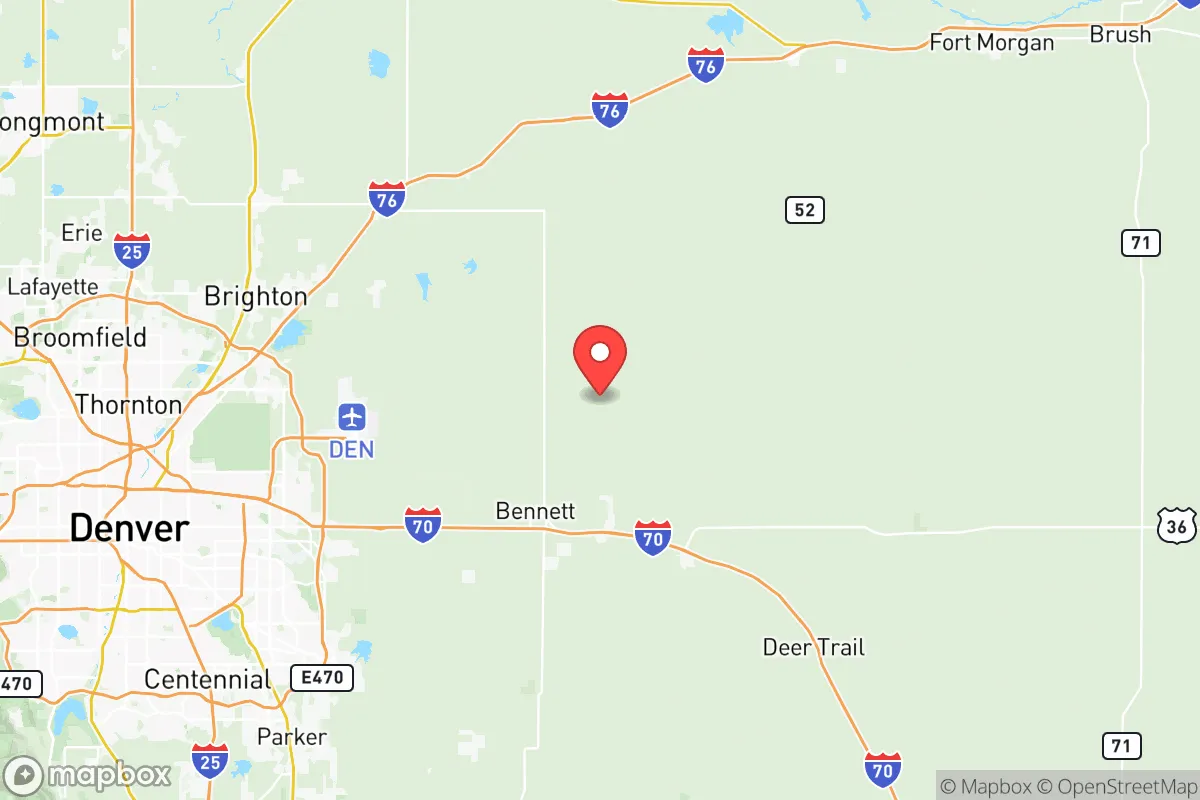
Adams County, Colorado, is a rapidly diversifying suburban and exurban hub where no single ethnic group holds a majority, shaped by waves of agricultural settlement, postwar suburbanization, and modern immigration. With a population of 524,408, the county is 46.2% white, 42.3% Hispanic, 3.3% Black, 3.2% East/Southeast Asian, and 0.7% Indian (subcontinent), with 9.7% foreign-born and 28.0% college-educated. Its identity is defined by a working-class heritage rooted in farming and rail, now overlain with a growing professional class and a strong Hispanic cultural presence that is reshaping politics, commerce, and daily life. For conservative-leaning newcomers, Adams County offers a mix of affordable housing, family-oriented suburbs, and a population that remains more politically moderate than neighboring Denver or Boulder.
Settlement & growth (pre-1960)
Before American settlement, the area now known as Adams County was part of the traditional territory of the Cheyenne and Arapaho nations, who followed bison herds along the South Platte River. The 1858 Pike’s Peak Gold Rush brought the first wave of Anglo-American settlers, mostly from the Midwest and Upper South, who established small farming communities along the river. The 1859 discovery of gold in nearby Cherry Creek spurred the creation of the region’s first permanent settlements, including Brighton (founded 1861 as a stagecoach stop) and Commerce City (originally a farming hamlet called “Rose Hill”). The arrival of the Kansas Pacific and Union Pacific railroads in the 1870s transformed the county into a transportation and agricultural hub, drawing German and Irish immigrants to work on the rails and in the sugar beet fields that dominated the economy through the early 1900s.
The sugar beet industry, fueled by the Great Western Sugar Company, attracted a distinct wave of German-Russian immigrants—ethnic Germans who had lived in Russia for generations—who settled in Brighton and Fort Lupton (the latter straddling the Adams-Weld county line) between 1900 and 1920. These families, along with smaller numbers of Italian and Mexican laborers, formed the backbone of the county’s agricultural workforce. The Dust Bowl of the 1930s brought a second wave of domestic migrants: “Okies” and “Arkies” fleeing the Southern Plains, who found work in the beet fields and later in the wartime industries that began appearing along the Front Range. World War II and the subsequent Cold War buildup at Rocky Mountain Arsenal (in what is now Commerce City) and Buckley Air National Guard Base (in Aurora, which extends into Adams County) shifted the economy from agriculture to manufacturing and defense, setting the stage for explosive suburban growth after 1950.
By 1960, Adams County’s population had reached roughly 90,000, still predominantly white and native-born, with a significant Hispanic minority concentrated in Brighton and the unincorporated farming communities of Barr Lake and Henderson. The county remained largely rural, with Denver’s urban core still separated by open farmland.
Modern era (post-1965)
The 1965 Hart-Cellar Act fundamentally reshaped Adams County’s demographics, as it did across the Front Range. The first major post-1965 immigrant wave was from Mexico and Central America, drawn by agricultural jobs that persisted through the 1970s and 1980s in the county’s northern reaches. These families settled heavily in Brighton, Commerce City, and the Sherrelwood neighborhood (an unincorporated area near Denver), creating a Hispanic population that grew from roughly 15% in 1970 to over 40% by 2020. A smaller but notable wave of Vietnamese refugees arrived after 1975, many sponsored by Catholic churches in Westminster and Thornton; today, East/Southeast Asian communities (3.2% of the county) are most visible in Westminster and Aurora, with Vietnamese and Korean grocery stores and churches anchoring their enclaves.
Domestic migration since 1990 has been equally transformative. The county has absorbed tens of thousands of relocating families from California, the Rust Belt, and the Mountain West, drawn by lower housing costs relative to Denver and Boulder. This in-migration has been predominantly white and Hispanic, with a smaller but growing Black population (3.3%) concentrated in Aurora and Commerce City. Suburbanization exploded in the 1990s and 2000s, with master-planned communities like Northglenn (incorporated 1969) and Thornton (which grew from 55,000 in 1990 to 141,000 by 2020) absorbing most of the new arrivals. The Indian (subcontinent) population (0.7%) is a recent and small presence, clustered in Aurora and Westminster, largely professionals in tech and healthcare.
Today, Adams County is a patchwork of distinct enclaves. Brighton remains the cultural heart of the Hispanic community, with a majority-Hispanic population and a downtown that reflects its agricultural roots. Thornton and Westminster are more ethnically mixed, with white, Hispanic, and Asian families living in newer subdivisions. Commerce City is the most working-class and industrial, with a Hispanic majority and a growing Black presence. The county’s foreign-born share (9.7%) is lower than Denver’s (17%) but higher than the national average, and the college-educated rate (28.0%) trails the state average (40%), reflecting the county’s blue-collar heritage.
The future
Adams County is likely to continue its trajectory toward a Hispanic-plurality majority, with the white share declining gradually as the Hispanic population grows through both immigration and higher birth rates. The East/Southeast Asian and Indian populations are expected to grow modestly, driven by tech and healthcare job growth in the Denver-Aurora metro, but will remain small relative to the Hispanic and white blocs. The county is not tribalizing into isolated enclaves—most suburbs are integrated, with intermarriage between Hispanic and white residents common—but distinct cultural centers persist, particularly in Brighton and Commerce City. In-migration from California and the Rust Belt is slowing as housing costs rise, but the county’s relative affordability compared to Denver and Boulder will continue to attract families and young professionals.
The next 10-20 years will likely see Adams County become more politically competitive, as the growing Hispanic electorate shifts the county from its historically Democratic lean toward a more moderate or swing status. Culturally, the county is absorbing newcomers into its existing working-class identity rather than being transformed by them; the agricultural and industrial roots remain strong in Brighton and Commerce City, even as Thornton and Westminster become more suburban and professional. The biggest challenge will be infrastructure and school capacity, as the county’s population is projected to exceed 600,000 by 2035.
For someone moving in now, Adams County offers a pragmatic, family-oriented environment where diversity is a lived reality rather than a political abstraction. It is not a place of elite culture or rapid gentrification, but of steady growth, affordable housing, and a population that values community and stability over trendiness. The county’s future is one of gradual demographic change, not disruption, making it a solid choice for conservative-leaning families seeking a middle-ground suburban lifestyle within commuting distance of Denver.

* Values derived from national, state, county, city and local statistics and may differ in a specific area. Last updated: 2026-05-13T12:29:41.000Z
Narrative content on this page is AI-generated and may contain mistakes. Verify any details that matter before acting on them.
ReloMaps may earn a commission from affiliate links at no extra cost to you.

