
Photo: Wikipedia
Strategic Assessment of Adams County
Meaningful friction. Expect exposure to either population pressure, blast zones, or natural disaster risk. Consider buying a retreat property.
What does the Strategic Assessment tell us?
Our Strategic Assessment grades tactical survivability of an area. Major population centers, military targets, fallout zones, natural disasters, and border exposure all drive risk — lower exposure means a more defensible position in a crisis.
This is heavily inspired by Joel Skousen's Strategic Relocation book. Highly recommended you checkout the book ($)What does this tell us?
Our Strategic Assessment grades tactical survivability of an area. Major population centers, military targets, fallout zones, natural disasters, and border exposure all drive risk — lower exposure means a more defensible position in a crisis.
This is heavily inspired by Joel Skousen's Strategic Relocation book. Highly recommended you checkout the book ($)Strategic Pillars

Key Distances
Strategic Assessment Analysis
Adams County, Colorado, sits in a precarious but potentially advantageous position for those prioritizing resilience and long-term preparedness. While its eastern edge touches the Denver metro sprawl, the county’s northern and eastern reaches offer a buffer of open plains and agricultural land that could prove critical during civic unrest or supply chain disruptions. The key is understanding that Adams County is not a retreat—it’s a staging ground. Its proximity to major highways (I-76, I-70, I-25) and the Front Range urban corridor means you’re close enough to access resources, but far enough from the worst fallout zones if you choose your specific location wisely. For a conservative-leaning relocator thinking about self-sufficiency and security, this county demands a hard look at both its natural advantages and its very real vulnerabilities.
Geographic position and natural advantages for long-term stability
Adams County’s geography is defined by the South Platte River, which cuts through the county from southwest to northeast, providing a reliable water source that many Front Range counties lack. The river valley offers fertile soil for small-scale agriculture, and the county’s position at the edge of the High Plains means you’re not boxed in by mountains—escape routes east toward Nebraska or Kansas remain open if things go sideways. The Rocky Mountain Arsenal National Wildlife Refuge, a former chemical weapons site turned protected area, sits in the southwestern corner of the county near Commerce City. While its history raises eyebrows, the refuge now serves as a massive undeveloped buffer zone between Adams County and Denver proper, reducing the risk of urban spillover during unrest. The county’s elevation (roughly 5,000 feet) also provides a natural defense against airborne contaminants settling from a Denver-area disaster—prevailing winds typically push fallout east, not north into Adams County’s core. For a prepper, the ability to tap into well water (many rural parcels have existing wells) and the county’s relatively low population density outside the I-76 corridor are tangible advantages. Towns like Brighton and Bennett offer a more rural feel while still being within 30 minutes of major medical facilities in Aurora.
Risks, exposures, and proximity to fallout-relevant landmarks
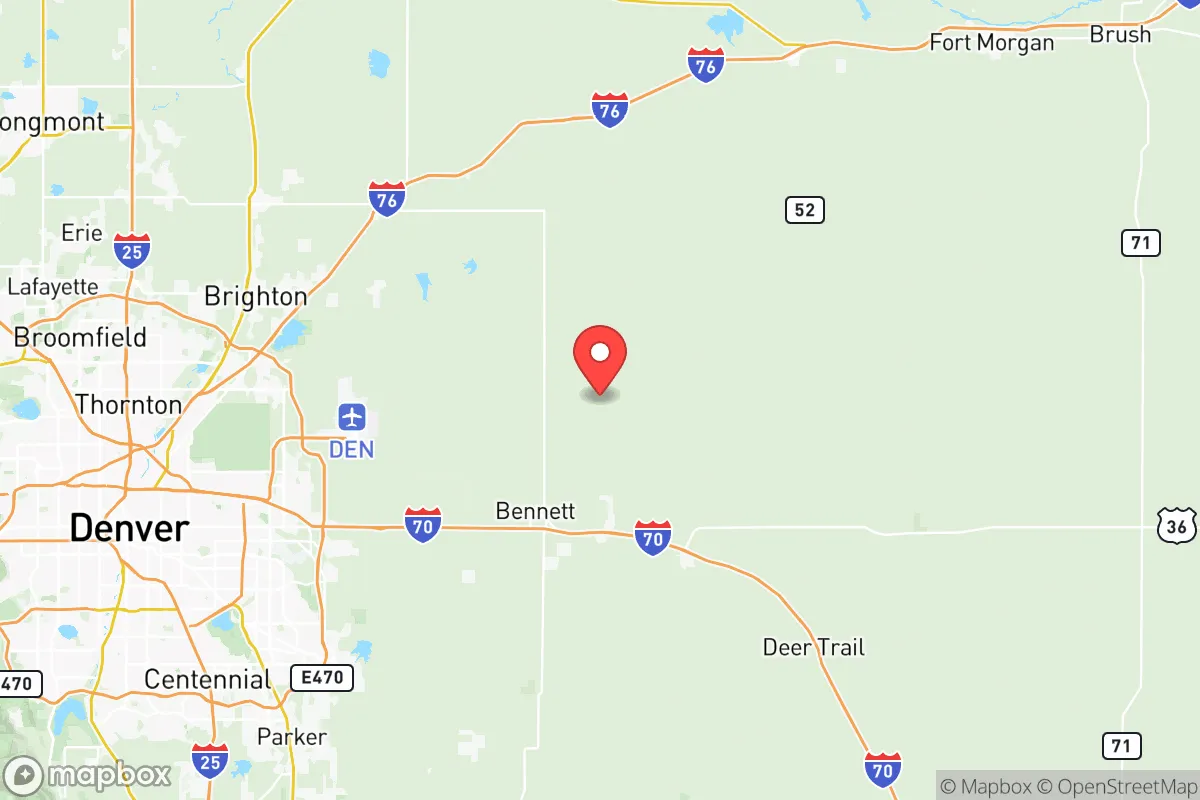
This is where Adams County gets complicated. The county is home to the Suncor Energy refinery in Commerce City, one of the largest oil refineries in the Rocky Mountain region. A major accident or targeted attack on that facility could release toxic clouds or trigger fires that would make large portions of southern Adams County uninhabitable for days. The refinery sits just north of Denver International Airport (DIA), which itself is a high-value target in any conflict scenario—DIA is a major cargo and military transport hub. The Rocky Mountain Arsenal’s buried chemical waste (though capped) is another long-term liability; a major earthquake or flood could disturb those containment systems. Additionally, Adams County borders Aurora, home to Buckley Space Force Base, a critical military installation that would be a primary target in any large-scale conflict. If you’re looking at a map, the area between Commerce City, Aurora, and Denver is a dense web of industrial, military, and transportation infrastructure that would be a nightmare during civil unrest or a mass casualty event. The county’s eastern plains, however, offer a stark contrast—towns like Strasburg and Watkins sit far enough from these hotspots that you could realistically bug in or bug out without being caught in the initial chaos. The key risk is that Adams County’s western half is effectively a buffer zone for Denver’s worst-case scenarios, so your specific location within the county matters more than the county’s overall profile.
Practical resilience for a relocator: food, water, energy, and defensibility
For a single individual or family looking to build a resilient setup, Adams County offers a mixed bag. Water is the strongest asset—the South Platte alluvial aquifer provides shallow groundwater that can be accessed with a hand pump or solar-powered well, and the county’s irrigation districts (like the Brighton Ditch Company) have senior water rights that predate Denver’s. Food production is viable in the eastern half, where you’ll find actual farmland and livestock operations; the Adams County Farmers Market in Brighton is a good indicator of local growing capacity. Energy independence is harder—natural gas is the dominant heating fuel, and the grid is tied to Xcel Energy’s Front Range network, which is vulnerable to cyberattacks or physical sabotage. Solar is viable (the county gets 300+ sunny days a year), but you’ll need battery storage to handle winter cloud cover. Defensibility is the weak point: the county is flat, with few natural chokepoints. Your best bet is a property with a long driveway, good sightlines, and neighbors you can trust. The county’s law enforcement presence is spread thin—the Adams County Sheriff’s Office covers 1,200 square miles with about 400 deputies, meaning response times in rural areas can exceed 30 minutes. For a prepper, this means you need to be your own first responder. Stockpiling ammunition and medical supplies is not paranoia here; it’s practical. The Brighton and Bennett areas have active shooting ranges and a culture of firearm ownership that aligns with a conservative mindset, making it easier to find like-minded neighbors for mutual aid networks.
The overall strategic picture for Adams County is one of calculated trade-offs. You get water, flat land for agriculture, and proximity to Denver’s medical and supply networks, but you also get the refinery, the military base, and the airport within a 20-mile radius of the county’s most livable areas. For a relocator serious about long-term survival, the smart play is to target the eastern half of the county—east of Highway 85, ideally near Bennett or Strasburg—where you can establish a self-sufficient homestead while maintaining a low profile. The western half, especially around Commerce City and Thornton, is too exposed to urban fallout and industrial hazards. If you’re willing to trade some convenience for security, Adams County can work. But don’t kid yourself: this is not a remote retreat. It’s a buffer zone with real risks that require real preparation. The conservative prepper who treats it as such—investing in water storage, solar, and community ties—will find it a viable base of operations. The one who moves here expecting suburban safety will be caught flat-footed when the lights go out.

* Values derived from national, state, county, city and local statistics and may differ in a specific area. Last updated: 2026-05-13T12:29:41.000Z
Narrative content on this page is AI-generated and may contain mistakes. Verify any details that matter before acting on them.
ReloMaps may earn a commission from affiliate links at no extra cost to you.

