
Photo: Wikipedia
Demographics of Montrose County
Affluence Level in Montrose County
A middle-class area roughly in line with national averages across income, home values, education, and employment.
People of Montrose County
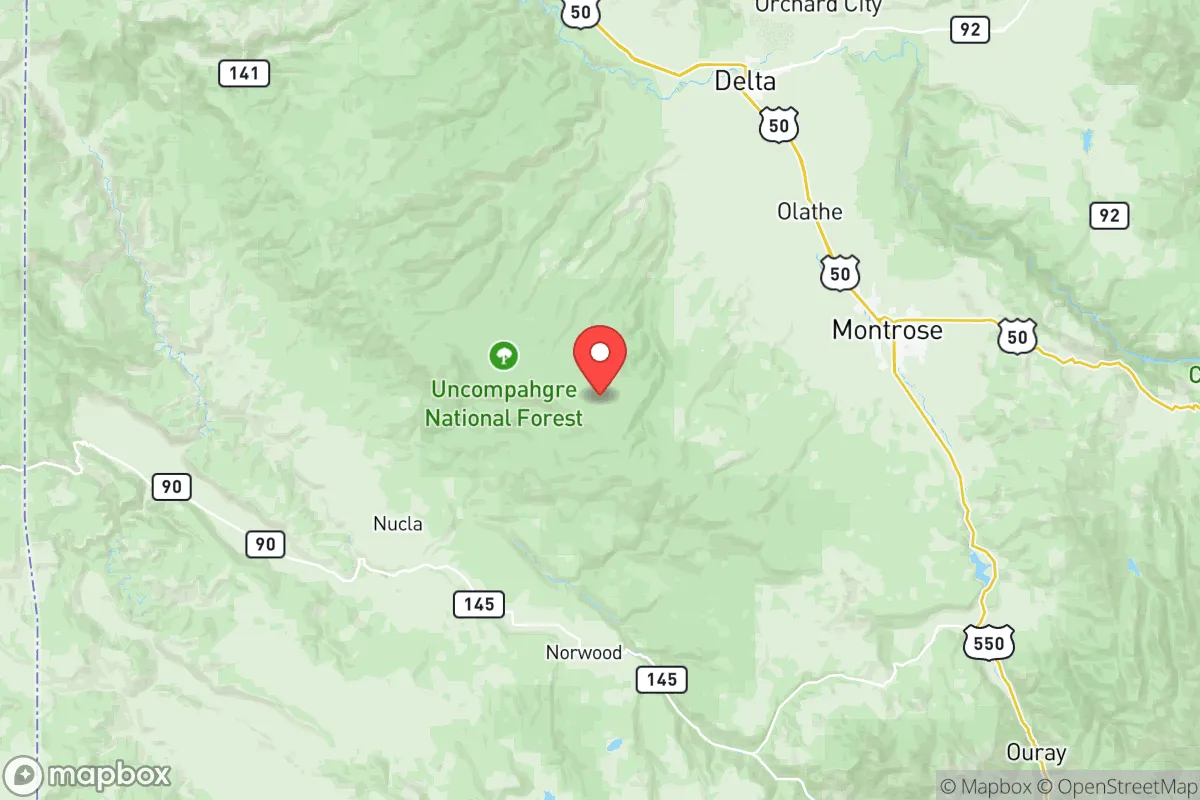
The people of Montrose County, Colorado, number roughly 43,300, forming a community that is predominantly white (74.0%) with a significant and growing Hispanic minority (21.2%). This is a region defined by its rural character, its deep roots in agriculture and energy, and a cultural identity that blends Western independence with a steady influx of newcomers drawn to the landscape. The county seat of Montrose serves as the commercial and population hub, while smaller communities like Olathe, Nucla, and Naturita each retain distinct identities shaped by their own settlement histories.
Settlement & growth (pre-1960)
The human history of Montrose County begins with the Ute people, who inhabited the Uncompahgre Valley and the surrounding mountains for centuries before European contact. The Ute bands, particularly the Tabeguache, used the area seasonally, following game and gathering resources. Spanish exploration touched the region in the 18th century, but no permanent Spanish settlements were established. The area remained firmly under Ute control until the 1870s, when the U.S. government forcibly removed the Utes to reservations in Utah following the Meeker Massacre of 1879, opening the land for Anglo-American settlement.
The first major wave of American settlers arrived in the early 1880s, drawn by the promise of irrigated farmland in the Uncompahgre Valley. The U.S. government's Gunnison Reclamation Project, which began in the 1880s and expanded through the early 1900s, transformed the arid valley into productive agricultural land. This project attracted a mix of Anglo-American homesteaders from the Midwest and Great Plains, many of them of German, English, and Scots-Irish descent. The town of Montrose was founded in 1882 as a railroad and supply center, quickly becoming the county's dominant community. Olathe, settled around the same time, became known for its sweet corn and later for its potato production, earning the title "Sweet Corn Capital of Colorado."
A second distinct wave of settlement occurred in the early 20th century, driven by mining and energy extraction in the county's western reaches. The discovery of uranium, vanadium, and other minerals in the Paradox Valley and the San Juan Mountains led to the founding of towns like Nucla (founded 1904) and Naturita (founded 1909). These communities attracted a more transient, working-class population of miners, many of whom were of Eastern European and Southern European descent, including Italians, Slavs, and Greeks, alongside Anglo-Americans. The uranium boom of the 1940s and 1950s, fueled by Cold War demand, brought a further influx of miners and engineers to these towns, creating a boom-and-bust cycle that continues to shape their identity. The town of Paradox, a tiny settlement in the remote Paradox Valley, also dates from this mining era.
By 1960, Montrose County's population was overwhelmingly white, native-born, and rural. Agriculture and mining were the twin pillars of the economy, and the county's cultural character was distinctly Western, conservative, and self-reliant. The Hispanic population was minimal, consisting mostly of a small number of families with roots in the Spanish colonial period of New Mexico, who had migrated north for work in the fields and mines.
Modern era (post-1965)
The post-1965 era brought two major demographic shifts to Montrose County: the growth of the Hispanic population and the arrival of domestic migrants from other parts of the United States. The Hart-Cellar Act of 1965 had a limited direct effect on the county, as international immigration remained low. However, the broader national trend of Hispanic population growth, driven by immigration from Mexico and Central America to the American Southwest, gradually reached Montrose County. Hispanic workers, many of them from Mexico and of Mexican-American heritage, began moving into the area in larger numbers from the 1970s onward, drawn by agricultural jobs in the Uncompahgre Valley, particularly in the potato and corn fields around Olathe and Montrose. This population has grown steadily, reaching 21.2% of the county's total population by the 2020s. The Hispanic community is now a visible and integral part of the county's social and economic fabric, with a growing presence in local businesses, schools, and civic life.
The second major shift has been domestic in-migration, which accelerated significantly after 2000. Montrose County has become a destination for retirees, remote workers, and lifestyle migrants from Colorado's Front Range (Denver, Colorado Springs) and from other states, particularly California, Texas, and the Midwest. These newcomers are drawn by the county's lower cost of living, its outdoor recreation opportunities (hunting, fishing, hiking, and skiing at nearby Telluride), and its relatively conservative political climate. This influx has driven population growth from roughly 33,000 in 2000 to over 43,000 today, fueling a construction boom and putting pressure on housing affordability. The new arrivals tend to be older, more affluent, and more likely to be college-educated than the existing population, contributing to the county's 28.3% college-educated rate. They have concentrated in the Montrose area and in new subdivisions along the Uncompahgre River, as well as in the scenic hills around Ridgway, a small town just north of the county line that has become a popular enclave for retirees and second-home owners.
Suburbanization has been modest compared to Front Range counties, but it is reshaping the landscape around Montrose. New housing developments, big-box retail, and chain restaurants have spread along the U.S. 550 corridor, creating a more suburban feel on the outskirts of the city. The county's racial and ethnic composition has shifted only slightly: the white share has declined from over 85% in 1990 to 74.0% today, while the Hispanic share has risen from under 10% to 21.2%. The Black (0.3%), East/Southeast Asian (0.4%), and Indian (0.1%) populations remain very small, reflecting the county's limited history of attracting non-white immigrants.
The future
Montrose County's population is projected to continue growing, likely reaching 50,000 to 55,000 by 2040, driven primarily by domestic in-migration. The Hispanic share of the population is expected to continue rising, potentially reaching 25-30% within two decades, as younger Hispanic families have higher birth rates and as continued migration from other parts of the Southwest and Mexico adds to the community. The county is likely to become more diverse in the sense of a larger Hispanic minority, but it will remain predominantly white and non-Hispanic. The white population will continue to age, as retirees are a major component of in-migration, while the Hispanic population will be younger on average, shaping the county's future workforce and school enrollment.
New communities are likely to concentrate in and around Montrose and along the U.S. 550 corridor, with continued suburban-style development. The more remote towns of Nucla and Naturita may see modest growth if energy prices (uranium, natural gas) rise, but they are unlikely to experience the same level of development as the Uncompahgre Valley. The county's cultural identity is evolving: the traditional Western, agricultural, and mining culture is being layered with a more amenity-oriented, outdoor-recreation culture brought by newcomers. This can create tensions over land use, water rights, and development, but it also brings economic diversification and new investment.
For someone moving to Montrose County today, the area offers a blend of small-town Western character, growing economic opportunity, and access to world-class outdoor recreation. The population is becoming more diverse, primarily through Hispanic growth, but remains culturally conservative and family-oriented. The key challenge ahead is managing growth in a way that preserves the county's rural character and agricultural heritage while accommodating the newcomers who are drawn to its landscape and lifestyle.

* Values derived from national, state, county, city and local statistics and may differ in a specific area. Last updated: 2026-08-08T12:42:46.000Z
Narrative content on this page is AI-generated and may contain mistakes. Verify any details that matter before acting on them.
ReloMaps may earn a commission from affiliate links at no extra cost to you.

