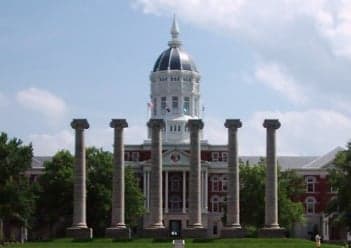
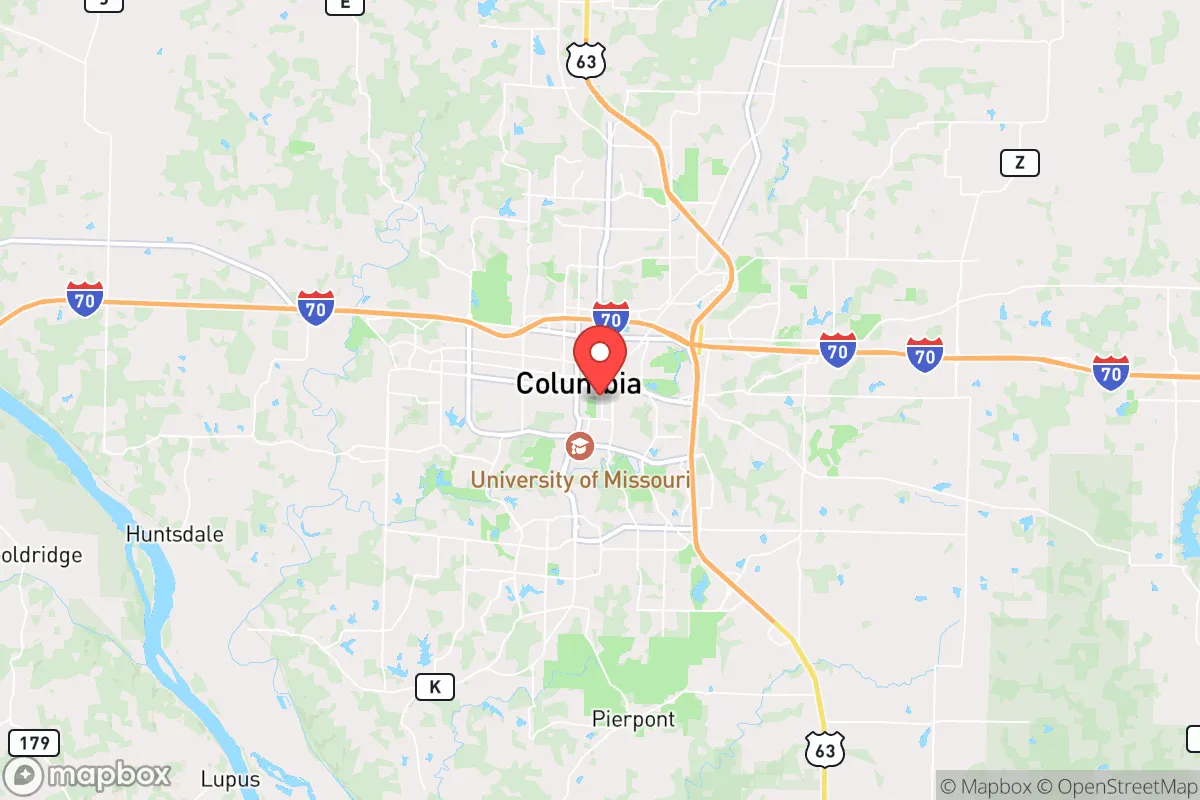
Photo: Wikipedia
Demographics of Columbia, MO
Affluence Level in Columbia, MO
A middle-class area roughly in line with national averages across income, home values, education, and employment.
People of Columbia, MO
The people of Columbia, MO today number roughly 127,200, forming a distinctly educated and politically moderate-to-liberal enclave in a conservative state. With 56.5% of adults holding a bachelor’s degree or higher, the city’s character is shaped by the University of Missouri and a robust healthcare sector, producing a population that is 72.5% white, 12.0% Black, 4.7% East/Southeast Asian, 4.3% Hispanic, and 1.4% Indian (subcontinent). The foreign-born share sits at just 4.7%, well below the national average, giving Columbia a predominantly native-born, Midwestern feel despite its university-driven diversity.
How the city was settled and grew
Columbia was founded in 1821 as the Boone County seat, deliberately sited near the geographic center of the county to attract settlers. The original population was overwhelmingly white, Anglo-American, and Protestant, drawn by fertile prairie land for farming and the promise of a county seat’s commercial advantages. The arrival of the Missouri-Kansas-Texas Railroad in the 1860s spurred a second wave, bringing German and Irish immigrants who settled in the North Village Arts District and the Benton-Stephens neighborhood, where their descendants’ modest frame houses still stand. The founding of the University of Missouri in 1839 created a steady demand for faculty, administrators, and support staff, but the city’s Black population—descended from enslaved people brought before the Civil War—remained concentrated in the Douglass Park and Sharp End districts, the latter a once-thriving Black commercial corridor that was largely demolished by urban renewal in the 1960s. By 1900, Columbia had about 5,000 residents, and growth remained slow through the Great Depression.
Modern era (post-1965)
The post-1965 era transformed Columbia’s population. The Hart-Celler Act opened immigration channels, but the city’s low foreign-born share (4.7%) reflects that most growth came from domestic in-migration. The University of Missouri’s expansion drew white and Black students from across the state, while the rise of MU Health Care and Boone Hospital Center attracted medical professionals. Suburbanization pushed middle-class white families into West Boulevard and the Rock Bridge area, while the East Campus neighborhood became a student-heavy rental zone. The Black population, which peaked at roughly 15% in the 1990s, has since declined to 12.0%, as many middle-class Black families moved to newer subdivisions in south Columbia or outlying towns like Ashland. The East/Southeast Asian community (4.7%) grew primarily through graduate students and faculty at MU, clustering near campus in East Campus and the Benton-Stephens area. The Indian-subcontinent population (1.4%) is smaller and more recent, tied to tech and medical jobs. The Hispanic share (4.3%) has risen steadily since 2000, driven by construction and service work, with families settling in northeast Columbia near the Business Loop 70 corridor.
The future
Columbia’s population is projected to grow to roughly 140,000 by 2035, driven by university enrollment and healthcare expansion. The white share is slowly declining as the Hispanic and Asian populations grow, but the city is not tribalizing into distinct ethnic enclaves—most neighborhoods remain moderately integrated. The Black population is plateauing, with out-migration to suburbs offsetting in-migration from other parts of Missouri. The East/Southeast Asian and Indian communities are likely to grow modestly as MU recruits internationally, but the foreign-born share will remain below 10% given the city’s lack of a large immigrant-employing industrial base. The biggest demographic shift may be generational: Columbia is becoming older, with the 65+ population rising faster than the under-18 cohort, as retirees from St. Louis and Kansas City move to the city’s medical hub.
For someone moving to Columbia now, the city offers a stable, educated, and predominantly native-born population with a strong university-town character. The political and cultural tilt is left of the surrounding region, but the low crime rate, good schools, and affordable housing (relative to coastal metros) attract a broad range of families and professionals. The city is not becoming a diverse immigrant gateway, but it is slowly diversifying along educational and professional lines, making it a predictable, low-risk relocation choice for conservative-leaning individuals who value institutional stability over rapid change.

* Values derived from national, state, county, city and local statistics and may differ in a specific area. Last updated: 2026-04-30T06:36:01.000Z
Narrative content on this page is AI-generated and may contain mistakes. Verify any details that matter before acting on them.
ReloMaps may earn a commission from affiliate links at no extra cost to you.

