
Photo: Wikipedia
Political ClimatePolitical Climate in Columbia, MO
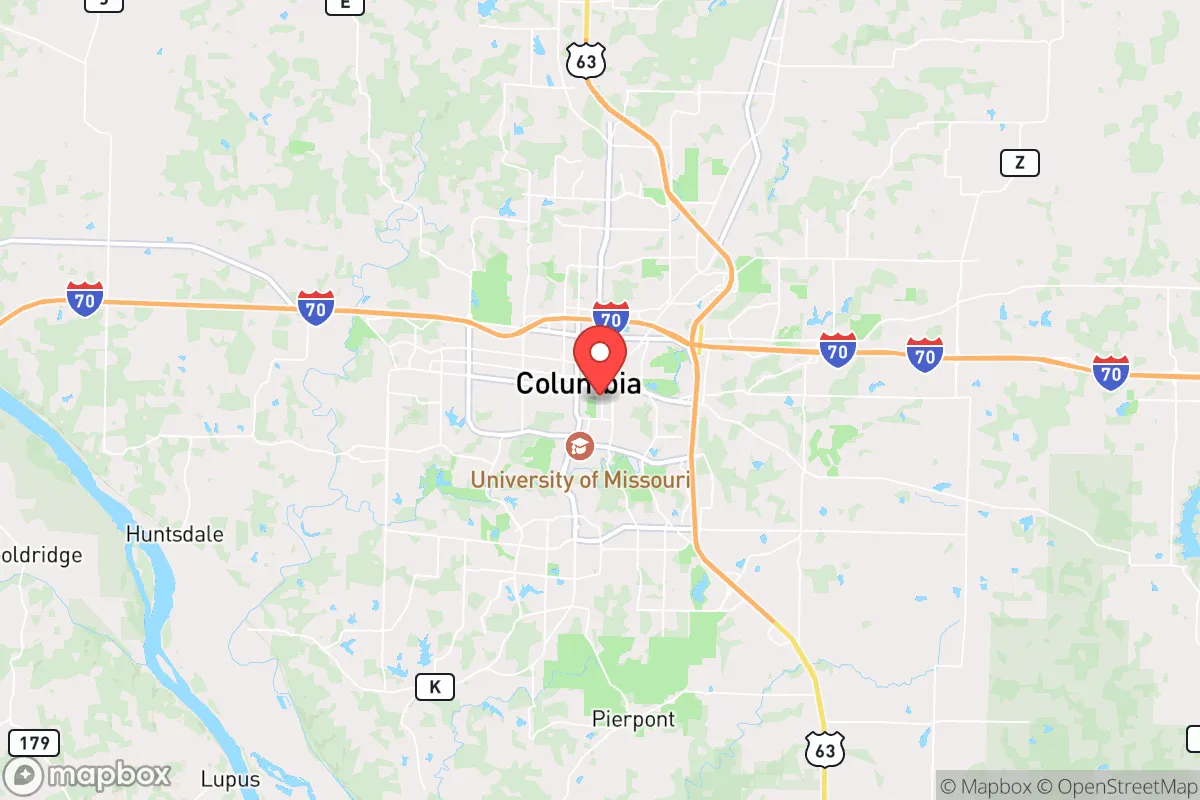
District shown is the primary district for this city’s centroid. Cities may span multiple districts.
Local Political AnalysisPolitical Analysis of Columbia, MO
Columbia, Missouri, has a political climate that feels increasingly out of step with the rest of the state. While the official Cook PVI rating is R+13, reflecting the strong conservative lean of Missouri as a whole, Columbia itself is a deep blue island in a sea of red. The city has shifted noticeably leftward over the past decade, and if you’ve lived here as long as I have, you can feel the change in the air. It’s not just about elections anymore—it’s about a growing sense that local government is more interested in pushing a progressive agenda than in protecting the personal freedoms and rights of its residents.
How it compares
Drive just 15 minutes outside of Columbia, and you’re in a completely different world. Towns like Ashland and Boonville are solidly conservative, where folks still believe in limited government and common-sense policies. Even Jefferson City, the state capital about 30 minutes south, leans more moderate-to-conservative. Columbia, by contrast, has become a magnet for university-driven activism and out-of-state transplants who bring big-city ideas with them. The contrast is stark: you can go from a county commission meeting in Boone County that’s debating property rights to a Columbia City Council meeting where the talk is all about diversity, equity, and inclusion mandates. It’s like two different states living side by side.
What this means for residents
For those of us who value personal freedom, the trajectory is concerning. The city council has shown a willingness to regulate everything from short-term rentals to business signage, and there’s a growing push for more government involvement in housing and land use. Property taxes have crept up as the city expands its budget for social programs and administrative staff. If you’re a small business owner or a homeowner who just wants to be left alone, you’ll find yourself butting heads with a bureaucracy that seems to think it knows better than you do. The school board has also become a battleground, with curriculum debates and library book challenges making headlines. It’s not the Columbia I grew up in, where the attitude was more “live and let live.”
On the flip side, if you lean left, you’ll find plenty of like-minded neighbors and a city government that’s eager to accommodate progressive priorities. But for conservatives, it can feel like you’re constantly on the defensive. Voter turnout in local elections is low, which means a small, motivated group can swing policy. The long-term trend is clear: Columbia is becoming more progressive, and that shift is accelerating. If you’re considering a move here, just know that the political climate is not neutral—it’s actively moving in one direction, and it’s not the direction that most of Missouri prefers.
Culturally, Columbia still has its charms—the university brings a vibrant arts scene and good restaurants—but the policy distinctions are hard to ignore. The city has declared itself a “sanctuary city” for certain groups, and there’s a strong push for environmental regulations that go beyond state law. For a conservative, it’s a place where you’ll need to stay engaged and vote in every local election, or risk waking up to a city that feels less like home and more like a college campus experiment in governance.

State Political ClimatePolitical Climate in Missouri
State Political AnalysisPolitical Environment in the State
Missouri has long been considered a bellwether state, but over the past 20 years it has shifted decisively from a purple swing state to a solidly red one, with Republicans now holding supermajorities in both legislative chambers and every statewide office except the governorship (which flipped back to the GOP in 2024). The state voted for Donald Trump by a comfortable 18-point margin in 2024, a stark contrast to the razor-thin wins of the 2000s and 2010s. This rightward lurch is driven by a massive rural and exurban realignment, coupled with the collapse of the old "Blue Dog" Democratic coalition that once dominated the state's small cities and union-heavy counties.
Urban vs. rural divide
The political map of Missouri is a textbook case of the urban-rural chasm. The two major metros—St. Louis and Kansas City—are deep blue islands in a sea of red. St. Louis City and County routinely deliver 70-80% of their votes to Democrats, while Jackson County (Kansas City) is similarly lopsided. But outside those two corridors, the landscape is overwhelmingly Republican. The key battlegrounds that used to decide elections—places like St. Charles County, Jefferson County, and Cass County—have all shifted hard right. St. Charles, once a classic suburban swing county, now votes +30 Republican. The I-70 corridor from Columbia to Boone County remains a purple outlier thanks to the University of Missouri, but even there, the surrounding rural towns like Fulton and Mexico are deeply red. The Bootheel and the Ozarks, including Springfield and Branson, are among the most conservative regions in the entire Midwest.
Policy environment
Missouri's policy environment is now aggressively conservative, with a low-tax, low-regulation posture that has made it a magnet for businesses fleeing Illinois and California. The state has a flat income tax of 4.95% (down from 5.4% in 2022), and the legislature is actively working to phase it out entirely. There is no state-level property tax on vehicles or business inventory, and the corporate tax rate is a flat 4%. On education, Missouri has a robust school choice landscape, including charter schools in Kansas City and St. Louis, and a growing tax-credit scholarship program for private school tuition. The state passed a universal school choice bill in 2024, allowing education savings accounts for all families. Healthcare policy is mixed: the state expanded Medicaid under the 2020 ballot initiative, but the GOP legislature has consistently underfunded it and added work requirements. Election laws have tightened significantly, with voter ID requirements, restrictions on ballot harvesting, and a ban on private funding of election offices. The state also passed a "Second Amendment Preservation Act" in 2021, which declares federal gun laws that infringe on the right to keep and bear arms as null and void in Missouri.
Trajectory & freedom
Missouri is on a clear trajectory of expanding personal liberty, particularly in the areas of gun rights, parental rights, and tax freedom. The Second Amendment Preservation Act (SAPA) was a landmark law that directly challenged federal authority over firearms, though it has faced legal challenges. In 2023, the legislature passed the Parental Bill of Rights, which requires schools to notify parents of any curriculum involving sexuality or gender identity and prohibits instruction on those topics in grades K-3. The state also enacted a near-total abortion ban in 2022, with no exceptions for rape or incest, though a 2024 ballot initiative to restore abortion access passed narrowly, creating a tense legal standoff. On medical freedom, Missouri banned COVID-19 vaccine mandates for state employees and contractors in 2021, and the legislature has repeatedly introduced bills to ban vaccine passports and mask mandates in schools. Property rights are strong, with no state-level zoning mandates and a "right to farm" constitutional amendment protecting agricultural operations from nuisance lawsuits. The biggest concern for freedom-minded residents is the growing power of the state's executive branch, particularly under Governor Mike Kehoe, who has used emergency powers more aggressively than his predecessors.
Civil unrest & political movements
Missouri has been a flashpoint for political movements on both sides. The 2014 Ferguson protests, following the shooting of Michael Brown, were a national catalyst for the Black Lives Matter movement and led to the "Ferguson Effect" that reshaped policing and criminal justice debates nationwide. More recently, the state has seen organized conservative activism, particularly around school board meetings and library boards, where parents have mobilized against critical race theory and sexually explicit materials. The Missouri Freedom Caucus has become a powerful force in the state legislature, pushing for more aggressive nullification of federal laws and stricter immigration enforcement. Immigration politics are particularly heated in the southwestern part of the state, where Springfield has seen a surge in legal and illegal immigration, straining local resources and sparking debates over sanctuary policies. The state has no sanctuary cities, and the legislature has passed laws requiring local law enforcement to cooperate with ICE. Election integrity remains a hot-button issue, with the 2020 and 2022 cycles seeing intense scrutiny of St. Louis City's election administration, leading to a state takeover of the city's election board in 2023. There is a visible undercurrent of secessionist rhetoric in the Ozarks, with some counties passing resolutions asserting local sovereignty, though this remains fringe.
Projection
Over the next 5-10 years, Missouri is likely to become even more conservative, driven by two demographic trends: the continued exodus of liberals from St. Louis and Kansas City to Illinois or the coasts, and the influx of conservative-leaning migrants from California, Illinois, and Colorado who are drawn by low taxes and cultural alignment. The rural and exurban counties will continue to grow faster than the urban cores, further diluting Democratic influence. The biggest wildcard is the abortion ballot initiative: if the courts uphold the 2024 amendment, it could energize suburban women voters and moderate the GOP's stance, but the legislature is likely to pass further restrictions to test the limits of the amendment. The state's fiscal position is strong, with a budget surplus and a growing economy, but the push to eliminate the income tax entirely could strain funding for roads and schools. Expect more fights over federal preemption, particularly on gun laws and environmental regulations, as the state continues to assert its sovereignty. For a new resident, the Missouri of 2035 will likely look much like the Missouri of today, only more so: lower taxes, fewer regulations, and a political culture that is unapologetically conservative.
For a conservative-leaning individual or family considering relocation, Missouri offers a rare combination of low taxes, strong gun rights, parental control in education, and a political culture that values personal liberty. The trade-offs are real: the public schools in rural areas are often underfunded, the healthcare system is strained in many regions, and the political climate can feel combative, especially in the suburbs of St. Louis and Kansas City where the culture wars are most visible. But if you're looking for a state where your vote actually counts and where the government is more likely to get out of your way than get in your face, Missouri is one of the strongest bets in the Midwest. Just know that the blue islands are shrinking, and the red sea is rising.
* Values derived from national, state, county, city and local statistics and may differ in a specific area. Last updated: 2026-04-30T06:36:01.000Z
Narrative content on this page is AI-generated and may contain mistakes. Verify any details that matter before acting on them.
ReloMaps may earn a commission from affiliate links at no extra cost to you.

