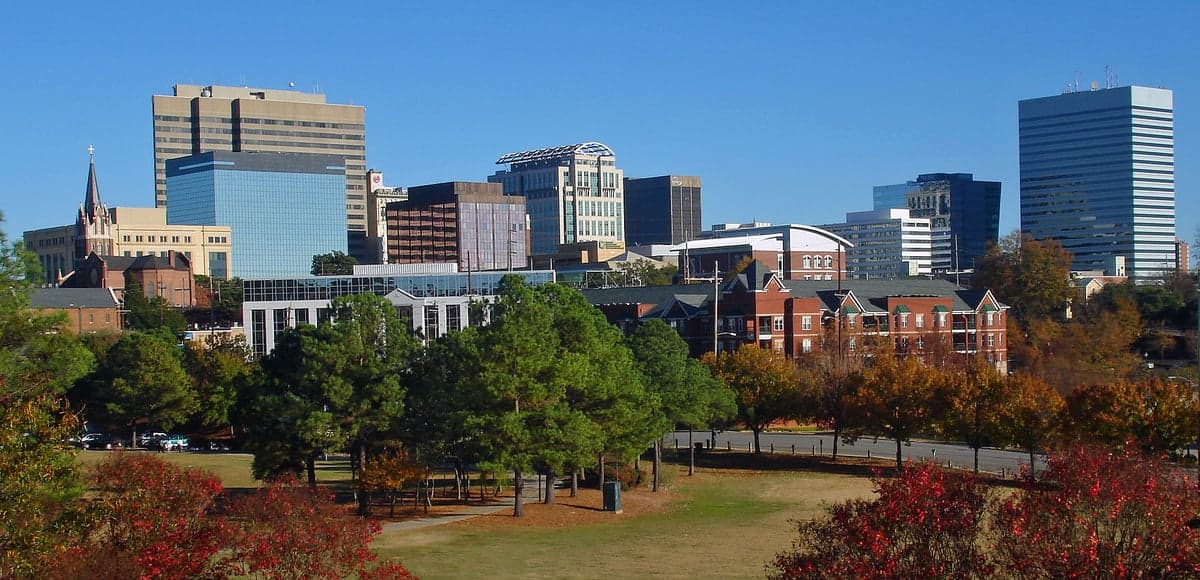
Photo: Wikipedia
Personal Sovereignty in Columbia, SC
Viable for self-reliance. Generally workable, though some barriers may limit total independence.
What does Personal Sovereignty tell us?
Personal Sovereignty measures your capacity for self-reliance and independence with minimal government friction. Higher scores mean fewer barriers between you and the way you want to live... but it assumes you have the space you need and good neighbors.
What does this tell us?
Personal Sovereignty measures your capacity for self-reliance and independence with minimal government friction. Higher scores mean fewer barriers between you and the way you want to live... but it assumes you have the space you need and good neighbors.
State Policy
Energy independence: Importer (25% of energy produced in-state)
Personal Liberty
Homesteading

Personal Liberty Analysis
Columbia, South Carolina, offers a mixed bag for those prioritizing personal sovereignty, with a state-level legal framework that generally respects individual autonomy but a local governance structure in Richland County that can feel more intrusive. The city sits in a state that has taken notable steps to limit federal overreach, particularly through the South Carolina Freedom of Conscience Act and a robust Second Amendment culture, yet the practical realities of living in a mid-sized state capital mean navigating zoning codes, tax policies, and local ordinances that can chafe against a self-reliant lifestyle. For the strategic relocation-minded individual or family, Columbia provides a foundation of legal protections worth building on, but requires careful selection of neighborhood and property to maximize personal freedom.
Tax burden and regulatory posture for self-reliant individuals
South Carolina's tax structure is relatively favorable for those seeking to minimize government entanglement, though it's not a tax-free haven. The state income tax is a flat 3% as of 2026, down from a progressive rate in prior years, which simplifies planning and reduces the bite on earned income. Property taxes are assessed at 4% of fair market value for owner-occupied homes, with a $50,000 exemption, meaning a $300,000 home carries an annual tax bill around $1,000 before local millage rates. Richland County adds its own layer, with millage rates around 0.3 to 0.4, pushing total property tax to roughly 0.6% of value—still lower than many Northern states but higher than rural South Carolina counties. Sales tax in Columbia is 9%, including state and local components, which is on the higher side for the region and can feel like a penalty on everyday purchases. Regulatory posture at the state level is generally light-touch: no state-level business license requirement for most sole proprietors, no inventory tax, and a right-to-work law that keeps labor costs flexible. However, Richland County enforces building codes and zoning with moderate strictness, and the city's stormwater and environmental regulations can add permitting delays for property improvements. For a prepper or homesteader, the state's lack of a personal property tax on vehicles or equipment is a plus, but the county's enforcement of nuisance ordinances (e.g., noise, vehicle storage, livestock limits) means you cannot simply do as you please on your land without checking local rules.
Self-defense and gun law specifics in Columbia and South Carolina
South Carolina is a strong Second Amendment state, and Columbia residents benefit from a legal environment that prioritizes the right to keep and bear arms. The state has permitless carry for anyone 18 or older who can legally possess a firearm, effective since 2024, meaning no government permission slip is needed to carry concealed or openly. This is a significant sovereignty win, eliminating a bureaucratic hurdle and the potential for local officials to deny permits. The state also has a "stand your ground" law with no duty to retreat, codified in South Carolina Code Section 16-11-440, which applies in any place you have a legal right to be. Castle doctrine protections extend to vehicles and workplaces, not just homes. Magazine capacity is unrestricted, and there is no state-level assault weapons ban. However, Columbia itself is not without friction: the city has a history of local ordinances that attempted to restrict firearms in public parks and government buildings, though state preemption laws (Section 23-31-520) generally override these. The Richland County Sheriff's Department is known for being relatively pro-2A in practice, but the Columbia Police Department operates under city council oversight that can be more restrictive. For the survivalist, the key takeaway is that your legal right to defend yourself is strong, but you must remain vigilant against local attempts to chip away at that right through zoning or "sensitive place" designations. Background checks are required for all commercial sales, but private transfers between individuals are legal without government involvement.
Self-reliance and homesteading viability: lot sizes, zoning, and off-grid feasibility
Columbia's urban core offers limited homesteading potential, but the surrounding areas within Richland County and into Lexington County provide more room for self-reliance. Inside the city limits, typical residential lots range from 0.1 to 0.25 acres, with zoning that restricts livestock to chickens only (hens, no roosters) and often prohibits goats, pigs, or larger animals. The city's building codes require connection to municipal water and sewer in most areas, making true off-grid living illegal without a variance. However, move just 15-20 minutes outside the city—towards Blythewood, Elgin, or into Lexington County—and lot sizes jump to 1-5 acres with agricultural zoning that allows for gardens, small livestock, and even limited hunting on your own land. Off-grid feasibility is mixed: South Carolina has no state law prohibiting rainwater collection, and solar panels are allowed without HOA interference in unincorporated areas, but Richland County requires septic system permits and well permits that involve health department inspections. The state's right-to-farm law (Section 46-45-10) protects agricultural activities from nuisance lawsuits, which is a strong sovereignty tool for homesteaders. For a prepper family, the sweet spot is a property in Lexington County's rural tier, where zoning is looser, taxes are lower, and you can realistically produce a significant portion of your own food. Columbia's water supply from the Broad and Saluda Rivers is generally reliable, but the city's dependence on a centralized treatment system is a vulnerability that off-grid well water mitigates.
Personal liberties: parental rights, medical autonomy, speech, and property
South Carolina has taken a strong stance on parental rights, with the 2023 Parents' Bill of Rights (H. 3728) affirming that parents have the fundamental right to direct their children's education, healthcare, and upbringing. This law requires schools to obtain parental consent before administering any mental health assessments or surveys, and it prohibits school districts from hiding a child's medical or emotional status from parents. For medical autonomy, the state has a broad religious exemption for vaccinations and medical treatments, and there is no state-level vaccine mandate for adults. However, Columbia's local health department can enforce quarantine orders during public health emergencies, which is a concern for those who prioritize medical choice. Speech protections are robust under state law, with no hate speech statutes that chill expression, and the state's campus free speech law (Act 209 of 2017) protects open discourse at public universities like the University of South Carolina. Property rights are generally strong, with South Carolina being a "Dillon's Rule" state that limits local government authority to what is expressly granted by the state, but Richland County's comprehensive plan gives it broad power over land use. Eminent domain is restricted to public use (not economic development) under state law, a protection that matters for rural landowners. For the sovereignty-minded, the biggest local threat is HOA covenants, which are common in Columbia's suburban developments and can restrict everything from flag displays to vehicle storage to garden size—always check deed restrictions before buying.
Overall, Columbia offers a solid baseline of personal sovereignty relative to many other mid-sized Southern cities, particularly in its gun laws, parental rights, and tax structure, but it falls short of the libertarian ideal found in more rural parts of the state or in places like Wyoming or New Hampshire. The city's local government in Richland County is more interventionist than the state government, meaning you must be deliberate about where you live within the metro area. For a single individual or family willing to choose a property in Lexington County's rural fringe, Columbia provides access to urban infrastructure—hospitals, supply chains, and employment—without sacrificing the core freedoms of self-defense, self-reliance, and family autonomy. The state's legal framework is a net positive for sovereignty, but the devil is in the local details, and a strategic relocation here requires due diligence on zoning, HOA rules, and county ordinances to ensure your personal liberties are not eroded by municipal overreach.

* Values derived from national, state, county, city and local statistics and may differ in a specific area. Last updated: 2026-04-23T04:57:37.000Z
Narrative content on this page is AI-generated and may contain mistakes. Verify any details that matter before acting on them.
ReloMaps may earn a commission from affiliate links at no extra cost to you.

