
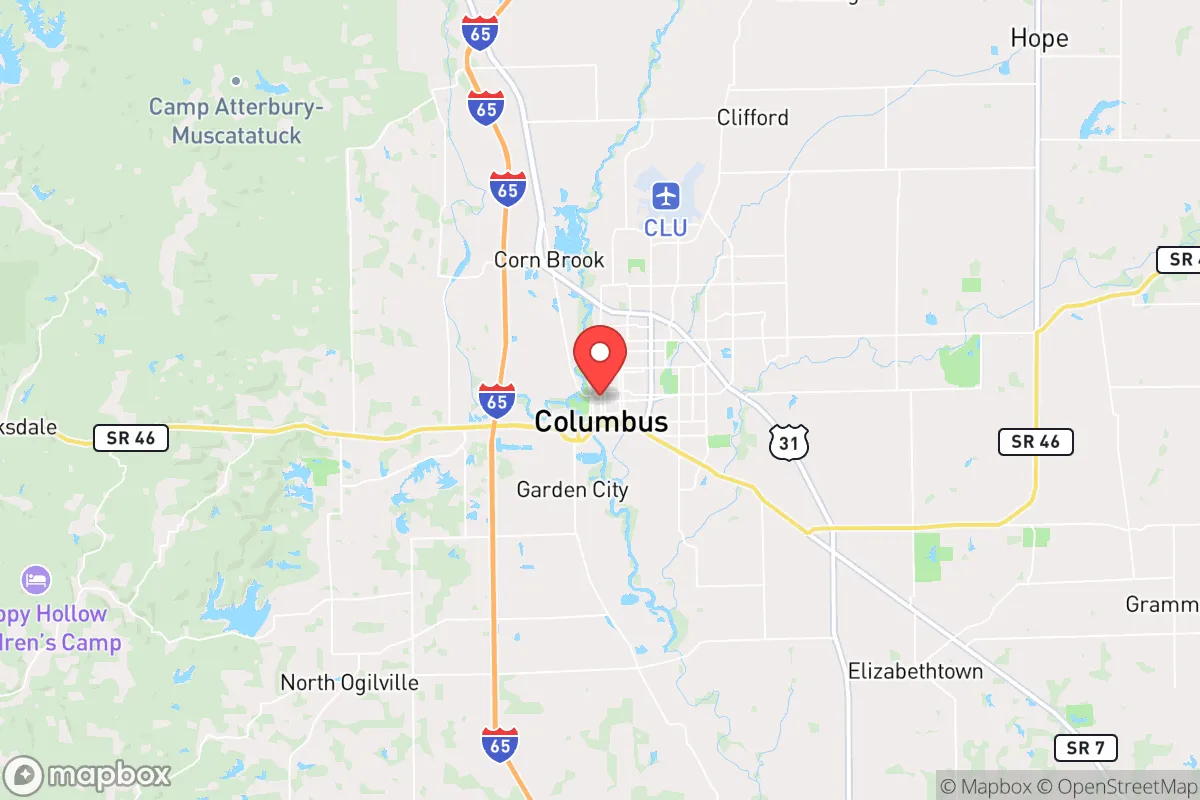
Photo: Wikipedia
Personal Sovereignty in Columbus, IN
Viable for self-reliance. Generally workable, though some barriers may limit total independence.
What does Personal Sovereignty tell us?
Personal Sovereignty measures your capacity for self-reliance and independence with minimal government friction. Higher scores mean fewer barriers between you and the way you want to live... but it assumes you have the space you need and good neighbors.
What does this tell us?
Personal Sovereignty measures your capacity for self-reliance and independence with minimal government friction. Higher scores mean fewer barriers between you and the way you want to live... but it assumes you have the space you need and good neighbors.
State Policy
Energy independence: Importer (35% of energy produced in-state)
Personal Liberty
Homesteading

Personal Liberty Analysis
Columbus, Indiana, offers a notably higher degree of personal sovereignty than many similarly sized Midwestern towns, largely because it sits in a state that has deliberately pushed back against federal overreach and maintains a legal framework that favors individual decision-making over collective mandates. For the survivalist or prepper, this isn't just about politics—it's about the practical ability to live your life without constant government interference. The city's environment is shaped by a state-level commitment to limited government, which translates into fewer restrictions on everything from how you can defend your family to what you can do with your own land. While no place is a libertarian utopia, Columbus provides a solid foundation for those seeking to maximize their autonomy in an increasingly uncertain national landscape.
Tax burden and regulatory posture: How much of your money and time does the government take?
Indiana's tax structure is one of the most favorable in the Midwest for individuals who want to keep more of what they earn. The state income tax is a flat 3.15% as of 2025, with no progressive brackets that penalize higher earners or those who build successful side businesses—a key consideration for preppers who may run a small farm or trade operation. Property taxes in Bartholomew County are also reasonable, with an effective rate around 0.85% of assessed value, well below the national average. This means a $250,000 home carries an annual tax bill of roughly $2,125, leaving more capital for supplies, land improvements, or emergency funds. On the regulatory side, Indiana is a "right-to-work" state and has no state-level occupational licensing requirements for many trades, making it easier to start a handyman, welding, or firearms instruction business without wading through bureaucratic red tape. The state also has a relatively low corporate income tax rate of 4.9%, which benefits anyone running a home-based LLC. For the sovereignty-minded, the key takeaway is that Indiana's government takes a smaller slice of your income and property than most states, and it doesn't layer on excessive local regulations that strangle self-employment or property improvements.
Self-defense and gun law specifics: Can you legally protect your home and family without permission slips?
Indiana is a strong Second Amendment state, and Columbus reflects that reality. The state has constitutional carry (permitless carry) for both open and concealed carry for any law-abiding adult 18 or older. You do not need a license to carry a handgun in public, which eliminates a common point of government control. For those who want reciprocity when traveling, a five-year license is available for a modest fee and is issued on a "shall issue" basis—meaning the local sheriff cannot arbitrarily deny it. The state also has a "Stand Your Ground" law, meaning you have no duty to retreat before using deadly force if you are lawfully present and reasonably believe it is necessary to prevent death or great bodily harm. Castle Doctrine protections extend to your home, vehicle, and occupied structure. There are no magazine capacity restrictions, no "assault weapon" bans, and no waiting periods for firearm purchases. For the prepper, this means you can legally stockpile ammunition, build a defensive rifle, and train without fear of sudden legislative bans. The only notable restriction is that private firearm sales between individuals do not require a background check, but federal law still applies to licensed dealers. Overall, Columbus offers a legal environment where self-defense is treated as a fundamental right, not a privilege to be managed by the state.
Self-reliance and homesteading viability: Can you actually grow food, keep animals, and live off-grid?
Within Columbus city limits, zoning becomes the primary constraint on self-reliance. Standard residential lots in the city are typically 0.25 to 0.5 acres, which is enough for a substantial vegetable garden, a few fruit trees, and a small chicken coop (up to six hens are generally allowed without a permit). However, keeping larger livestock like goats, pigs, or a dairy cow is prohibited within city limits. For serious homesteading, you need to look at unincorporated Bartholomew County, where lot sizes of 1 to 5 acres are common and affordable, often under $15,000 per acre. In the county, there are no zoning restrictions on livestock, and you can build a pole barn, install a greenhouse, or set up a rainwater collection system without permits. Off-grid living is legally feasible in the county, but with caveats: the state requires a septic system for wastewater, and the local health department must approve it. Solar panels are fully legal and net metering is available, though the utility company (Duke Energy) has caps on system size. Burning trash is restricted, but composting and wood heating are unregulated. The biggest practical hurdle is that the county does not have a building code for owner-built homes, meaning you can construct your own dwelling without inspections—but you'll also struggle to get a conventional mortgage or insurance on such a property. For the prepper who wants to be truly self-sufficient, the rural areas around Columbus offer a realistic path, while the city itself is better suited for a "suburban homestead" approach.
Personal liberties: Parental rights, medical autonomy, speech, and property
Indiana has become a battleground for several key personal liberties, and the outcomes have generally favored individual sovereignty. On parental rights, the state passed a law in 2023 requiring schools to notify parents of any changes in a child's mental, emotional, or physical health, and it prohibits instruction on human sexuality in grades K-3. This gives parents significant control over what their children are exposed to in public schools. Medical autonomy is more mixed: Indiana banned nearly all abortions in 2022, which aligns with a conservative pro-life view, but the state also has a vaccine mandate for schoolchildren (with medical and religious exemptions available). The COVID-19 era saw no state-level vaccine mandates for adults, and local health departments cannot impose lockdowns without county commissioner approval—a check on government overreach that preppers value. Free speech is robustly protected under the Indiana Constitution, which has its own free speech clause that courts have interpreted as at least as protective as the First Amendment. Property rights are strong: Indiana has no statewide zoning, and the "right to farm" law protects agricultural operations from nuisance lawsuits, which is critical if you plan to keep livestock or run a small farm. The state also has a "Castle Doctrine" that explicitly protects property owners who use force to defend their land. For the sovereignty-minded individual, the legal framework in Columbus and Indiana generally errs on the side of personal freedom, with the notable exception of some health-related mandates that remain on the books.
Compared to states like California, New York, or Illinois, Columbus offers a dramatically higher degree of personal sovereignty—you can carry a gun without a permit, build a home without inspections in the county, keep most of your income, and raise your children with minimal state interference. The trade-off is that you're still in a state that has some regulatory holdovers from the Progressive Era, and the city itself has more restrictions than the surrounding rural areas. For the prepper or survivalist looking for a place that respects individual autonomy while still providing access to jobs and infrastructure, Columbus ranks well above average. It's not a free state in the absolute sense, but it's a place where a determined individual can live largely on their own terms, with the law as an ally rather than an adversary.

* Values derived from national, state, county, city and local statistics and may differ in a specific area. Last updated: 2026-04-30T02:18:37.000Z
Narrative content on this page is AI-generated and may contain mistakes. Verify any details that matter before acting on them.
ReloMaps may earn a commission from affiliate links at no extra cost to you.

