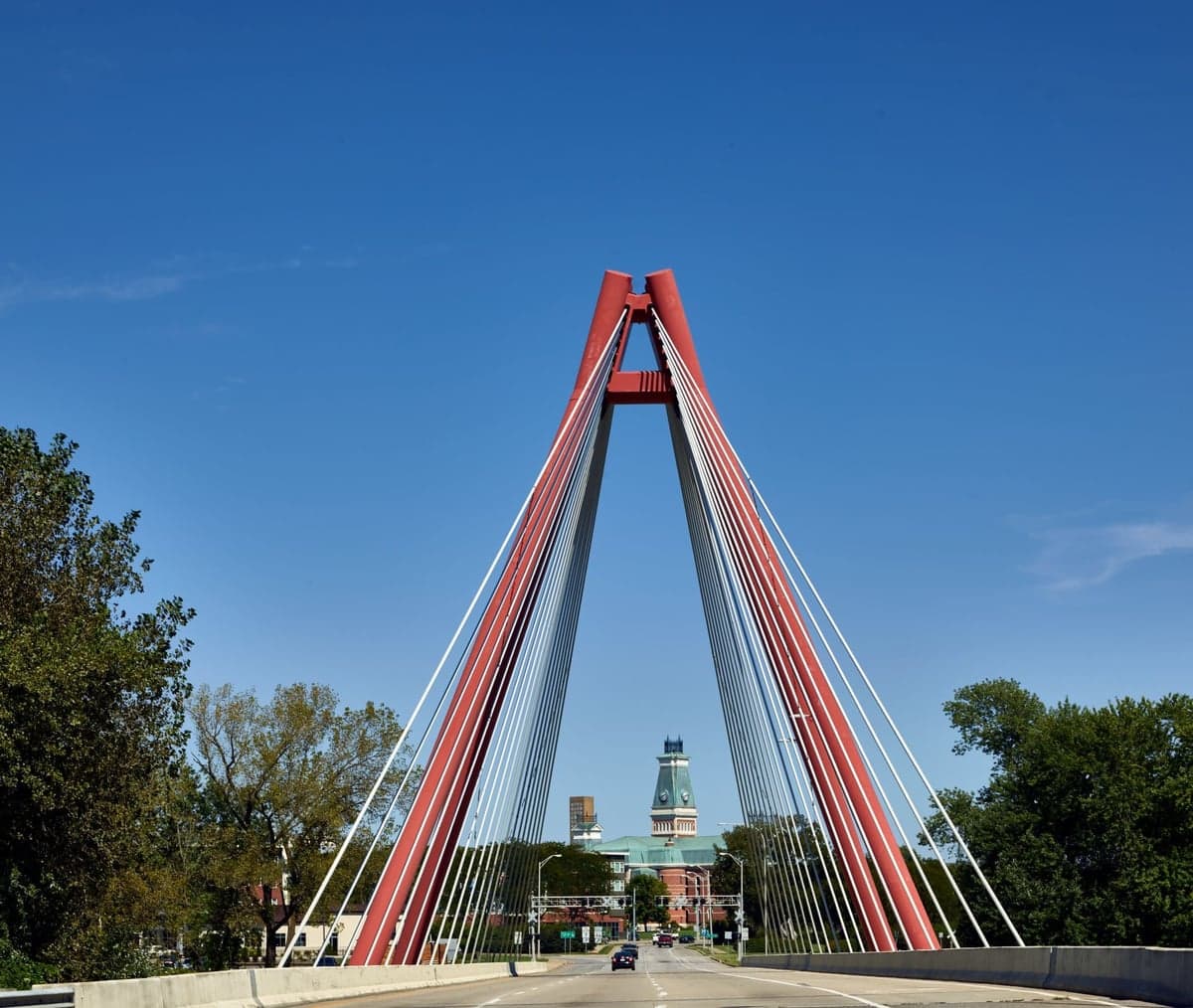
Photo: Wikipedia
Strategic Assessment of Columbus, IN
Meaningful friction. Expect exposure to either population pressure, blast zones, or natural disaster risk. Consider buying a retreat property.
What does the Strategic Assessment tell us?
Our Strategic Assessment grades tactical survivability of an area. Major population centers, military targets, fallout zones, natural disasters, and border exposure all drive risk — lower exposure means a more defensible position in a crisis.
This is heavily inspired by Joel Skousen's Strategic Relocation book. Highly recommended you checkout the book ($)What does this tell us?
Our Strategic Assessment grades tactical survivability of an area. Major population centers, military targets, fallout zones, natural disasters, and border exposure all drive risk — lower exposure means a more defensible position in a crisis.
This is heavily inspired by Joel Skousen's Strategic Relocation book. Highly recommended you checkout the book ($)Strategic Pillars

Key Distances
Regional Safe Places
Below is our recommended "safe zones" in Indiana and the surrounding area based on our strategic heuristics. For most people, it's unrealistic to live in a “safe zone” full-time due to work, family or other personal reasons. They tend to be more rural. However, many of these areas are perfect for second homes and retreat properties that double as a vacation home or even a short-term rental.

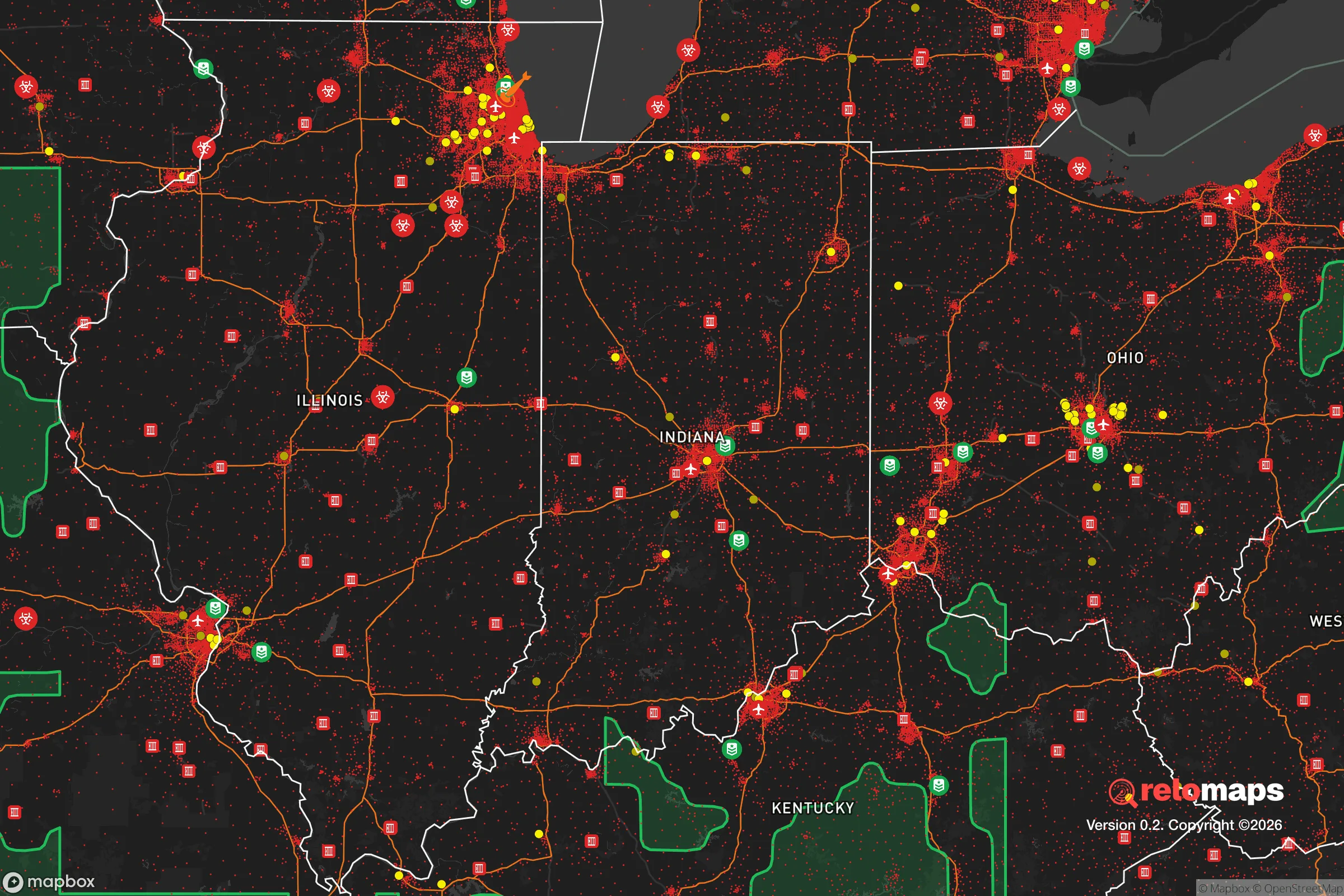


Important Note: For informational purposes only. This does not mean nothing bad ever happens in the green zones. Please use common sense. This is based on public data and modeled with AI. We tried to take a conservative approach but mistakes happen. We update this regularly as new information becomes available.
Solar Generator Recommendations
Backup power matters more here than in safer locations. We've picked three solar generators across budgets and capacity tiers — start with the budget unit if you only need a few essentials, or step up if you want to run a fridge and HVAC for days at a time.

Jackery Portable Power Station Explorer 300
Budget OptionPower on the Go: Weighing only 11 lbs, it's convenient to set up and store with book-sized foldable solar panels

BLUETTI Portable Power Station AC180
Designed for both indoor and outdoor scenarios, AC180 is highly capable as it has a robost capacity and continuous output power.

EF ECOFLOW DELTA Pro Ultra Power Station
Upgraded PickEcoFlow DELTA Pro Ultra is a whole-home energy system designed to grow with your family. Integrated with the Smart Home Panel 2, it scales to meet your evolving energy needs — keeping your home powered, intelligent, and secure through every stage of life.
We earn a commission, at no additional cost to you.
Strategic Assessment Analysis
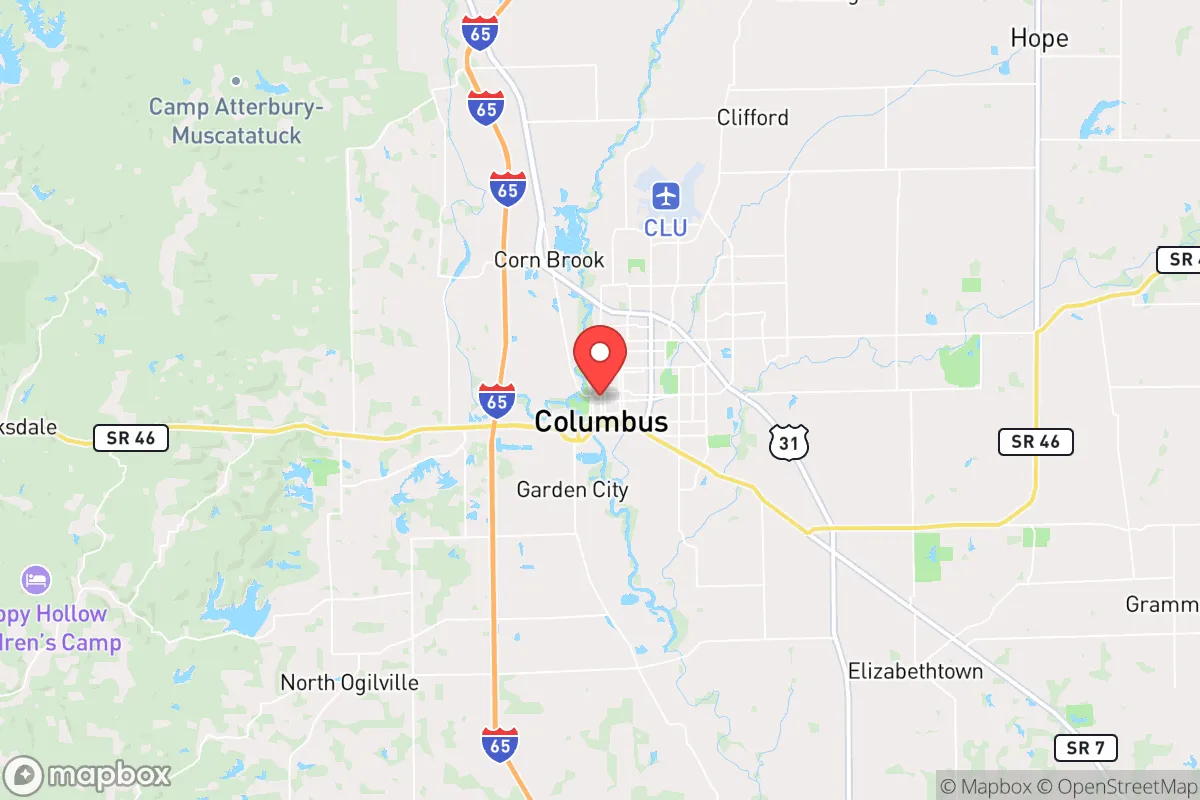
Columbus, Indiana, presents a mixed bag for the conservative prepper or survivalist—it’s not a hardened bunker, but it’s far from a soft target. The city’s real strength lies in its position as a secondary manufacturing hub with a surprisingly resilient local economy, anchored by Cummins Inc., which gives it a degree of economic independence from the coastal chaos. Its location, roughly 40 miles south of Indianapolis and 80 miles north of Louisville, places it in a sweet spot: close enough to access major medical and logistical resources, yet far enough from the immediate blast radius of a major metropolitan target. For a relocator thinking in terms of decades, not just next year, Columbus offers a workable middle ground—but only if you understand its specific vulnerabilities and plan accordingly.
Geographic position and natural advantages for long-term survival
Geographically, Columbus sits in the flat, fertile floodplain of the Driftwood River, part of the White River watershed. This is not mountainous terrain, so you won’t get the natural defensibility of a ridge or valley, but the area’s agricultural productivity is a genuine asset. The surrounding Bartholomew County is prime farmland, meaning local food production is viable even if supply chains break down. The Driftwood River and nearby reservoirs—like Lake Monroe to the southwest—provide surface water sources, though you’ll need to treat it. The region’s temperate climate avoids the extremes of the Great Plains or the Gulf Coast, with four distinct seasons that allow for both growing crops and storing food without the spoilage risks of a humid subtropical zone. Columbus’s biggest natural advantage is its position in the “Corn Belt” breadbasket, giving it a local food security buffer that coastal cities simply don’t have. The flat terrain also means road networks are straightforward, but that cuts both ways—it’s easy to move around, but also easy for outsiders to approach.
Risks, exposures, and proximity to fallout-relevant landmarks
The elephant in the room is proximity to Indianapolis, a major logistics hub with a FedEx hub, a Superfund site (the former Naval Avionics facility), and a population density that would make it a prime target for any coordinated attack or civil unrest. Columbus is within the fallout plume range of a ground burst on Indianapolis, depending on wind direction—roughly 40 miles puts it at the edge of the lethal radiation zone for a 300-kiloton yield, but well inside the zone for longer-term contamination. Similarly, the nearby Muscatatuck Urban Training Center (a military urban warfare training facility) and Camp Atterbury (an Army National Guard base) are both within 20 miles. These are not targets in themselves, but they could become staging areas for federal forces during a crisis, drawing unwanted attention or becoming choke points for movement. The city’s own industrial base—Cummins’ engine plants, plus several plastics and metal fabrication facilities—could be secondary targets for economic disruption. On the plus side, there are no nuclear power plants within 50 miles, and the nearest major chemical storage facilities are in Indianapolis and Louisville, reducing the risk of a Bhopal-style event. The biggest exposure is simply being within a two-hour drive of two major cities that would become chaos magnets in a collapse scenario.
Practical resilience for a relocator: food, water, energy, and defensibility
For a relocator setting up a homestead or retreat, Columbus offers a mixed report card. Water is the first concern: the municipal supply comes from the Driftwood River and is treated, but a prolonged grid-down event would cut that off. A well is the obvious solution, but the local water table is shallow (20-40 feet) and prone to agricultural runoff, so you’ll need a deep well or a robust filtration system. Rainwater catchment is viable, with average annual precipitation around 44 inches. Food-wise, you can grow a solid garden in the rich loam soil, and local farmers’ markets are abundant in normal times, but you’ll want to establish relationships with local growers now—they’re not going to sell to strangers when the shelves go empty. Energy is a bright spot: Indiana’s net metering policies are decent, and solar is viable year-round, though you’ll need battery storage for the cloudy winter months. Natural gas is widely available in the city, but rural properties rely on propane or heating oil. Defensibility is the weak link. The flat terrain and grid-like road system make it hard to create a defensible perimeter. A rural property with a long driveway and some tree cover is better than a suburban cul-de-sac, but you’re not going to hold off a determined group for long. The best strategy here is to be low-profile and self-sufficient, not to build a fortress. The local gun culture is strong—Indiana is a constitutional carry state—so you won’t stand out by owning firearms, but you also won’t have the advantage of a remote mountain pass.
Overall strategic picture: a viable fallback, not a final redoubt
So where does Columbus land on the prepper’s map? It’s a solid B-tier location. It’s not the remote Idaho compound or the Appalachian holler that survivalist lore romanticizes, but it’s also not the suburban sprawl of Atlanta or the coastal vulnerability of Charleston. For a single individual or a family who wants to be prepared without going off-grid entirely, Columbus offers a workable balance. You get a stable local economy that won’t collapse overnight, a food-producing hinterland, and enough distance from the worst urban chaos to buy you time to react. The downsides are real: the flat terrain, the proximity to Indianapolis, and the lack of natural barriers mean you’re betting on being overlooked rather than being impregnable. That’s a bet that can pay off if you’re disciplined about OPSEC (operational security) and have a solid bug-out plan for a secondary location further north or east. If you’re looking for a place to ride out the next decade of instability while still holding a job and sending kids to school, Columbus is a rational choice. If you’re planning for a total societal collapse where every city becomes a war zone, you’ll want to keep driving. The smart move is to treat Columbus as a base of operations, not a final destination—build your skills, stock your supplies, and keep your options open. That’s the honest assessment for a conservative relocator who’s thinking strategically.

* Values derived from national, state, county, city and local statistics and may differ in a specific area. Last updated: 2026-04-30T02:18:37.000Z
Narrative content on this page is AI-generated and may contain mistakes. Verify any details that matter before acting on them.
ReloMaps may earn a commission from affiliate links at no extra cost to you.

