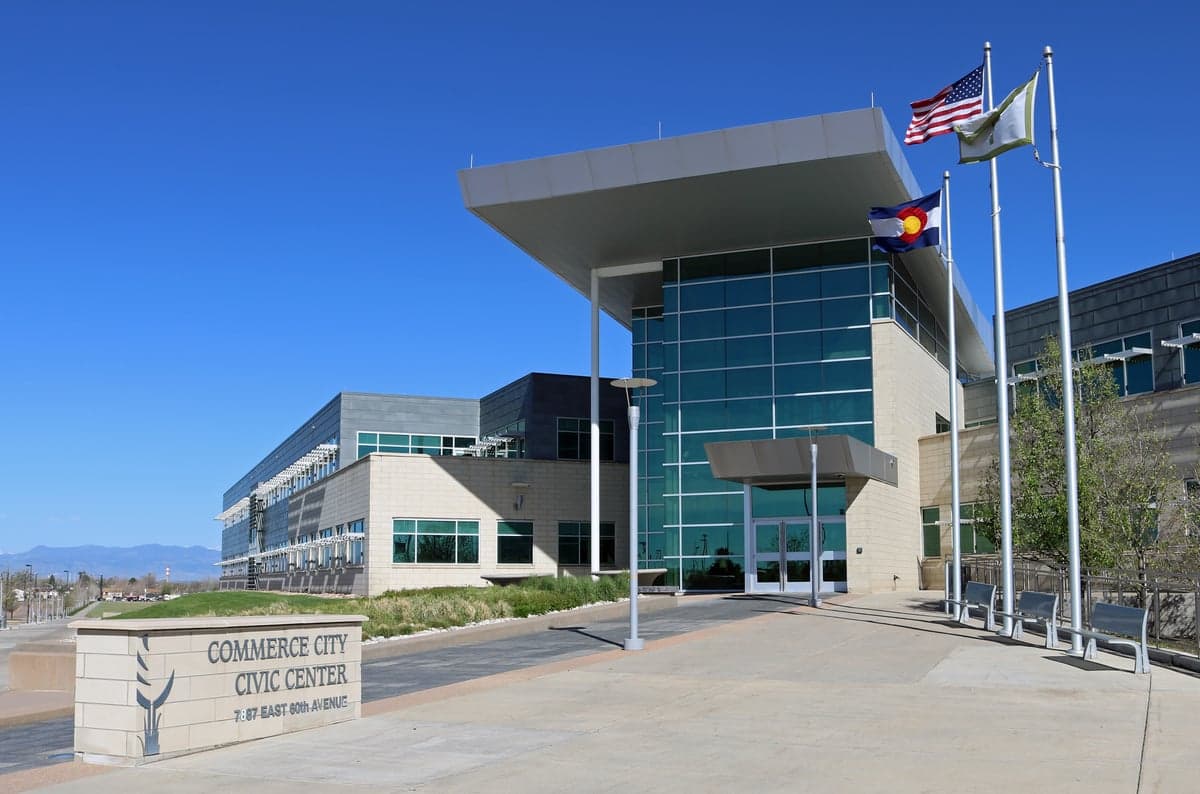
Photo: Wikipedia
Demographics of Commerce City, CO
Affluence Level in Commerce City, CO
A middle-class area roughly in line with national averages across income, home values, education, and employment.
People of Commerce City, CO
Commerce City, Colorado, is a community of 64,640 residents defined by its working-class roots and rapid demographic transformation. The city is now a Hispanic-majority municipality (48.3% Hispanic) with a significant White minority (41.2%), a small Black population (4.4%), and growing East/Southeast Asian (1.9%) and Indian (0.4%) communities. With only 23.9% of adults holding a college degree, it remains a blue-collar hub where industrial history meets suburban expansion, creating a distinct identity as a gateway for immigrant families and young households seeking affordable housing near Denver.
How the city was settled and grew
Commerce City’s human history begins not with pioneers but with industry. The area was originally part of the vast South Platte River valley, settled by homesteaders in the 1850s, but the city itself did not take shape until the 20th century. The key catalyst was the construction of the Rocky Mountain Arsenal in 1942, a chemical weapons manufacturing plant that drew a wave of defense workers—overwhelmingly White and native-born—to the area. After World War II, the arsenal’s conversion to pesticide production and the simultaneous expansion of oil refineries along the South Platte turned the region into an industrial corridor. The city was officially incorporated in 1952, absorbing several unincorporated pockets. The earliest neighborhoods, such as Derby (a historic farming community that became a working-class suburb) and Dupont (named after the chemical company that operated the arsenal), were built by these industrial workers. Derby, in particular, became a tight-knit enclave of White, blue-collar families, many of whom worked at the arsenal or the nearby Suncor Energy refinery. A second wave arrived in the 1950s and 1960s as the interstate highway system (I-76 and I-270) made the area accessible to Denver commuters, spurring the development of subdivisions like Belle Creek—though that neighborhood would not fully develop until later decades.
Modern era (post-1965)
The 1965 Hart-Cellar Act opened immigration from Latin America, and Commerce City began absorbing a growing Hispanic population. Initially, Mexican-American families settled in older, lower-cost areas like Derby and the Southlawn neighborhood, where aging postwar housing stock was affordable. By the 1980s and 1990s, the Hispanic share of the population surged as new arrivals from Mexico and Central America—many drawn by construction, landscaping, and warehouse jobs—moved into the Reunion area (a master-planned community that began development in the late 1990s) and the older Buffalo Mesa subdivision. The White population, meanwhile, began a slow out-migration to more distant suburbs like Brighton and Thornton, a pattern common across the Denver metro area. The Black population, historically small, remained concentrated in the Southlawn and Derby neighborhoods, though never exceeding 5% of the city total. The East/Southeast Asian community—primarily Vietnamese and Filipino—grew modestly after 2000, settling in Belle Creek and the newer Turnberry subdivision, drawn by the area’s affordable new construction and proximity to Denver’s Asian commercial corridors along Federal Boulevard. The Indian subcontinent population (0.4%) is too small to form a distinct enclave, with families dispersed across the newer subdivisions. Today, the city’s racial geography is stark: the eastern half (Reunion, Turnberry, Belle Creek) is more diverse and newer, while the western half (Derby, Southlawn, Dupont) remains older and more heavily Hispanic and White working-class.
The future
Commerce City’s population is heading toward further Hispanic majority and increasing diversity in its newer neighborhoods. The Hispanic share has risen steadily from roughly 30% in 2000 to 48.3% in 2024, and this trend is likely to continue as younger Hispanic families replace aging White residents in the western neighborhoods. The White population is projected to decline further, falling below 35% within a decade, as out-migration continues and the city’s housing stock ages. The East/Southeast Asian and Indian communities are growing slowly but remain small; they are unlikely to form large ethnic enclaves, instead assimilating into the newer subdivisions. The city is not homogenizing—it is tribalizing into distinct age and income bands: older, poorer, Hispanic-majority west versus younger, more diverse, middle-class east. The Reunion and Belle Creek neighborhoods are absorbing most new construction and attracting a mix of Hispanic, White, and Asian families, while Derby and Southlawn are seeing population stagnation and aging housing stock. The next 10-20 years will likely see the city’s overall population grow modestly (to perhaps 75,000-80,000) as infill development continues, but the demographic center of gravity will shift eastward. For a new resident, this means choosing between the established, heavily Hispanic west side with lower home prices and the newer, more diverse east side with better schools and amenities.
Commerce City is becoming a predominantly Hispanic, working-class suburb with a growing middle-class eastern tier—a place where industrial history still shapes the landscape, but where the future belongs to families seeking affordable entry into the Denver metro area. For a conservative-leaning mover, the city offers low taxes and a blue-collar ethos, but the demographic and political trajectory is toward a younger, more Hispanic, and more Democratic-leaning electorate. The key decision is neighborhood: Derby for deep roots and lower costs, Reunion for newer homes and diversity, or Belle Creek for a balanced middle ground.

* Values derived from national, state, county, city and local statistics and may differ in a specific area. Last updated: 2026-04-19T09:27:46.000Z
Narrative content on this page is AI-generated and may contain mistakes. Verify any details that matter before acting on them.
ReloMaps may earn a commission from affiliate links at no extra cost to you.

