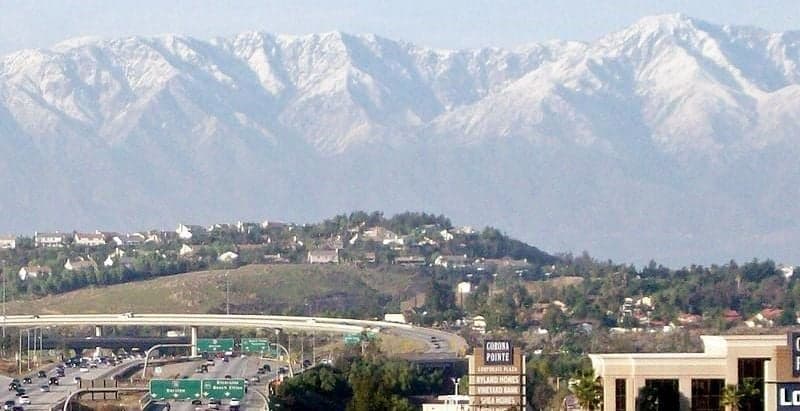
Photo: Wikipedia
Personal Sovereignty in Corona, CA
Moderate friction. Expect trade-offs in some aspect of personal liberty and independence.
What does Personal Sovereignty tell us?
Personal Sovereignty measures your capacity for self-reliance and independence with minimal government friction. Higher scores mean fewer barriers between you and the way you want to live... but it assumes you have the space you need and good neighbors.
What does this tell us?
Personal Sovereignty measures your capacity for self-reliance and independence with minimal government friction. Higher scores mean fewer barriers between you and the way you want to live... but it assumes you have the space you need and good neighbors.
State Policy
Energy independence: Importer (33% of energy produced in-state)
Personal Liberty
Homesteading

Personal Liberty Analysis
Corona, California, presents a complex picture for those prioritizing personal sovereignty. While the city itself is not a bastion of libertarian ideals, its location in Riverside County offers a slightly more autonomy-friendly environment than what you’d find in coastal California. The reality is that state-level overreach—from Sacramento’s mandates on energy, healthcare, and education—casts a long shadow, but Corona’s local culture and geography provide some breathing room for those willing to navigate the regulatory maze. For a survivalist or prepper, the key question isn’t whether California is a free state (it isn’t), but whether Corona offers enough practical wiggle room to build a resilient, self-determined life.
Tax burden and regulatory posture: How California’s policies hit Corona residents
California’s tax structure is a primary concern for anyone valuing financial sovereignty. The state’s top marginal income tax rate of 13.3% (as of 2025) applies to high earners, but even middle-class households in Corona face a combined state and local tax burden that ranks among the highest in the nation. Sales tax in Corona is 8.75%, and property taxes, while capped at 1% of assessed value under Proposition 13, are based on purchase price—meaning recent buyers pay significantly more than long-term owners. The regulatory posture is equally heavy: California’s California Environmental Quality Act (CEQA) can delay or kill any construction project, and the state’s energy mandates (like the push for all-electric new homes) limit individual choice. For a prepper, this means that building a detached workshop, installing a backup generator, or even adding solar panels requires navigating a thicket of permits and inspections. Corona’s city government is generally more business-friendly than Los Angeles or San Francisco, but it still operates under Sacramento’s thumb. The practical takeaway: your financial autonomy is constrained by high taxes and regulatory friction, but you can mitigate this by buying an older home (lower property tax base) and focusing on low-visibility improvements.
Self-defense and gun law specifics: What Corona allows and what it restricts
California’s gun laws are among the most restrictive in the nation, and Corona residents must comply with them. The state requires a 10-day waiting period for all firearm purchases, a background check through the California Department of Justice, and a Firearm Safety Certificate. “Assault weapons” are banned by name and feature, including AR-15s with pistol grips or flash hiders, and magazines are capped at 10 rounds. Concealed carry is a “may-issue” system, but after the Supreme Court’s Bruen decision (2022), Riverside County has become more permissive—though the process remains expensive and time-consuming, requiring a good cause statement, training, and a sheriff’s interview. For self-defense at home, a shotgun or handgun is legal, but you cannot carry openly in public. The state also has a “red flag” law (Gun Violence Restraining Order) that allows authorities to seize firearms without a criminal conviction. For a prepper, this means your defensive capabilities are legally limited: no standard-capacity magazines, no suppressors, and no short-barreled rifles. The upside is that Corona’s crime rate is moderate (property crime is the bigger concern), so a well-secured home with a legal firearm is still a viable deterrent. If you’re serious about self-defense, consider a bolt-action rifle for long-range and a pump shotgun for home defense—both remain relatively unregulated.
Self-reliance and homesteading viability: Lot sizes, zoning, and off-grid feasibility
Corona’s suburban character limits traditional homesteading, but there are pockets of opportunity. Most residential lots in the city are 6,000 to 10,000 square feet, which is enough for a substantial vegetable garden, a few fruit trees, and a chicken coop (hens only, no roosters). Zoning regulations allow backyard chickens in most single-family zones, but you’ll need a permit for larger livestock like goats or pigs—and those are generally restricted to properties zoned for agriculture. The city’s municipal code also restricts rainwater harvesting to two 55-gallon barrels per property without a permit, and off-grid solar systems that disconnect from the utility grid are effectively illegal due to state building codes. For a prepper, this means full self-sufficiency is not feasible within city limits. However, the surrounding unincorporated areas of Riverside County (like the hills east of Corona or near Lake Matthews) offer larger parcels—often 1 to 5 acres—with fewer restrictions. These areas allow for well water, septic systems, and more livestock, but they come with higher fire risk and longer emergency response times. The strategic play: buy a small home in Corona for daily life and a separate parcel in the nearby hills for a bug-out location or serious gardening operation.
Personal liberties: Parental rights, medical autonomy, speech, and property
California’s state government has aggressively asserted control over areas that many conservatives consider personal liberties. On parental rights, the state mandates that public schools cannot notify parents if a child changes their gender identity or pronouns, a policy that directly conflicts with many families’ values. Corona’s school district (Corona-Norco Unified) has been a flashpoint for these debates, with some parents organizing to push back, but state law overrides local preferences. Medical autonomy is similarly constrained: California has strict vaccine mandates for schoolchildren (though exemptions exist for medical reasons), and the state’s public health orders during the pandemic were among the longest-lasting in the country. On speech, California’s “hate speech” laws and workplace harassment regulations can chill political expression, but Corona’s local culture is more conservative than the state average, so open political discussion is generally tolerated. Property rights are the brightest spot: Proposition 13 protects against runaway property tax increases, and California’s “builder’s remedy” (a loophole in housing law) has been used to force cities to approve more housing, which can increase density. For a prepper, the biggest threat to personal liberty is the state’s ability to impose emergency orders—like the 2020 stay-at-home orders that shut down “non-essential” businesses. Corona’s city council has shown some resistance to state overreach (e.g., declaring itself a “Second Amendment sanctuary” in 2021), but these resolutions are symbolic and don’t override state law.
Overall, Corona offers a moderate degree of personal sovereignty relative to other California cities, but it falls far short of what you’d find in states like Texas, Idaho, or Montana. The city’s conservative local culture and Riverside County’s more permissive gun policies provide some breathing room, but the state-level tax burden, regulatory density, and erosion of parental and medical autonomy are significant drawbacks. For a survivalist or prepper, Corona is a compromise: you get a decent climate, a growing community of like-minded people, and access to nearby rural land, but you must accept that you’re operating within a system that is fundamentally hostile to full self-reliance. If you’re willing to fight for every inch of freedom—through legal gun ownership, backyard gardening, and active political engagement—Corona can work. But if you’re looking for a place where the government stays out of your life, you’ll need to look east.

* Values derived from national, state, county, city and local statistics and may differ in a specific area. Last updated: 2026-04-24T13:29:41.000Z
Narrative content on this page is AI-generated and may contain mistakes. Verify any details that matter before acting on them.
ReloMaps may earn a commission from affiliate links at no extra cost to you.

