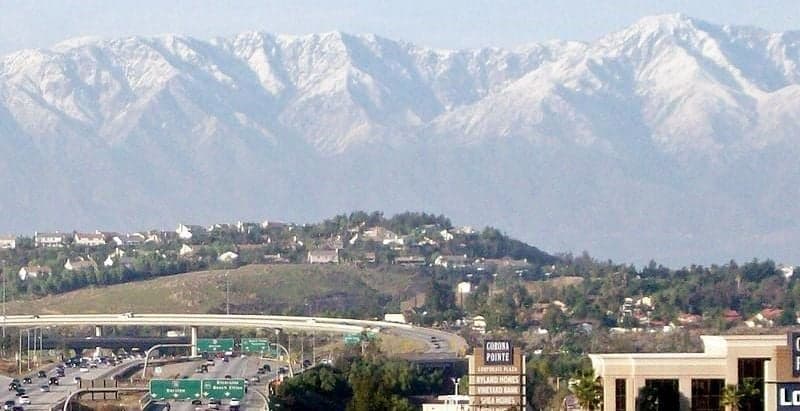
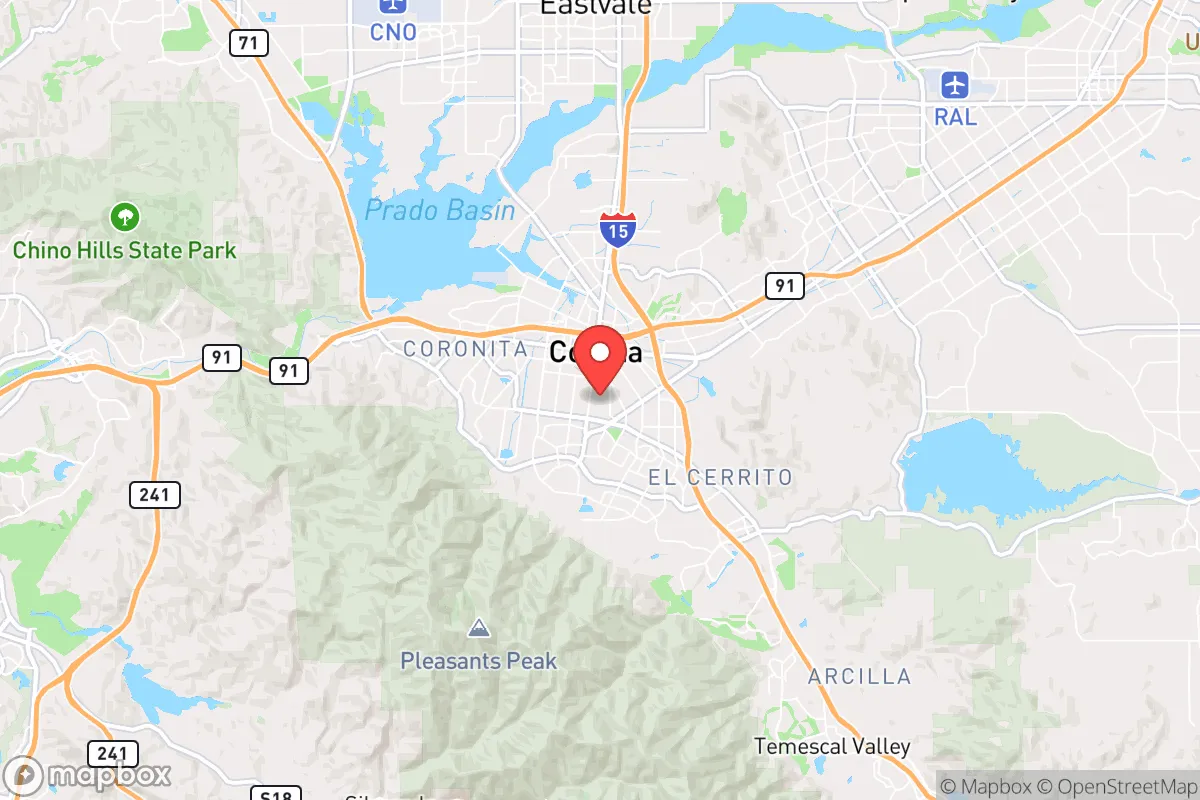
Photo: Wikipedia
Political ClimatePolitical Climate in Corona, CA
District shown is the primary district for this city’s centroid. Cities may span multiple districts.
Local Political AnalysisPolitical Analysis of Corona, CA
Corona, CA, has long been a solidly conservative stronghold in Riverside County, with a Cook PVI of R+2 that reflects a reliable Republican lean in most elections. If you’ve been around here since the 90s or early 2000s, you remember when this town was a no-nonsense, family-first community where folks minded their own business and the local government stayed out of your hair. That’s still the baseline, but you can feel the winds shifting—especially as more people pour in from Orange County and Los Angeles, bringing with them a more progressive mindset. The 2020 election saw Trump win Corona by about 5 points, down from a 10-point margin in 2016, and that narrowing gap is something longtime residents are watching closely. It’s not a blue wave yet, but the undercurrent is real, and it’s got a lot of us worried about what’s coming next.
How it compares
Drive 15 minutes west to Anaheim Hills or Yorba Linda, and you’ll find a similar conservative vibe—maybe even a bit stronger, with those areas leaning R+4 or R+5. But head east to Riverside proper, and you’re in a different world: the city council there has been flirting with rent control and sanctuary city policies, and the university crowd pushes a lot of progressive noise. Corona sits right in the middle, politically and geographically. It’s not as deep red as Norco (the “Horsetown USA” next door, which is practically R+10), but it’s nowhere near as blue as Lake Elsinore or Murrieta, which have seen more transplants and a younger, more diverse electorate. What sets Corona apart is its stubbornness—the old guard here still shows up to city council meetings to fight zoning changes that would bring high-density apartments or homeless shelters. But every year, a few more “for sale” signs go up, and the new neighbors don’t always share our values on taxes, property rights, or the Second Amendment.
What this means for residents
For those of us who’ve been here a while, the biggest concern is government overreach creeping in under the radar. The city council is still majority conservative, but we’ve seen them cave on things like mask mandates and business closures during the pandemic—decisions that felt more about following Sacramento’s orders than protecting local freedoms. Property taxes are already high in California, and there’s chatter about adding new “impact fees” for new developments, which would hit homeowners hard. On the plus side, Corona’s police department is well-funded and community-oriented, and the city has resisted the defund movement that’s plagued places like Los Angeles. But the school board has become a battleground: a few years back, we had to fight to keep critical race theory out of the curriculum, and it’s an ongoing battle to ensure parents retain the right to opt their kids out of controversial lessons. If you value personal liberty—like the right to build a shed without a permit or carry a concealed weapon without a mountain of red tape—Corona is still better than most of SoCal, but you’ve got to stay engaged.
Culturally, Corona is a place where the Fourth of July parade still draws thousands and the local VFW hall is packed on Memorial Day. But there’s a growing tension between that old-school patriotism and the new wave of “equity” initiatives pushed by county-level bureaucrats. The city’s recent decision to allow a “Pride” flag on city property for one month was a flashpoint—many of us saw it as a slippery slope toward politicizing public spaces. Long-term, if the trend continues, Corona could become a purple city within a decade, especially if housing prices keep driving out working-class families and replacing them with remote workers from San Francisco. For now, it’s still a place where you can raise kids without worrying about your neighbor reporting you for a backyard barbecue, but you’d better keep an eye on the ballot box. The fight for Corona’s soul isn’t over, but it’s getting louder every election cycle.

State Political ClimatePolitical Climate in California
State Political AnalysisPolitical Environment in the State
California is a one-party Democratic state where registered Democrats outnumber Republicans by nearly 2-to-1, and no Republican has won a statewide election since 2006. Over the last 20 years, the state has shifted from a competitive purple state—where Arnold Schwarzenegger governed as a moderate Republican—to a deep blue stronghold where progressive Democrats control every lever of power. The dominant coalition is a mix of coastal urban professionals, union households, and a growing bloc of Latino voters, though the latter has shown signs of fraying in recent cycles. For a conservative considering relocation, the political reality is that your vote in statewide races will be effectively meaningless, though local pockets of red resistance still exist.
Urban vs. rural divide
The political map of California is a tale of two radically different worlds. The coastal metros—Los Angeles, San Francisco, San Jose, Oakland, and San Diego—drive the state's blue lean with massive margins. San Francisco County gave Biden 85% of the vote in 2020, while Los Angeles County alone delivered more raw Democratic votes than 40 other states. Inland, the Central Valley and far northern counties are reliably red: Bakersfield (Kern County) voted +16 for Trump, and Redding (Shasta County) went +30. The Inland Empire around Riverside and San Bernardino is a genuine battleground—San Bernardino County flipped from Obama to Trump in 2016 and then back to Biden in 2020 by just 5 points. Orange County, once the heart of California conservatism, has flipped blue at the presidential level since 2016, though its northern suburbs like Yorba Linda and Huntington Beach remain conservative strongholds. The rural-urban divide is stark: drive 90 minutes east from San Francisco and you're in Stockton, a blue-collar city that voted for Trump in 2016 and narrowly for Biden in 2020, surrounded by agricultural counties that are deep red.
Policy environment
California's policy environment is aggressively progressive and increasingly burdensome for conservatives. The state has the highest income tax rate in the nation (13.3%), a regressive sales tax that can exceed 10% in some cities, and some of the highest gas taxes in the country—now over $0.60 per gallon after a 2023 increase tied to inflation. Property taxes are capped at 1% of assessed value under Prop 13, but reassessment upon sale means new buyers face massive tax jumps. The regulatory state is vast: California has its own environmental agency (CARB) that sets emissions standards stricter than federal law, and its own OSHA, labor board, and consumer protection laws. Education policy is dominated by the California Teachers Association, a powerful union that has blocked school choice and charter expansion. The state's universal mail-in voting system, enacted permanently in 2021, sends ballots to every registered voter—a system conservatives argue erodes ballot security. Healthcare is heavily regulated, with the state running its own insurance exchange (Covered California) and moving toward a single-payer system, though it hasn't passed yet. On immigration, California is a sanctuary state under SB 54, which prohibits state and local law enforcement from cooperating with federal immigration authorities.
Trajectory & freedom
California is becoming less free by nearly every measure, and the pace is accelerating. On gun rights, the state has some of the strictest laws in the nation: an assault weapons ban, a 10-day waiting period, a "may issue" concealed carry regime that was tightened further after the Bruen decision, and a 2023 law (SB 2) that created "sensitive places" where carry is banned—effectively making most public spaces off-limits. On parental rights, the state passed AB 1955 in 2024, which prohibits school districts from requiring parental notification when a child changes their gender identity or pronouns—a direct blow to parental authority. On speech, California's AB 587 (2023) requires social media companies to report their content moderation policies, which critics argue is a backdoor to state censorship. On medical autonomy, the state has expanded abortion access and taxpayer funding for out-of-state patients, but has also mandated COVID-19 vaccines for schoolchildren (though the mandate is currently suspended). Property rights are under constant assault from rent control (AB 1482 caps annual rent increases at 5% plus inflation) and CEQA, a 1970s environmental law that allows virtually anyone to sue to block development. The state's high-speed rail project, now projected to cost over $100 billion, is a monument to government overreach and mismanagement.
Civil unrest & political movements
California has been a flashpoint for political unrest. The 2020 George Floyd protests in Los Angeles, San Francisco, and Oakland saw widespread looting and property destruction, with some estimates of $1 billion in damage statewide. The state's progressive district attorneys—Chesa Boudin in San Francisco (recalled in 2022), George Gascón in Los Angeles (facing a recall effort), and Pamela Price in Alameda County—have pursued "progressive prosecution" policies that critics say have led to rising property crime and retail theft. The recall of Gavin Newsom in 2021 failed, but the effort gathered 1.7 million signatures and showed the depth of conservative frustration. The state's sanctuary policies have created tension with federal immigration enforcement, and the border crisis has spilled into interior cities like San Diego and Los Angeles, where migrant shelters are overwhelmed. Secession movements like "Calexit" have fizzled, but the State of Jefferson movement—which seeks to carve a new state from the conservative northern counties and southern Oregon—still has active supporters in places like Redding and Yreka. Election integrity remains a concern for conservatives: the state's universal mail-in system, combined with same-day registration and no voter ID requirement, has led to widespread skepticism about the accuracy of voter rolls.
Projection
Over the next 5-10 years, California will likely become even more progressive as demographic trends accelerate. The state's population has declined for three consecutive years (2020-2023), with net out-migration of over 700,000 people—many of them middle-class families and conservatives fleeing to Texas, Arizona, and Idaho. Those leaving are disproportionately Republican-leaning, while those arriving from abroad (legal and illegal) tend to vote Democratic. The Latino vote, once seen as a potential swing bloc, has shifted leftward after Trump's immigration policies, though there are signs of a modest rightward drift among working-class Latinos in the Central Valley. The state's housing crisis will continue to drive up costs, pushing out moderates and consolidating the remaining population into high-density, progressive urban cores. The Democratic supermajority in the legislature is likely to persist, meaning more tax increases, more regulation, and more progressive social policies. A conservative moving to California in 2026 should expect to live in a state where their political views are increasingly marginalized, where their taxes will fund policies they oppose, and where their children will be educated in a system that actively undermines traditional values.
For a conservative considering California, the bottom line is this: if you're moving for a high-paying job in tech or entertainmenthare, you can carve out a comfortable life in a conservative suburb like Yorba Linda, Temecula, or El Dorado Hills, where your local school board and city council might still reflect your values. But you'll be fighting an uphill battle against a state government that is hostile to your worldview. Your vote for president, senator, or governor will be meaningless. Your taxes will be among the highest in the nation. And your children will be exposed to a public school curriculum that emphasizes critical race theory and gender ideology. If you value personal freedom, limited government, and traditional values, California is not a welcoming place—and it's only getting worse.
* Values derived from national, state, county, city and local statistics and may differ in a specific area. Last updated: 2026-04-24T13:29:41.000Z
Narrative content on this page is AI-generated and may contain mistakes. Verify any details that matter before acting on them.
ReloMaps may earn a commission from affiliate links at no extra cost to you.

